
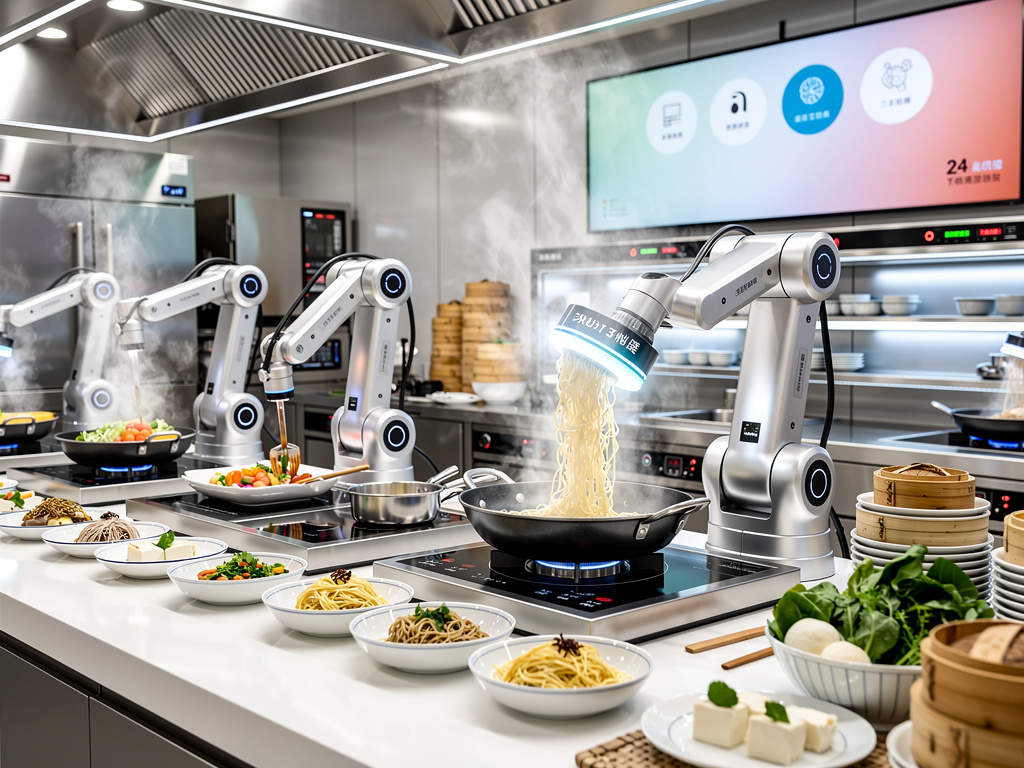
In the bustling Xihu district of Hangzhou, a new dining venue has opened its doors, where robotic arms chop vegetables, stir pots of Hangzhou cuisine, and deliver steaming bowls of noodles—all without a human chef in sight. The 24 Solar Terms AI Robot Restaurant, which began trial operations in January 2026, marks China’s latest push into fully automated eateries, blending ancient wellness traditions with cutting-edge robotics. More than 10 robots handle everything from food prep to floor cleaning, preparing over 100 dishes featuring the city’s light, fresh flavors.
Visitors watch as cooking robots follow pre-set programs to add ingredients sequentially for dishes like Three-Cup Chicken, automatically adjusting flavors while robotic arms toss and stir. A noodle-cooking robot simultaneously prepares three types of noodles, completing each order in about three minutes, as reported by Bastille Post. Coffee-making and ice-cream bots add precision pours and swirls, while delivery robots zip between tables.
Tech Meets Tradition in Zhejiang
The restaurant’s name draws from China’s 24 solar terms, an ancient calendar guiding seasonal eating for health. An AI consultation system scans faces or tongues to suggest personalized menus tied to these terms, offering wellness-aligned dishes that appeal across generations, according to CGTN. Staff note the cooking robot’s built-in menu emphasizes Hangzhou’s delicate cuisine, ensuring consistency no human chef could match amid labor shortages.
This setup addresses China’s rising food costs and chef scarcity, with robots operating autonomously yet under minimal human oversight for maintenance. Early trial footage shows seamless coordination, from ingredient grabbing to plating, echoing broader trends where AI robots now stir-fry in 63 seconds elsewhere in China, per People’s Daily Online.
Speed and Precision Redefine Service
From order to plate, single dishes average under three minutes, with noodle bots gripping strands and lowering them into boiling water with mechanical finesse. Cleaning robots patrol floors, and the system supports multiple cooking techniques: stir-frying, steaming, stewing. Xinhua highlights how these machines brew coffee and craft desserts autonomously, turning the venue into a live tech showcase.
Customer reactions on X praise the novelty: “Locals say imaginations come true,” posted @Leonard53382858, sharing video of stir-fries and noodles. Hangzhoufeel noted on X the facial diagnosis robot tailoring dishes to solar terms, drawing crowds to North Jingzhou Road.
Roots in Qianxi’s Automation Push
This Hangzhou outlet builds on pioneers like Qianxi Robot Catering Group’s Foodom in Guangdong, operational since 2020 with over 40 robots serving 200 dishes to 600 patrons. Their noodle bot outputs 120 bowls hourly in just 4 square meters, as deputy GM Xiao Ran told Sixth Tone. During COVID, Qianxi deployed rice-cooking robots to Wuhan hospitals, prepping 100 portions hourly contact-free.
Qianxi’s philosophy—scientific data for stable production—powers techniques from sauteing to simmering, covering northern and southern tastes. Their sites boast 0.3-second payments and two-minute service, per the company’s site Qianxi Robot Catering.
China’s Broader Robotics Surge
Beyond Hangzhou, robots proliferate: Shenzhen’s unmanned noodle shops deliver in 48 seconds for $1.40, mixing dough in eight seconds (South China Morning Post). T-chef Tech’s models cut labor 30% with precise heat and stirring (KrASIA). Hestia aims for 30,000 robot chefs offering three-minute meals.
Posts on X from @thinking_panda and @hangzhoufeel capture the buzz, with CGTN videos showing robots in action. Beijing’s first robot-themed spot opened in August 2025 (Beijing Government).
Efficiency Drives Expansion
Robots excel at “wok hei”—smoky high-heat flavor—at 600°F, mimicking pros without fatigue, as in LA’s Tigawok using Chinese tech (Eater LA). In Chengdu, bots fry in 63 seconds, earning praise: “If the shop owner didn’t tell me, I wouldn’t know it was a robot,” a customer told People’s Daily Online.
China Daily on X called it “AI becoming part of daily life,” with robots syncing for fresh dishes in minutes (@ChinaDaily). Operators like Omni self-clean post-stew, needing only touchscreen guidance (South China Morning Post).
Challenges and Global Echoes
While efficient, skeptics on Reddit question multi-tasking limits, but Hangzhou’s trial proves viability amid labor crunches. Xinhua footage from Newsflare (2022 origins) shows evolution to 2026 sophistication. As Qianxi expands, these venues promise scalable, hygienic dining, potentially reshaping global chains.


 WebProNews is an iEntry Publication