
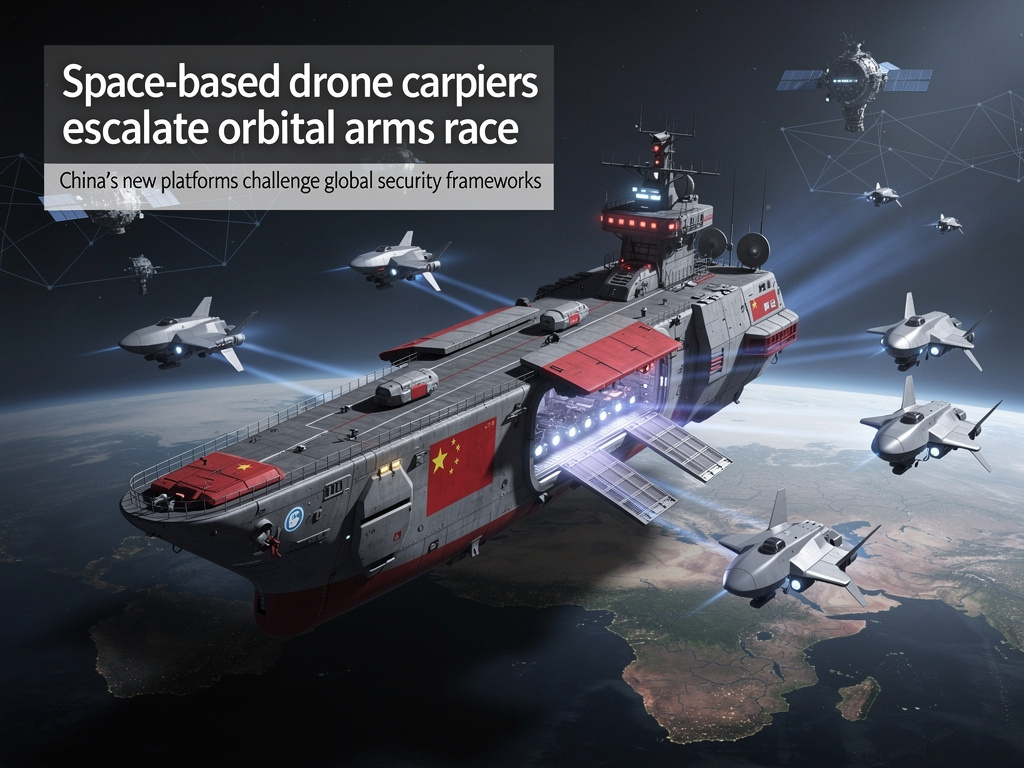
China has unveiled ambitious plans to develop space-based drone carriers capable of deploying unmanned aerial vehicles from orbit, marking a significant escalation in the militarization of space and raising profound questions about the future of extraterrestrial warfare. According to Futurism, Chinese researchers have published detailed proposals for orbital platforms that could release swarms of drones to conduct surveillance, reconnaissance, and potentially offensive operations from the edge of space.
The concept, which sounds like science fiction, represents a logical evolution of China’s rapidly advancing space program and its growing emphasis on asymmetric military capabilities. The proposed system would position carrier platforms in low Earth orbit, from which they could deploy drones that would descend through the atmosphere to perform missions before either returning to the carrier or being recovered on Earth. This approach would provide unprecedented flexibility in projecting power globally, as orbital platforms can pass over virtually any point on the planet multiple times per day.
The technical challenges involved in such a system are formidable. Drones would need to survive the extreme temperatures and forces associated with atmospheric reentry, maintain control during descent, and possess sufficient fuel and propulsion to complete their missions. However, Chinese aerospace engineers have reportedly made significant progress in developing heat-resistant materials and guidance systems that could make such operations feasible within the next decade.
Strategic Implications for Global Security
The development of space-based drone carriers would fundamentally alter the strategic calculus for military planners worldwide. Unlike traditional satellites, which follow predictable orbits and have limited maneuverability, a drone carrier system would offer dynamic, responsive capabilities that could be deployed on short notice. This would effectively compress the decision-making timeline for potential adversaries and create new vulnerabilities in air defense systems designed primarily to counter threats originating from within the atmosphere.
Defense analysts have expressed particular concern about the dual-use nature of such technology. While China has characterized its space program as primarily civilian and scientific in nature, the potential military applications of orbital drone carriers are impossible to ignore. The ability to deploy surveillance drones over any location on Earth with minimal warning could provide significant intelligence advantages, while the potential for weaponized variants raises the specter of space-to-ground strike capabilities that would be extremely difficult to defend against.
The United States and its allies have historically maintained technological superiority in space-based military systems, but China’s rapid progress threatens to erode that advantage. The U.S. Space Force, established in 2019, has prioritized developing capabilities to counter emerging threats in orbit, but the pace of Chinese innovation has caught many Western observers by surprise. The space-based drone carrier concept represents a creative approach to circumventing American strengths in traditional satellite technology and missile defense systems.
Technical Architecture and Engineering Challenges
The proposed Chinese system would likely consist of multiple components working in concert. The orbital carrier platform itself would need to be substantial, requiring robust power generation, thermal management, and communications systems. Solar panels would provide primary power, while the platform would need to maintain precise attitude control to facilitate drone launches and recoveries. The carrier would also require propulsion systems for orbital adjustments and potentially evasive maneuvers.
The drones themselves represent perhaps the most complex engineering challenge. They would need to be compact enough to be stored efficiently on the orbital platform, yet robust enough to survive reentry and perform useful missions in the atmosphere. Chinese researchers have reportedly explored various designs, including folding wing configurations that could be deployed after atmospheric entry and hybrid propulsion systems combining rocket motors for initial deorbit burns with air-breathing engines for atmospheric flight.
Thermal protection is a critical consideration. During reentry, vehicles experience temperatures exceeding 1,500 degrees Celsius due to atmospheric friction. Traditional heat shields are heavy and designed for single-use applications, making them impractical for reusable drones. Chinese engineers are believed to be developing advanced ceramic matrix composites and active cooling systems that could allow drones to survive multiple reentry cycles, though the effectiveness of these technologies remains unproven in operational conditions.
International Legal and Diplomatic Dimensions
The development of space-based drone carriers exists in a legal gray area under current international law. The Outer Space Treaty of 1967, which forms the foundation of space law, prohibits the placement of nuclear weapons and other weapons of mass destruction in orbit but does not explicitly address conventional weapons systems or dual-use technologies like drone carriers. This ambiguity has created space for nations to pursue military space capabilities without clearly violating existing treaties.
China has consistently advocated for the peaceful use of outer space in international forums while simultaneously expanding its military space capabilities. This apparent contradiction reflects a broader pattern in Chinese strategic thinking, where civilian and military space programs are closely integrated and the distinction between defensive and offensive capabilities is deliberately blurred. Chinese officials argue that their space activities are necessary responses to American militarization of space, pointing to U.S. anti-satellite weapons development and the creation of the Space Force as evidence of Washington’s aggressive intentions.
The international community faces difficult choices in responding to these developments. Traditional arms control approaches, which rely on verification and mutual transparency, are poorly suited to space systems where the line between civilian and military applications is often indistinct. Satellite imagery and other remote sensing technologies can identify large orbital platforms, but determining their specific capabilities and intentions is far more challenging. This verification problem has stymied previous attempts to negotiate space weapons treaties and will likely complicate efforts to address the drone carrier challenge.
Economic and Industrial Considerations
China’s pursuit of space-based drone carriers is supported by massive investments in aerospace infrastructure and research. The country has dramatically expanded its launch capabilities in recent years, with multiple spaceports now operational and a growing fleet of heavy-lift rockets capable of placing large payloads in orbit. State-owned enterprises and private companies alike are contributing to this effort, creating a robust industrial base that can support ambitious space projects.
The economic implications extend beyond direct military applications. Technologies developed for space-based drone systems could have significant civilian spillover effects, including advances in materials science, autonomous systems, and precision guidance. China has explicitly linked its space program to broader economic development goals, viewing aerospace as a key sector for technological innovation and high-value manufacturing. This dual-use approach allows Beijing to justify substantial public investments while building capabilities with clear military utility.
Western companies and governments are now grappling with how to respond. Some analysts advocate for accelerated development of counter-systems, including anti-satellite weapons and directed energy systems capable of disabling orbital platforms. Others emphasize the need for diplomatic engagement and confidence-building measures to prevent an uncontrolled arms race in space. The challenge is compounded by the involvement of commercial space companies, which operate across national boundaries and may be reluctant to accept restrictions on their activities.
Future Trajectories and Strategic Competition
The next decade will likely see intensified competition in space-based military systems as China, the United States, and other spacefaring nations race to develop and deploy new capabilities. Space-based drone carriers represent just one element of this broader competition, which also includes anti-satellite weapons, space-based sensors, and potentially orbital strike systems. The risk of miscalculation and inadvertent conflict is substantial, as space systems are vulnerable to both kinetic and non-kinetic attacks, and the consequences of space warfare could include widespread disruption of civilian satellite services.
China’s approach to space militarization reflects its broader strategic philosophy of developing asymmetric capabilities that can offset American conventional superiority. By investing in novel systems like orbital drone carriers, Beijing aims to create dilemmas for U.S. military planners and complicate American operational concepts. This strategy has proven effective in other domains, such as anti-ship ballistic missiles and cyber warfare, and China appears determined to apply similar logic to space operations.
The ultimate success or failure of China’s space-based drone carrier program will depend on numerous factors, including technical feasibility, cost-effectiveness, and international responses. However, the mere pursuit of such capabilities is already reshaping the strategic environment and forcing other nations to reconsider their assumptions about space security. As orbital platforms become increasingly militarized and the distinction between Earth-based and space-based operations blurs, the international community faces the urgent task of developing new frameworks for managing competition and preventing conflict in the final frontier. The decisions made in the coming years will determine whether space remains a domain of peaceful cooperation or becomes the next battlefield in great power competition.


 WebProNews is an iEntry Publication