
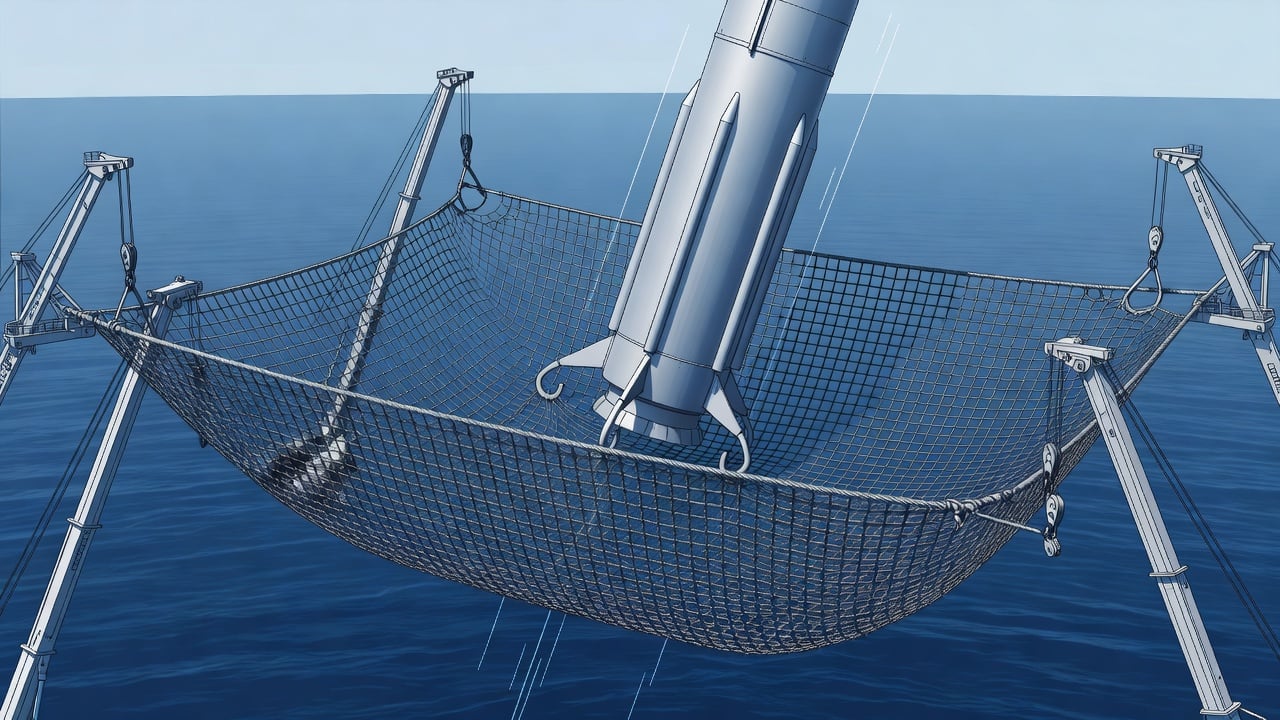
China just pulled off something no one else has managed on a first try. On July 10, its Long March-10B rocket lifted off from a pad in Hainan. Six minutes later the first stage came back down. But it didn’t settle on legs. Hooks on the booster snagged a giant net strung across a ship’s deck. Success on the maiden flight. Payload reached orbit. And Beijing now stands as the second nation after the United States to recover an orbital-class booster.
The approach differs sharply from SpaceX. Where Falcon 9 boosters deploy legs and touch down with pinpoint burns on a pad or drone ship, the Chinese vehicle relies on a cable-and-net system. That choice sheds weight from the rocket itself. It also widens the acceptable landing window. Yet it transfers complexity to the recovery vessel, which must hold steady amid ocean swells.
State-owned China Aerospace Science and Technology Corporation built the rocket. Officials there called the test a historic breakthrough. They plan to fly the same booster again before the year ends. If they succeed, costs could drop fast. Reusability has already let SpaceX outpace the combined launch rate of every Chinese vehicle. Closing that gap matters to Beijing’s ambitions in space.
News of the catch broke quickly. TechCrunch reported that the booster landed on a seagoing recovery vessel, making China the second country to achieve the feat. The demonstration shows CASC intends to match the advance that propelled SpaceX forward: flying the same hardware repeatedly to slash expenses.
But this wasn’t a copy. Engineers designed the net from the start. Four hooks on the descending stage latch onto tensioned steel cables stretched over a large frame. Robotic rails adjust the net’s position in real time. The system caught the booster cleanly. No damage reported. State broadcaster CCTV released footage that spread across social platforms within hours.
The Long March-10B stands 63 meters tall. In its reusable configuration it can lift about 16,000 kilograms to low Earth orbit. That trails the Falcon 9 yet still qualifies as medium-lift class. Seven YF-100K kerosene engines power the first stage. A methane-fueled YF-219 drives the upper stage. The test also validated engine restarts, high-precision guidance and controlled descent.
Earlier concepts hinted at this direction. Digital Trends outlined the net idea years ago, noting how it diverged from legs. The recent flight turned concept into reality. Mao Ning, a Chinese foreign ministry spokesperson, posted on X: “A historic day in China’s space program! China’s Long March-10B has successfully completed its maiden flight—and recovered its first stage via a sea-based net. This marks the country’s first-ever controlled rocket recovery.”
And the timing carries weight. Only days earlier analysts had questioned how quickly Beijing could match American reuse. Then came this. BBC News noted the booster returned vertically and was recovered on a floating platform using landing hooks that catch the net instead of legs. Shares in related Chinese space firms jumped the daily limit.
Critics on X pushed back. Some called it catch-up theater funded by the state. Others pointed out SpaceX has flown reused boosters hundreds of times while China has yet to demonstrate rapid turnaround. One post observed that true advantage lies in flying, refurbishing and relaunching the same stage dozens of times profitably. Still, success on attempt one stands out. SpaceX required multiple tries before its first drone-ship landing stuck.
The recovery ship, named Linghangzhe, weighed in at thousands of tons. It held position more than 300 kilometers offshore. Waves and wind add risk the net must absorb. Engineers claim the system tolerates larger errors than a leg landing would allow. That tolerance could prove useful in rough seas or during future night operations.
Yet questions linger. How much does the massive platform cost to build and operate? What does refurbishment of a net-snagged booster actually require? CASC has released few financial details. Transparency remains limited. Even so, the engineering feat cannot be dismissed. It shows Chinese teams studied public SpaceX flights for a decade then chose an entirely different path.
Scott Manley, a popular space commentator on YouTube, highlighted the novelty. In a video posted hours after the event he said China refused to copy the legs and instead pulled off a mid-air catch that SpaceX has never attempted on an orbital booster. The booster did not land under its own power on the deck. Hooks met the net. The platform absorbed the impact. A fresh approach.
Western coverage mixed admiration with caution. The Financial Times described the giant floating net as upping the stakes in the broader competition. CNN reported the event as a breakthrough that helps Beijing challenge U.S. dominance in reusable technology. Both noted the test’s success on debut flight.
Analysts at the U.S. Space Force have long warned about China narrowing the launch gap. Reusable vehicles shrink the expense of reaching orbit. Lower costs mean more frequent missions. More missions support bigger constellations, faster response times and greater commercial revenue. China’s state program now holds a working example. Next comes the hard part: turning one recovery into dozens.
The booster sits on the ship now. Teams will inspect it, replace any worn parts and prepare it for another launch. If that second flight occurs before December, China will have moved from zero to operational reuse faster than many predicted. Skeptics wait for data on turnaround time and per-launch savings. Supporters see proof that Beijing can innovate rather than imitate.
Either way the net worked. The hooks held. The stage came home intact. For an industry that once accepted expendable rockets as normal, this counts as progress. China has joined an exclusive club. Only a handful of organizations have ever brought an orbital booster back in one piece. How they choose to fly it next will decide whether the net becomes standard practice or an interesting footnote.
Private Chinese firms have watched closely. Some have their own reusable projects underway. The state success could accelerate investment across the sector. It already lifted stock prices. Market reaction suggests investors believe the milestone carries real commercial weight.
But reusability alone does not guarantee dominance. Reliability, cadence and cost per kilogram decide launches. SpaceX refined those numbers over years of flight. China must now do the same. The net offers one solution. Whether it scales, survives repeated use and undercuts the competition remains to be seen. For now the images speak clearly. A rocket falling from the sky. A net rising to meet it. Capture. Recovery. The next chapter begins.


 WebProNews is an iEntry Publication