
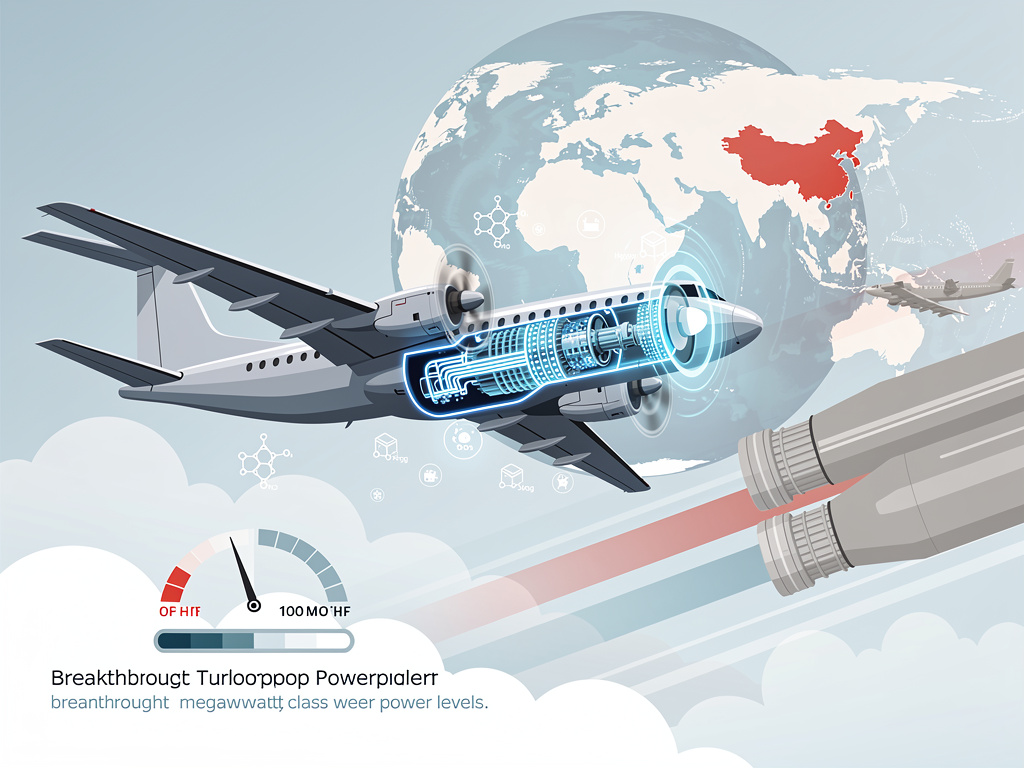
On a runway in China, a modified turboprop aircraft climbed into the air powered by something no plane had ever used in flight before: a megawatt-class hydrogen turbine engine. The flight lasted long enough to prove a point. Hydrogen, long dismissed as too difficult, too dangerous, or too far off for aviation, just took a very real step toward viability — and it happened in a country the West often underestimates on green technology.
The milestone, first reported by Slashdot, involved a hydrogen-fueled turboprop engine developed by Chinese researchers that achieved megawatt-level power output during an actual flight test — not a ground demonstration, not a bench test, but sustained airborne operation. That distinction matters enormously. Ground tests are controlled. Flight tests are unforgiving.
The engine was developed under the auspices of China’s state-backed aerospace research apparatus, which has been pouring resources into alternative propulsion systems with an urgency that reflects both environmental ambition and strategic calculation. Details about the specific aircraft used, the altitude achieved, and the duration of flight remain limited, as is typical with Chinese aerospace disclosures. But the core claim — a megawatt-class hydrogen turbine operating in flight — represents a threshold no other nation has publicly crossed.
Why does the megawatt threshold matter? Because it’s the dividing line between experimental curiosity and practical relevance. Below a megawatt, you’re powering drones and ultralight demonstrators. Above it, you’re in the territory of regional turboprops, cargo haulers, and eventually short-haul commercial aircraft. The gap between a 100-kilowatt proof-of-concept and a megawatt flight engine is not just tenfold in power — it’s an order-of-magnitude leap in engineering complexity involving fuel storage, thermal management, combustion stability, and weight optimization.
Hydrogen aviation has been a subject of intense interest and equally intense skepticism for decades. The appeal is obvious: hydrogen produces no carbon dioxide when burned, and its energy density by weight is roughly three times that of jet fuel. The problems are also obvious. Hydrogen’s energy density by volume is terrible. It must be stored either as a cryogenic liquid at minus 253 degrees Celsius or as a compressed gas at extreme pressures. Both options demand heavy, complex tankage that eats into the very weight advantage hydrogen offers.
And then there’s the infrastructure question. Airports don’t have hydrogen refueling systems. Supply chains don’t exist at scale. Regulatory frameworks for hydrogen-powered commercial aircraft are essentially nonexistent. None of this is news to anyone in the industry. What is news is that China appears willing to push past these barriers with the kind of state-directed urgency that characterized its dominance in solar panels, batteries, and electric vehicles.
The Chinese program isn’t operating in isolation. Airbus has been pursuing its ZEROe concept, which envisions hydrogen-powered commercial aircraft entering service by 2035. That timeline has been met with varying degrees of belief within the industry. Airbus has focused on both hydrogen combustion and hydrogen fuel cell approaches, and its public statements have grown more cautious as engineering realities have set in. The European manufacturer conducted ground tests of a modified A380 with a hydrogen combustion engine in partnership with CFM International, but flight testing of a megawatt-class system has not been publicly announced.
In the United States, the picture is fragmented. Universal Hydrogen, a startup that aimed to convert regional turboprops to hydrogen fuel cell power, conducted a brief flight test of a modified Dash 8 in 2023 before running into financial difficulties. ZeroAvia, a UK-based company with significant U.S. operations, has been testing hydrogen-electric powertrains but has focused primarily on fuel cells rather than direct hydrogen combustion, and its demonstrated power levels have remained below the megawatt class. The Department of Energy has funded hydrogen aviation research, but there’s no single coordinated national program comparable to what China appears to be executing.
So China has, at least for the moment, seized a lead. The question is whether that lead is durable or symbolic.
There are reasons for skepticism. China’s aerospace announcements have sometimes outpaced verifiable results. The lack of detailed technical disclosure — specific power output figures, flight duration, fuel consumption rates, engine weight — makes independent assessment difficult. A megawatt-class engine that weighs twice what a comparable kerosene turboprop weighs, or that consumes hydrogen at an impractical rate, would be a technical achievement but not a commercially meaningful one.
But there are also reasons to take this seriously. China’s track record in scaling green technologies from laboratory to mass deployment is unmatched. The country dominates global production of electrolyzers, which produce green hydrogen from water. It has the world’s largest installed base of renewable energy, which is the prerequisite for producing hydrogen without fossil fuels. And its state-directed industrial policy can sustain research programs through the long, expensive middle phase between first flight and commercial certification — the phase where Western startups tend to run out of money and Western corporations tend to lose patience.
The geopolitical implications are significant. Aviation accounts for roughly 2.5 percent of global carbon dioxide emissions, a figure that’s projected to grow as other sectors decarbonize and air travel demand increases in developing economies. Whoever cracks zero-emission aviation will own an enormous market and hold substantial regulatory influence. If China develops a certified hydrogen aircraft before Airbus or Boeing, it won’t just be selling planes. It’ll be setting standards.
There’s a historical parallel worth considering. In the early 2010s, Western automakers and energy analysts widely dismissed Chinese electric vehicle companies as producing inferior products for a subsidized domestic market. By 2024, BYD had surpassed Tesla in global EV sales for multiple quarters, and Chinese EVs were being shut out of European and American markets not because they were bad, but because they were too competitive. The aviation industry may be watching the early frames of a similar film.
The technical path from a single flight test to a certified, commercially operated hydrogen aircraft is long and littered with potential failure points. Hydrogen embrittlement of engine components over time. The challenge of scaling cryogenic fuel systems to larger aircraft. Certification standards that don’t yet exist. The sheer cost of building airport hydrogen infrastructure worldwide. Each of these is a multibillion-dollar problem that could take a decade or more to solve.
None of that diminishes what just happened.
A megawatt-class hydrogen turbine engine flew. It flew in China. And while Western aerospace companies continue to publish roadmaps and timelines, China put hardware in the air. The gap between a PowerPoint presentation and a flight test is the gap between aspiration and engineering reality. China just crossed it.
For Airbus, Boeing, Rolls-Royce, Pratt & Whitney, GE Aerospace, and the constellation of startups chasing hydrogen aviation, this should function as a clarifying event. Not a reason to panic, but a reason to accelerate. The competitive dynamics of aviation decarbonization just shifted, and the companies and governments that fail to respond may find themselves playing catch-up in a market they assumed they would lead.
The American and European response will likely involve a familiar combination of increased government funding, public-private partnerships, and diplomatic hand-wringing about technology transfer and intellectual property. Whether it will also involve the kind of sustained, focused, adequately funded engineering programs needed to match or exceed China’s progress is less certain. Democracies are good at many things. Maintaining decade-long industrial focus against a determined state-backed competitor is not always one of them.
Meanwhile, in a hangar somewhere in China, engineers are almost certainly already working on the next iteration. Bigger. More powerful. Closer to something that could carry passengers. The first megawatt flight was a beginning, not an end. And for an industry that has spent years talking about hydrogen as the fuel of the future, the future just arrived — in a place many didn’t expect, and sooner than most predicted.


 WebProNews is an iEntry Publication