
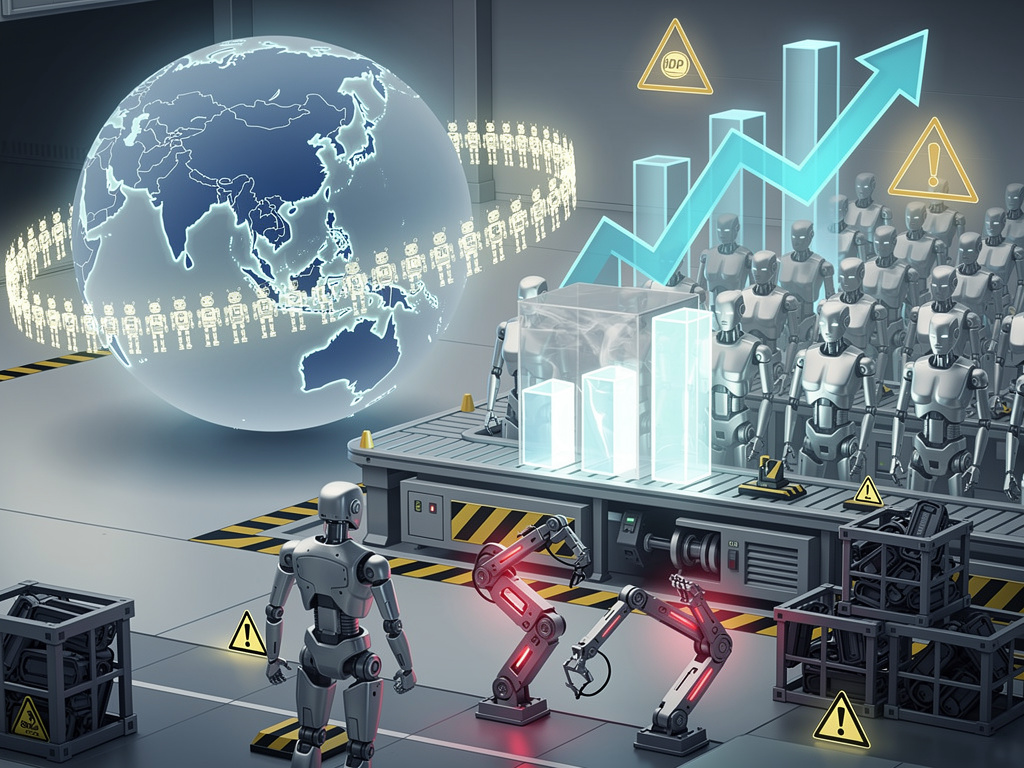
Chinese companies shipped thousands of humanoid robots last year. They captured roughly 85% of the global total. Yet the machines that rolled off assembly lines largely performed for crowds rather than tackled factory floors or warehouses.
Flashy demos grab headlines. Practical deployment lags. The gap reveals much about Beijing’s industrial strategy and the hurdles facing the entire sector.
Unitree Robotics and AgiBot Innovation Technology Co. alone accounted for more than 10,000 shipments in 2025, according to data cited by Bloomberg. Tesla delivered around 150 of its Optimus units during the same period. Morgan Stanley forecasts China’s sales could reach 28,000 units this year. The numbers sound impressive. But analysts caution that volume masks limited capability.
Samm Sacks, senior fellow at the New America think tank, put it plainly. Most humanoid robots remain “performative rather than functional,” falling short in messy, unpredictable environments. Her assessment, reported in Fortune, captures the central tension. China excels at rapid manufacturing scale. Real-world utility trails.
And the performances dazzle. During the 2026 CCTV Spring Festival Gala, robots from Unitree, Galbot, Noetix and MagicLab executed acrobatic dances and martial arts routines. One year earlier many could barely walk. Now they handle swords, recreate drunken boxing steps and recover from falls. Videos spread quickly across Chinese social media. They fuel national pride and investor interest.
But. A recent incident in Xinjiang exposed risks. A remote-controlled humanoid performing martial arts struck a young boy. No serious injury resulted. The episode, widely discussed on X, triggered debate over crowd control and safety barriers. Such events underscore that these machines operate under close supervision. Full autonomy stays distant.
Production capacity surges. Unitree filed for a 4.2 billion yuan IPO on Shanghai’s STAR Market in March 2026. The company targets a $7 billion valuation. Gross margins on its humanoid and quadruped lines reached about 60% in 2025. Humanoid revenue overtook quadrupeds for the first time, making up over 51% of total sales. It shipped more than 5,500 humanoids last year. Plans call for 20,000 in 2026. Details drawn from analysis at KraneShares.
Government policy drives much of this push. Beijing’s “Made in China 2026” initiative sets ambitious targets for robotics. Local governments offer subsidies, land and procurement contracts. Factories, hotels and offices test early units. Yet executives admit orders often come from state-linked entities eager to support the industry rather than solve immediate labor shortages.
AP News reporters found robot makers claim growing real-life demand. Matrix Robotics, a Shanghai startup, builds AI-equipped humanoids for parcel sorting and other tasks. Companies speak of coping with an aging population and rising wages. Still, many deployments remain pilots. The Associated Press detailed how scaling production proves easier than finding sustained commercial buyers.
Market forecasts vary widely. Fortune Business Insights projects the global humanoid market growing from $6.24 billion in 2026 to $165 billion by 2034. Chinese share dominates early volumes. Asia-Pacific held 42.6% of the market in 2025. China itself could reach $1.41 billion in humanoid sales this year. Those figures reflect hardware shipments more than profitable applications.
Elon Musk has watched closely. “China is an ass-kicker, next level,” he said in January, according to The Wall Street Journal. He warned that most significant humanoid competitors operate inside China. Beijing’s vast supplier ecosystem and engineering talent pool accelerate progress. More than 140 humanoid robotics firms now dot the country from Shenzhen to Suzhou.
Western observers note parallels with earlier Chinese successes in solar panels, batteries and electric vehicles. Early cost leadership and scale can lock in standards. If Chinese designs set global expectations for price and performance, competitors may struggle. Morgan Stanley research suggests humanoid robots could power the next phase of China’s manufacturing export dominance. Its share of global manufacturing might expand further.
Challenges persist. Current models handle structured tasks with heavy human oversight. Unpredictable environments expose weaknesses in perception, dexterity and decision-making. Battery life, joint durability and safety certification present engineering obstacles. Incidents like the Xinjiang kick highlight liability questions when machines interact with the public.
So investors pour money in. UBTech, already listed, trades at high multiples. Unitree’s upcoming IPO will test market appetite. Venture funding flows to startups promising breakthroughs in embodied AI. Yet skeptics label parts of the sector a bubble. Without clear return on investment, enthusiasm could fade.
Recent demonstrations at CES 2026 showed Chinese firms dominating exhibition floors. Robots swept, played table tennis and practiced kung fu. Jonathan Krane of KraneShares observed that many units already operate in real settings. The shift from prototype to deployment gains momentum, even if uneven.
Half-marathons featuring hundreds of humanoids test endurance and coordination. Traffic management robots appear in Hangzhou. Education programs introduce students to the technology. Each application builds familiarity. None yet displaces human workers at scale.
The coming years will test whether volume converts to value. Chinese producers bet that lower prices, iterative software improvements and policy support will close the functionality gap. Unitree’s planned R1 model, priced around $4,370, signals aggressive cost reduction. If successful, such machines could open new markets.
Global competitors race to catch up. Tesla, Figure AI and others emphasize software and general intelligence. They argue superior AI will deliver machines that adapt without extensive reprogramming. Chinese firms counter with hardware speed and manufacturing expertise. The contest plays out in laboratories, factories and policy rooms.
One thing appears clear. Humanoid robots have moved beyond laboratory curiosities. Thousands now exist. Their presence grows. Whether they transform economies or remain expensive demonstrators depends on solving the hard problems of reliability and economics. China leads in numbers. The world watches to see who leads in usefulness.


 WebProNews is an iEntry Publication