
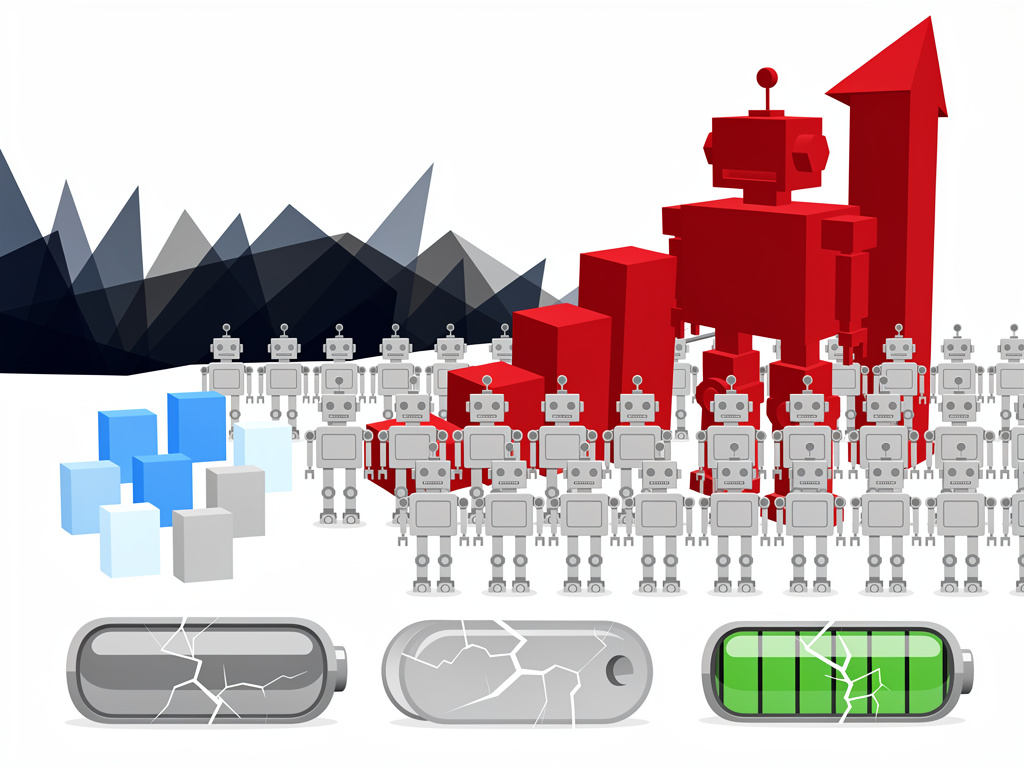
China shipped 90% of the world’s humanoid robots in 2025. Over 150 companies now crowd the field. Unitree and AgiBot eye IPOs that could value them at $13 billion combined. Morgan Stanley doubled its 2026 delivery forecast to 28,000 units—a 133% jump. But only 23% of potential buyers say they’re satisfied with what’s on offer. Battery life? Two to three hours max. Most robots still dance at galas or pose in showrooms.
The boom feels unstoppable. Yet cracks show early. China’s National Development and Reform Commission sounded the alarm late last year. Spokesperson Li Chao highlighted redundant products and duplicated investments among the 150-plus firms, more than half startups or industry crossovers. Beijing backs the sector as one of ten priorities in its 15th Five-Year Plan, with a one-trillion-yuan state fund. Still, the agency sees a bubble.
Manufacturing muscle flexes hard. Smartphone suppliers pivot fast. Lingyi iTech, a Foxconn iPhone assembler, aims for 500,000 units by 2030. Unitree filed for a $608 million IPO on Shanghai’s STAR Market; its humanoid revenue topped quadruped sales in 2025, though total scale lags its $7 billion target. AgiBot chases a $6 billion Hong Kong listing. Government support flows. Production ramps. Demand? That’s the hitch.
Morgan Stanley’s survey paints the gap. Analyst Sheng Zhong found 62% of firms likely to adopt humanoids in three years. But satisfaction sits at 23%. Dexterity falls short. Functionality disappoints. Prices must drop below 200,000 renminbi—about $28,000—for mass uptake. Only 10% run pilots now. “2026 will be a critical year as humanoid integrators strive to reach commercialisation and build up their ecosystems,” Zhong warned, foreseeing a shake-out where production outpaces sales. Companies build for training, not customers.
Spectacles grab headlines. Honor’s Lightning robot won Beijing’s E-Town Half-Marathon in April, clocking 50 minutes 26 seconds—beating the human record by nearly seven minutes. Over 100 bots raced. Engineers tout tech transfers to industrial reliability. Experts shrug. Running flat doesn’t solve factory dexterity or real-world perception. Spring Festival galas feature kung-fu flips. Viral backflips pull capital. The loop spins. Revenue doesn’t follow at IPO scale.
China’s industrial playbook worked wonders before. Solar. EVs. Batteries. Dominance in a decade. Humanoids test if manufacturing edges close demonstration-to-deployment gaps. Output surges. EE Times Asia reports a 94% jump in 2026 shipments, driven by clarified use cases. Unitree’s prospectus shows humanoid revenue over 51% of total in 2025.
UBTech pushes ahead. Walker S2 hit mass production early 2026, with 800 million yuan in orders. A Beijing factory targets 10,000 units yearly by year-end. The firm offered $18 million for a chief AI scientist—talent war rages. Recent numbers dazzle: $112 million in Walker S2 orders last year, eyeing 5,000 by December. Globally, 80% of 2025 shipments came from China.
New factories signal scale. Leju Robotics and Dongfang Precision opened a Guangdong line in March, claiming one bot every 30 minutes—10,000 annually. Shenzhen accelerates, with AI robots making popcorn or arranging flowers. The city calls 2026 pivotal for commercialization. State Grid commits huge: 6.8 billion yuan ($940 million) for 8,500 embodied robots in 2026—5,000 quadrupeds, 500 humanoids for live-line work, 3,000 dual-arms. Suppliers: Unitree, UBTech, Fourier, Deep Robotics, AgiBot. Efficiency gains: 5x inspections, 60% faster faults, 80% fewer incidents, 500,000-800,000 yuan labor savings per unit.
Targets mount. Unitree plans 20,000 units in 2026. BYD matches. AgiBot aims for 5,000. Costs drop 40% yearly, eyeing $20,000 by 2030. Unitree’s R1 sells at $5,900; G1 at $16,000. CES 2026 showcased 20+ Chinese firms eyeing the U.S. market, with untethered demos of walking and handling.
Challenges persist. South China Morning Post echoes the reality check: capital floods, but profitability eludes as business models strain. Vey-Sern Ling of Union Bancaire Privée calls commercial cases “fairly restrictive.” Leaderdrive, a components supplier, saw profits double on demand—Bloomberg notes full-year gains to 124.4 million yuan.
West watches closely. Boston Dynamics’ electric Atlas enters commercial production, deploying thousands at Hyundai by 2028. Figure AI holds $39 billion valuation. Tesla’s Optimus hits factories, though Elon Musk admits “not in usage in a material way.” Pentagon funds humanoid soldiers. China prices lower: Unitree H2 under $30,000. Kepler matches.
Wall Street Journal spots humanoids at hotel desks, factories, serving lattes—fueled by subsidies in Beijing’s embodied AI push. The U.S. races to catch up. China deploys now. Shakeouts loom. Winners build revenue, not just robots.


 WebProNews is an iEntry Publication