
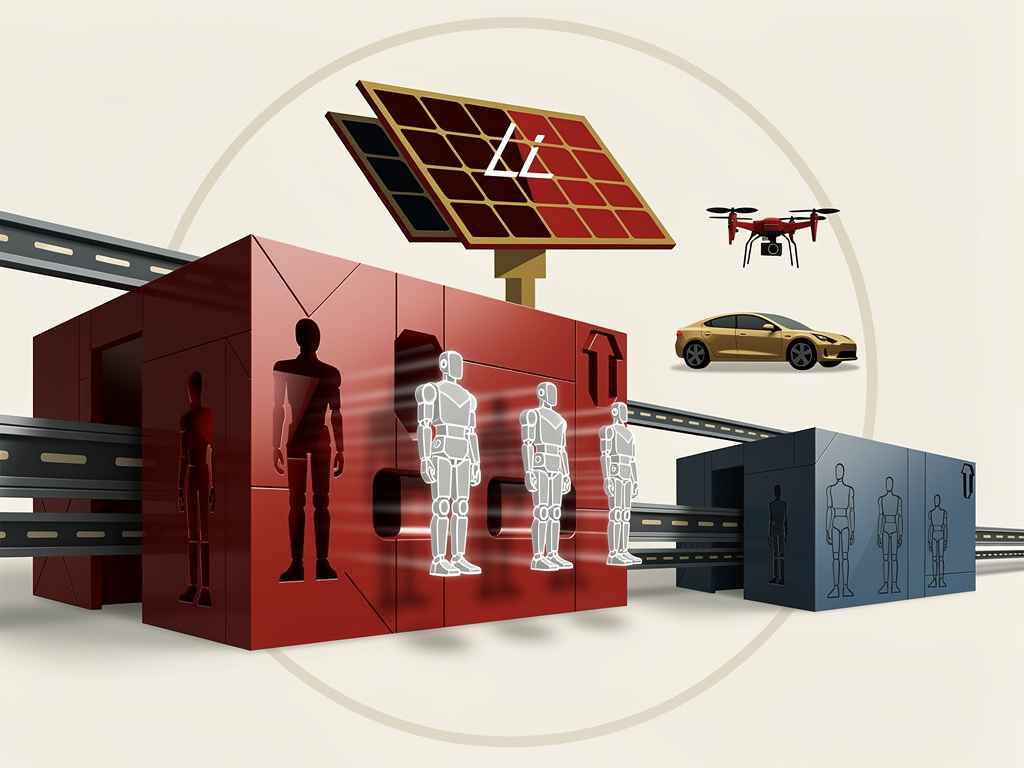
China is now mass-producing humanoid robots at price points that would have seemed absurd two years ago. Not prototypes. Not concept models. Full-production machines priced between $16,000 and $30,000, rolling off factory floors in volumes that suggest Beijing isn’t experimenting with humanoid robotics — it’s industrializing it.
The numbers are startling. Unitree’s G1 humanoid robot retails for roughly $16,000. UBTECH’s Walker S Pro is available for commercial deployment. Engine Humanoid — a newer entrant backed by significant state and private capital — is scaling production capacity at a pace that mirrors China’s earlier blitzes in solar panels, EVs, and lithium batteries. As technology writer K.D. Walmsley documented in a detailed Substack analysis, China’s approach to humanoid robots follows a familiar playbook: subsidize aggressively, manufacture at scale, undercut global competitors on price, and iterate fast enough that quality catches up before anyone can respond.
This is the playbook that buried European solar manufacturers. It’s the same one threatening to upend the global automotive industry through ultra-cheap EVs. And now it’s being applied to what many consider the next trillion-dollar hardware category.
The Chinese government has made no secret of its ambitions. In late 2023, the Ministry of Industry and Information Technology published guidelines calling for China to establish a “preliminary humanoid robot innovation system” by 2025, with mass production capabilities firmly in place by 2027. Several provincial governments — including Beijing, Shanghai, and Guangdong — have since established dedicated humanoid robot industrial parks and funding mechanisms, often with billions of yuan earmarked for the sector. The policy infrastructure is deep and deliberate.
What makes the current wave different from prior Chinese industrial campaigns is speed. Unitree went from unveiling the G1 to shipping commercial units in under a year. The company’s H1 model, a more capable full-size humanoid, has been demonstrated performing backflips and navigating unstructured terrain — feats that Boston Dynamics’ Atlas took years to achieve at a cost per unit that remains undisclosed but is widely estimated to be north of $1 million. Unitree’s H1 is priced around $90,000.
Cost asymmetry at that magnitude isn’t a gap. It’s a chasm.
As Walmsley notes, the bill of materials for these Chinese humanoids benefits from the same supply chain dominance that China has established across consumer electronics, drones, and electric vehicles. Actuators, sensors, batteries, compute modules — Chinese manufacturers either produce these components domestically or source them from tightly integrated regional suppliers at fractions of Western costs. The vertical integration is formidable. When Unitree builds a robot, it doesn’t need to import servos from Japan or LiDAR from Germany. The entire stack exists within a few hundred kilometers of its Hangzhou headquarters.
And then there’s the AI layer. Chinese humanoid robot companies are increasingly integrating large language models and vision-language-action models into their control systems. UBTECH has partnered with Baidu to incorporate ERNIE-based AI into its Walker platform. Fourier Intelligence, another major player, has been working with several Chinese AI labs to develop what it calls “embodied intelligence” — the ability for robots to perceive, reason, and act in real-world environments without explicit programming for every task.
This is where things get genuinely competitive with Western efforts. Tesla’s Optimus project, arguably the highest-profile American humanoid robot program, remains pre-commercial. Elon Musk has repeatedly promised that Optimus will eventually be manufactured for under $20,000, but Tesla has yet to demonstrate anything close to a production-ready unit at that price point. The latest Optimus prototypes shown at Tesla events have performed controlled tasks — folding laundry, sorting objects, walking slowly — but independent observers have noted that many demonstrations appear to involve significant teleoperation or pre-programmed sequences rather than autonomous behavior.
Figure AI, the well-funded Bay Area startup that has attracted investment from Jeff Bezos, Microsoft, and NVIDIA, is further along on the autonomy front. Its Figure 02 robot has been deployed in limited pilot programs at BMW’s manufacturing facility in Spartanburg, South Carolina. But Figure’s robots are not yet available for commercial purchase at scale, and the company’s unit economics remain opaque. The same is true for Agility Robotics, whose Digit robot has been piloted at Amazon fulfillment centers but hasn’t reached mass production.
The contrast is sharp. American companies are piloting. Chinese companies are shipping.
That distinction matters enormously in hardware markets, where manufacturing scale drives cost reduction through learning curves, supplier negotiations, and process optimization. Every unit Unitree ships makes the next one cheaper and more reliable. Every month Figure spends in pilot mode is a month China’s manufacturers are accumulating production know-how that will be extraordinarily difficult to replicate later.
The applications being targeted in China are also telling. Rather than pursuing the “general-purpose humanoid” vision that dominates Silicon Valley pitch decks — a robot that can do anything a human can — Chinese manufacturers are deploying humanoids in structured industrial settings first. Factory floors. Warehouses. Inspection tasks. These are environments where the robots don’t need to handle the infinite variability of a household but do need to perform repetitive physical tasks reliably and cheaply. It’s a pragmatic strategy that generates revenue, builds operational data, and funds iterative improvement.
UBTECH’s Walker S Pro, for instance, has been deployed in NIO’s electric vehicle factories for quality inspection tasks. Fourier Intelligence’s GR-1 is being tested in rehabilitation and elderly care facilities across several Chinese cities. Engine Humanoid has focused on logistics and light manufacturing applications. None of these are glamorous consumer applications. All of them are real businesses with real customers paying real money.
The geopolitical implications are substantial. Humanoid robots sit at the intersection of artificial intelligence, advanced manufacturing, and physical automation — three domains that both Washington and Beijing have identified as critical to national power. The Biden administration’s export controls on advanced semiconductors were designed in part to slow China’s AI development, which in turn was expected to constrain applications like autonomous robotics. But Chinese companies have proven adept at working around chip restrictions, either by stockpiling NVIDIA GPUs before bans took effect, designing domestic alternatives through companies like Huawei’s Ascend division, or simply optimizing their AI models to run on less powerful hardware.
The Trump administration’s tariff regime adds another wrinkle. Humanoid robots imported from China would face steep tariffs under current trade policies, potentially neutralizing China’s cost advantage in the American market. But tariffs don’t help in third-party markets. If Chinese humanoid robots are available to manufacturers in Southeast Asia, the Middle East, Africa, and Latin America at one-fifth the cost of American alternatives, the market share implications are obvious. China could establish the same kind of global installed base dominance in humanoid robots that it has already achieved in solar panels, where Chinese companies now control roughly 80% of global production capacity.
There’s a workforce angle too. China faces a demographic crisis that is no longer theoretical. Its working-age population is shrinking. Birth rates have plummeted to record lows. The country’s leadership has explicitly framed humanoid robots as a partial solution to labor shortages in manufacturing, elder care, and logistics. This isn’t speculative futurism — it’s policy-driven demand creation. When the government simultaneously subsidizes supply and mandates demand, markets form quickly.
Japan, facing even more severe demographic pressures, has taken notice. Toyota’s robotics division and Honda’s ASIMO successor program have both accelerated timelines in response to Chinese competition. South Korea’s KAIST and Hyundai-owned Boston Dynamics are similarly recalibrating. But none of these efforts match the sheer volume ambition of China’s humanoid push.
Back in the United States, the venture capital community has poured billions into humanoid robotics startups over the past 18 months. Figure AI raised $675 million at a $2.6 billion valuation in early 2024. Apptronik, based in Austin, Texas, has secured funding from major defense and industrial investors. 1X Technologies, a Norwegian-American company, has raised over $125 million for its NEO humanoid. The capital is flowing. But capital alone doesn’t build factories, train assembly workers, or establish supplier relationships.
The uncomfortable question for American robotics companies is whether they’re building products or building PowerPoints. The history of hardware competition with China is littered with Western companies that had superior technology but couldn’t match Chinese manufacturing velocity. DJI didn’t dominate the global drone market because its technology was dramatically better than American competitors’. It dominated because it could produce drones at scale, at low cost, with sufficient quality, faster than anyone else. The same dynamic played out in telecom equipment with Huawei, in solar with LONGi and JA Solar, and in batteries with CATL and BYD.
Humanoid robots are more complex than drones or solar panels. The mechanical engineering alone — dozens of actuated joints, force-torque sensors, high-density batteries, real-time control systems — represents a genuine technical challenge. And the AI required for useful autonomous behavior in unstructured environments remains an unsolved problem globally. No Chinese humanoid robot is currently capable of the kind of general-purpose household assistance that would represent a true consumer product.
But perfection isn’t the standard for market success. Good enough, cheap enough, and available now has beaten superior-but-expensive-and-coming-soon in virtually every hardware category China has entered.
Some Western analysts argue that Chinese humanoid robots are more impressive in marketing materials than in practice. Videos of smooth, capable robots are easy to produce with selective editing. Real-world performance in uncontrolled environments is much harder. There’s merit to this skepticism. Early reviews of Unitree’s G1, while positive on the hardware quality relative to its price, have noted limitations in autonomous capability and software maturity.
But this critique misses the trajectory. Chinese manufacturers iterate at a pace that Western competitors consistently underestimate. The G1 that ships in 2025 will not be the G1 that ships in 2027. And with thousands of units deployed in real-world settings generating operational data, the improvement cycle will be informed by vastly more field experience than any American competitor currently possesses.
The data advantage compounds. More deployed robots means more training data for AI models. Better AI models mean more capable robots. More capable robots mean more deployments. This flywheel effect is precisely what made Tesla’s Autopilot program so powerful — not because the technology was uniquely brilliant at launch, but because millions of vehicles collecting billions of miles of driving data created an insurmountable data advantage over competitors with smaller fleets.
China is building that flywheel now. In humanoid robots.
For industrial buyers evaluating automation investments, the calculus is straightforward. A $16,000 humanoid robot that can reliably perform even a narrow set of physical tasks — carrying boxes, conducting visual inspections, basic assembly operations — pays for itself in weeks at Western labor rates. Even at Chinese labor rates, the payback period is measured in months. The economic logic is overwhelming, provided the robots actually work.
And that’s the critical variable. Reliability. The gap between a demonstration and a deployment is vast. Robots that perform flawlessly in controlled factory showrooms routinely fail in the messy reality of actual work environments. Dust, vibration, temperature variation, unexpected obstacles, software crashes — the failure modes are numerous. Chinese manufacturers will need to prove that their humanoid robots can operate reliably across thousands of hours of real-world use before industrial buyers adopt them at scale.
But they’re getting the chance to prove it. That’s the point. While American companies seek additional funding rounds and extend pilot timelines, Chinese manufacturers are shipping units, collecting failure data, and engineering fixes. The learning-by-doing advantage is real and growing.
Washington’s policy response so far has been fragmented. Export controls target chips but don’t address the broader manufacturing capacity gap. Tariffs protect the domestic market but cede the rest of the world. DARPA and the Department of Defense fund advanced robotics research, but the results tend to stay in laboratories rather than reaching commercial production. There is no coherent national strategy for ensuring American competitiveness in humanoid robotics manufacturing — a sector that the White House’s own AI and automation reports have identified as strategically critical.
The private sector, for its part, is betting that superior AI will ultimately matter more than manufacturing cost. The theory goes like this: humanoid robots are only as useful as the intelligence running them, and American AI companies — OpenAI, Google DeepMind, Meta, Anthropic — maintain a meaningful lead in frontier AI capabilities. If the brain matters more than the body, then the country that builds the best AI wins the humanoid race regardless of who builds the cheapest hardware.
It’s a reasonable argument. Maybe even correct. But it assumes that the AI gap persists, which is far from guaranteed given the pace of Chinese AI development. It also assumes that hardware commoditizes cleanly, which ignores the reality that mechanical design, actuator quality, and system integration profoundly affect what an AI can actually accomplish in the physical world. The best brain in the world is useless in a body that can’t grip, balance, or move reliably.
The next twelve to eighteen months will be decisive. If Chinese humanoid robots demonstrate consistent real-world reliability in industrial applications, the adoption curve will steepen dramatically — first in China, then across emerging markets, and eventually in any market where cost matters more than national origin. If they stumble on reliability, the window stays open for American and Japanese competitors to close the manufacturing gap.
History, however, does not favor the optimistic scenario for Western incumbents. In sector after sector, the bet that Chinese manufacturers would stumble on quality has proven wrong. Not immediately. Not on the first generation. But by the second or third iteration, the quality gap narrows and the cost advantage becomes decisive.
China is mass-producing humanoid robots today. The United States is not. Everything else is commentary.


 WebProNews is an iEntry Publication