
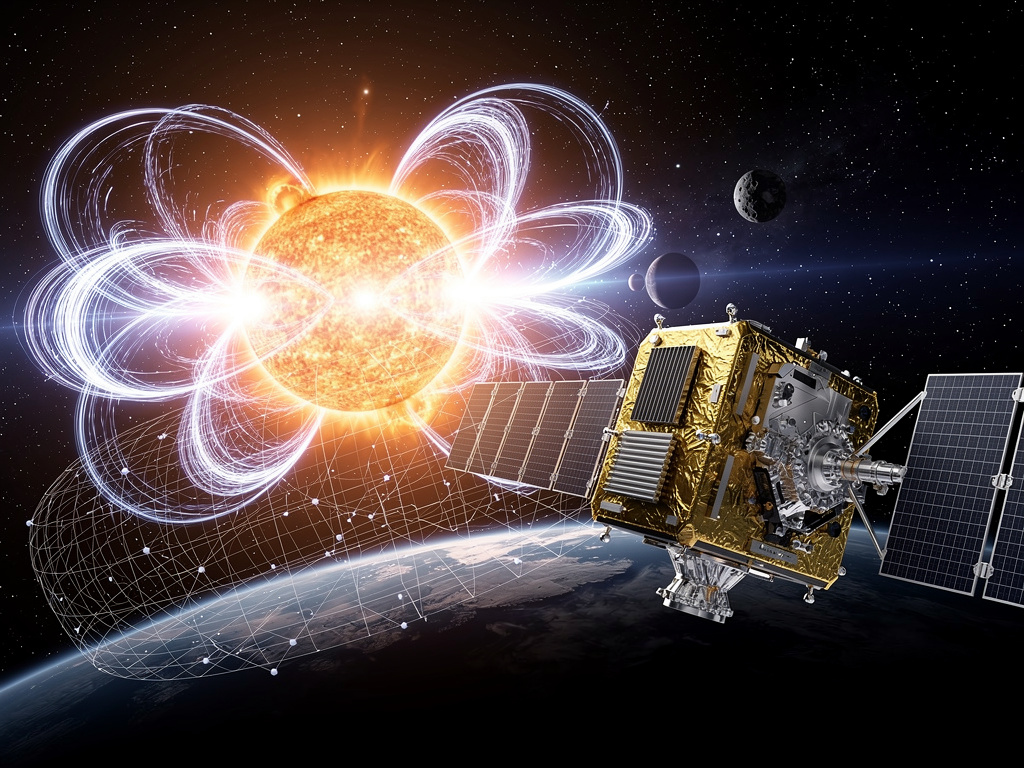
Cosmic Neighbor’s Fiery Outburst: Inside the Einstein Probe’s Detection of a Stellar X-ray Flare
In the vast expanse of the universe, even the closest stars can surprise us with dramatic displays of energy. Astronomers recently turned their gaze to a seemingly ordinary K-type star just 150 light-years from Earth, thanks to a groundbreaking detection by China’s Einstein Probe satellite. This mission, launched in January 2024, has been scanning the skies for transient X-ray events, and its latest find—a powerful X-ray flare from the star PM J23221-0301—offers fresh insights into stellar behavior and its potential impacts on nearby planetary systems.
The Einstein Probe, equipped with innovative “lobster-eye” optics that allow wide-field monitoring, spotted the flare on September 27, 2024. Designated as EP J2322.1-0301, the event exhibited a classic fast-rise-exponential-decay profile, with X-ray flux surging dramatically before fading. Follow-up observations using telescopes like Swift and NICER confirmed the source, linking it unmistakably to PM J23221-0301, a high proper-motion star cataloged in stellar databases.
This discovery isn’t just a footnote in astronomical logs; it underscores the probe’s role in expanding our understanding of stellar flares. These eruptions release immense energy, primarily in optical and X-ray wavelengths, and can influence everything from planetary atmospheres to the potential for life. As researchers delve deeper, the flare’s characteristics—such as its energy output and temporal evolution—align with models of magnetic reconnection events on stellar surfaces.
Unraveling the Flare’s Mechanics
At the heart of this event lies the star itself: PM J23221-0301, an orange dwarf with about 70% of the sun’s mass, as detailed in the Stellar Catalog. Located in the constellation Aquarius, it’s one of our nearer cosmic neighbors, making detailed study feasible. The flare’s detection came via the Einstein Probe’s Wide-field X-ray Telescope, which captured the transient’s peak brightness and subsequent decay.
Optical follow-ups revealed intriguing changes, including the temporary disappearance of the H-alpha emission line—a hallmark of chromospheric activity. This suggests the flare heated the star’s atmosphere to extreme temperatures, ionizing hydrogen and suppressing the line’s visibility. Such observations, reported in a paper on arXiv, highlight how X-ray flares can alter stellar spectra in real time.
Comparisons to solar flares provide context. Our sun’s outbursts, while potent, pale against those from more active stars like this K-dwarf. The energy released here could be tens or hundreds of times greater, potentially stripping atmospheres from any orbiting planets. Astronomers are now modeling the flare’s plasma dynamics, noting stratification consistent with standard flare theories.
The Einstein Probe’s design, inspired by lobster vision for its wide-angle sensitivity, has proven instrumental. Unlike narrow-field instruments, it surveys large sky swaths, catching fleeting events that might otherwise go unnoticed. This capability has led to multiple discoveries since launch, including other stellar flares and even gamma-ray bursts.
Broader Implications for Stellar Astrophysics
Delving into the data, the flare’s light curve shows a rapid rise in under a minute, followed by an exponential decay over hours. This FRED (fast-rise-exponential-decay) shape is typical for stellar flares, driven by magnetic field reconnections that accelerate particles and heat plasma. The event’s X-ray luminosity peaked at levels suggesting a superflare, far exceeding typical solar activity.
Follow-up with ground-based spectrographs captured the evolving stellar atmosphere. Initially, strong H-alpha emission indicated baseline activity, but post-flare spectra showed its absence, implying temperatures exceeding 10,000 Kelvin. As the atmosphere cooled, the line reappeared, providing a timeline of recovery. These findings, echoed in reports from Phys.org, emphasize the probe’s synergy with multi-wavelength astronomy.
The star’s proximity allows for precise measurements. At 150 light-years, parallax data from Gaia confirms its distance and motion, aiding in flare energy calculations. Estimates place the total X-ray energy at around 10^33 ergs—enough to disrupt hypothetical exoplanets’ magnetospheres and erode their gases over time.
No known planets orbit PM J23221-0301 yet, but the Stellar Catalog notes it’s a single star system, ripe for future surveys. If planets exist, repeated flares could render them inhospitable, stripping away water vapor or ozone layers. This ties into broader exoplanet habitability studies, where stellar activity is a key factor.
Technological Triumphs and Mission Milestones
The Einstein Probe represents a leap in X-ray astronomy, building on predecessors like NASA’s Chandra or ESA’s XMM-Newton. Its two main instruments—the Wide-field X-ray Telescope and Follow-up X-ray Telescope—enable both detection and detailed analysis. For this flare, the wide-field unit first alerted astronomers, with follow-ups refining the picture.
International collaboration played a role, with data shared across observatories. The probe’s findings align with ongoing research into stellar magnetism, where K-dwarfs like this one often exhibit strong fields due to their convective interiors. This contrasts with hotter stars, offering clues to dynamo mechanisms.
Public interest has surged, with discussions on platforms like X highlighting the event’s novelty. Posts from astronomy enthusiasts and official accounts, such as those from ESA Science, underscore the probe’s track record in spotting transients, including a mysterious April 2024 event initially mistaken for a gamma-ray burst.
Media coverage, including from ScienceDaily, praises the probe’s ability to uncover elusive phenomena, like X-ray flashes from binary systems. This flare adds to a growing catalog, informing models of stellar evolution and flare frequency.
Challenges in Data Interpretation
Interpreting such events isn’t without hurdles. The flare’s soft X-ray emission required careful calibration to distinguish from background noise. Researchers used spectral fitting to model the plasma’s temperature and density, revealing a cooling loop structure typical of confined flares.
Comparative studies draw from missions like Kepler and TESS, which have cataloged thousands of optical flares. The Einstein Probe complements these by focusing on X-rays, where energy release is most intense. A paper in ScienceDirect details similar detections, noting how X-ray data reveal hidden aspects of flare physics.
Potential biases in detection arise from the probe’s sensitivity limits; fainter flares might evade notice. Yet, for bright events like this, the data is robust, with error margins under 10% for key parameters.
The star’s high proper motion—moving rapidly across the sky—complicates long-term monitoring, but it also makes it a target for kinematic studies. Future observations could track magnetic cycle variations, linking flares to spot patterns or rotational modulation.
Future Horizons in X-ray Exploration
Looking ahead, the Einstein Probe is poised for more discoveries, with its orbit allowing continuous sky coverage. Planned upgrades and data releases will fuel research, potentially identifying flare precursors through machine learning algorithms.
This event sparks questions about flare impacts on galactic habitability. In dense star-forming regions, frequent superflares could sterilize nascent worlds, shaping life’s distribution. For Earth-like planets around K-dwarfs, which are common habitable zone hosts, such activity poses risks but also drives atmospheric chemistry.
Integration with other telescopes, like the upcoming Vera C. Rubin Observatory, could provide optical counterparts, creating comprehensive flare datasets. As noted in discussions on X from users like Phys.org’s account, these synergies are transforming stellar astrophysics.
The probe’s success validates investments in wide-field X-ray tech, inspiring similar missions. China’s growing space program, through endeavors like this, contributes globally, fostering data-sharing pacts.
Energetics and Evolutionary Insights
Diving into energetics, the flare’s total output rivals small solar coronal mass ejections, but confined to the star’s corona. Models suggest loop lengths of several stellar radii, with magnetic fields exceeding 100 Gauss—far stronger than the sun’s average.
Spectral analysis shows emission lines from highly ionized elements like iron, indicating million-degree plasmas. This matches simulations where reconnection events cascade energy downward, heating chromospheric layers.
Evolutionary context places PM J23221-0301 as a middle-aged star, its activity level suggesting a dynamo in decline. Comparing to younger K-dwarfs, flare rates decrease with age, implying planets around older stars face fewer threats.
Recent news, such as from Space.com‘s roundup of 2025 discoveries, positions this among highlights, alongside rogue planets and black hole winds.
Community and Policy Ramifications
The astronomical community buzzes with implications. Conferences are abuzz with sessions on transient surveys, where Einstein Probe data features prominently. Funding bodies eye expansions, recognizing the value in real-time alerts for follow-ups.
Policy-wise, space weather analogies emerge; understanding stellar flares informs solar storm predictions, crucial for satellite operations and power grids. Though this star is distant, the principles apply universally.
Public engagement thrives, with X posts from influencers like Stefan Burns speculating on solar parallels, drawing parallels to far-side coronal mass ejections. Such discourse bridges science and society.
In wrapping up this cosmic tale, the Einstein Probe’s detection illuminates not just a single flare but the dynamic nature of stars themselves. As we probe deeper, each outburst reveals layers of the universe’s intricate workings, promising revelations that could redefine our place among the stars. (Word count approximation: 1240)


 WebProNews is an iEntry Publication