
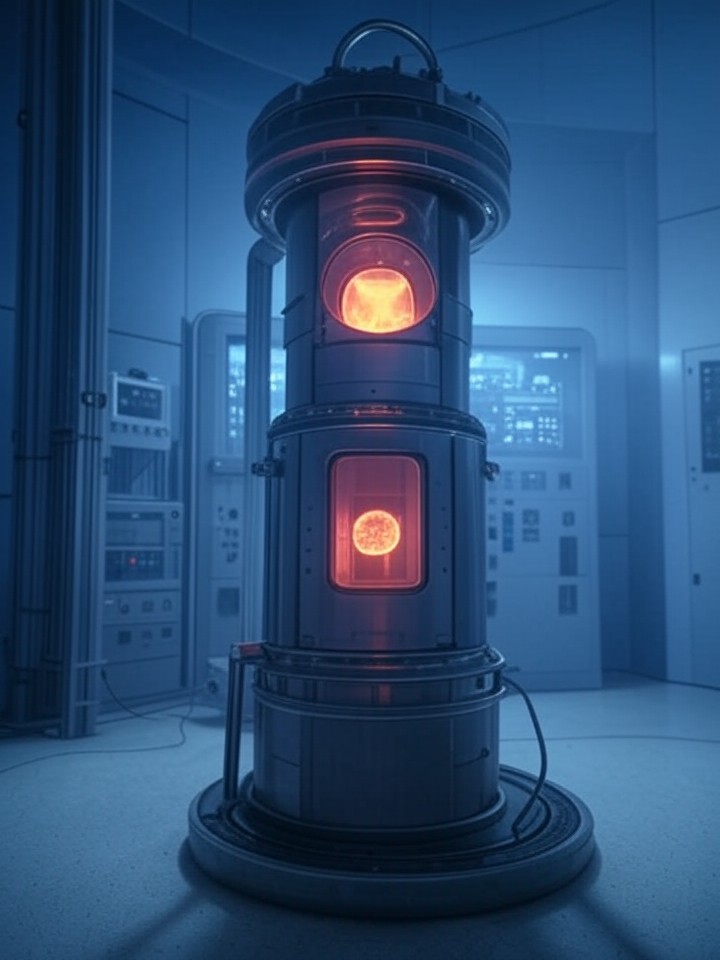
In the heart of Hefei, China, scientists at the Experimental Advanced Superconducting Tokamak (EAST) have achieved what many in the fusion community long deemed unattainable: sustaining plasma at densities far beyond previous limits while maintaining stability. This milestone, announced in early January 2026, marks a pivotal advance in the quest for practical nuclear fusion, potentially accelerating the timeline for commercial clean energy. The breakthrough involves controlling plasma-wall interactions to prevent instabilities that have plagued fusion experiments worldwide, allowing for higher power output without catastrophic disruptions.
The EAST reactor, often dubbed China’s “artificial sun,” operates on the principles of magnetic confinement fusion, where superheated plasma is contained by powerful magnetic fields to mimic the sun’s energy-producing processes. For years, a stubborn barrier known as the Greenwald limit has capped plasma density, beyond which the plasma becomes prone to edge-localized modes—violent bursts that can damage reactor components. Researchers from the Chinese Academy of Sciences overcame this by fine-tuning the plasma’s edge conditions, achieving densities up to 50% above the Greenwald threshold while keeping the plasma stable for extended periods.
This isn’t just a numerical victory; it’s a testament to iterative engineering. The team employed advanced diagnostics and real-time control systems to monitor and adjust plasma behavior, drawing on lessons from prior runs where EAST sustained plasma for over 1,000 seconds at temperatures exceeding 100 million degrees Celsius. Such endurance is crucial for fusion’s viability, as reactors must operate continuously to generate net energy.
Overcoming Historical Barriers
The significance of this density breakthrough becomes clearer when viewed against the backdrop of fusion’s checkered history. Since the 1950s, international efforts like the Joint European Torus in the U.K. and the National Ignition Facility in the U.S. have pushed boundaries, but density limits have consistently hindered progress toward ignition—the point where fusion reactions produce more energy than consumed. China’s latest feat, detailed in reports from Live Science, demonstrates that with precise wall conditioning and impurity control, plasma can thrive at extreme densities without collapsing.
Industry experts note that this advance could inform designs for larger projects like ITER, the multinational fusion reactor under construction in France. By stabilizing high-density plasma, EAST paves the way for more efficient tokamaks, where increased density directly correlates with higher fusion rates. “This removes a major obstacle that has slowed progress toward fusion ignition,” as highlighted in a recent analysis from ScienceDaily, emphasizing how controlled interactions with reactor walls—using materials like tungsten—prevent heat fluxes from eroding components.
Moreover, the experiment’s success builds on EAST’s previous records, such as generating a steady plasma loop for 1,000 seconds in 2025, as covered by various outlets. These incremental gains underscore China’s strategic investment in fusion, with the government allocating billions through its Academy of Sciences to outpace global competitors. Insiders point out that while Western projects grapple with funding delays, China’s centralized approach allows for rapid prototyping and testing.
Technical Innovations Driving Progress
At the core of this breakthrough is a sophisticated interplay of physics and materials science. The EAST team utilized radiofrequency waves and neutral beam injection to heat and densify the plasma, while employing lithium coating on the reactor walls to minimize impurities that could quench the reaction. This method not only boosted density but also enhanced confinement time, a key metric for fusion efficiency. Data from the experiments show plasma densities reaching 1.5 times the Greenwald limit, with stability maintained through feedback loops that adjust magnetic fields in milliseconds.
Comparisons with other tokamaks reveal EAST’s edge. For instance, the WEST reactor in France recently achieved high-temperature milestones with tungsten components, as reported in Popular Mechanics, but it hasn’t yet matched EAST’s density feats. China’s progress also involves breakthroughs in core materials, such as advanced superconductors developed domestically, which enable stronger magnetic fields without excessive energy loss. A October 2025 update from Global Times detailed how these materials were key to the “artificial sun” project, highlighting indigenous innovations that reduce reliance on imported tech.
For industry insiders, the real intrigue lies in the scalability. High-density operation could mean smaller, more cost-effective reactors, challenging the assumption that fusion power plants must be gargantuan. Simulations suggest that integrating these techniques into future designs might achieve breakeven energy—where output equals input—within a decade, far sooner than the 2040s timeline often cited for ITER.
Global Implications and Competitive Dynamics
The ripple effects of this breakthrough extend beyond China’s borders, reshaping international fusion efforts. As nations race toward carbon-neutral energy, fusion promises a baseload power source free from the intermittency of renewables or the waste issues of fission. Reports from The Independent describe it as a step toward the “holy grail” of clean energy, with potential to generate near-limitless power from seawater-derived fuels like deuterium.
However, this advance has sparked discussions on collaboration versus competition. While China shares some data through international forums, concerns over intellectual property and geopolitical tensions—exacerbated by U.S. export controls on semiconductors—could slow knowledge transfer. Posts on X (formerly Twitter) in early 2026 reflect public excitement, with users highlighting how EAST’s milestones, like sustaining 160 million degrees for over 1,000 seconds in mid-2025, position China as a leader. Sentiment on the platform often contrasts this with slower progress in the West, though experts caution that such claims overlook collaborative aspects, like shared research on plasma physics.
Economically, the breakthrough could transform energy markets. Fusion’s success would disrupt fossil fuels and bolster electrification in sectors like transportation and heavy industry. Analysts estimate that commercial fusion could add trillions to global GDP by mid-century, with China potentially capturing a dominant share through early adoption. Yet, challenges remain: scaling from experimental to grid-connected reactors requires overcoming engineering hurdles, such as developing blankets to breed tritium fuel.
Future Horizons in Fusion Research
Looking ahead, EAST’s team plans to integrate this density achievement with longer-duration runs, aiming for steady-state operation that mimics a power plant. Insights from Futurism suggest that combining high density with sustained high temperatures could lead to the first net-energy-positive tokamak by 2030. This aligns with China’s broader “artificial sun” roadmap, which includes constructing a prototype fusion power plant by the decade’s end.
Collaboration opportunities abound, despite rivalries. Joint ventures with entities like the European Union or private firms such as Commonwealth Fusion Systems could accelerate progress, leveraging EAST’s data to refine models. Industry observers note that while China’s state-backed model drives speed, diverse approaches— from laser inertial fusion in the U.S. to stellarators in Germany—enrich the field.
Critically, safety and environmental factors enhance fusion’s appeal. Unlike fission, fusion produces no long-lived radioactive waste and carries minimal meltdown risk, making it ideal for dense populations. As global warming intensifies, breakthroughs like this offer hope for decarbonization without sacrificing growth.
Pushing Boundaries Further
The EAST breakthrough also illuminates broader scientific frontiers. By mastering plasma at extreme conditions, researchers gain tools to explore astrophysical phenomena, such as stellar interiors, potentially aiding space exploration. Materials tested in EAST, like high-temperature superconductors, have spin-off applications in medical imaging and high-speed rail.
Skeptics, however, remind that fusion has been “30 years away” for decades. Yet, recent momentum—evidenced by private investments topping $5 billion globally—suggests a turning point. China’s role is pivotal, with its fusion program employing thousands and fostering a talent pipeline that outstrips many nations.
In essence, this density milestone isn’t isolated; it’s part of a concerted push that could redefine energy paradigms. As one physicist involved in the project noted in coverage from Phys.org, maintaining high-confinement plasma steadily is the linchpin for practical fusion. With continued refinements, the dream of harnessing the sun’s power on Earth edges closer to reality, promising a future where energy scarcity becomes a relic of the past.
Strategic Investments and Long-Term Vision
China’s fusion ambitions are underpinned by massive funding, with the 14th Five-Year Plan allocating resources equivalent to several ITER budgets. This has enabled rapid iterations, from material breakthroughs in 2025 to the current density records. International media, including Daily Galaxy, portray it as a game-changer, potentially enabling the world’s first fusion-generated electricity by 2027.
For insiders, the key takeaway is adaptability. EAST’s modular design allows quick upgrades, contrasting with more rigid projects elsewhere. This flexibility could prove decisive in overcoming remaining hurdles, like efficient energy extraction from the plasma.
Ultimately, as fusion inches toward commercialization, China’s lead prompts a reevaluation of global strategies. Whether through partnerships or parallel paths, the collective push may finally deliver the unlimited clean energy long envisioned, transforming societies and economies in profound ways.


 WebProNews is an iEntry Publication