
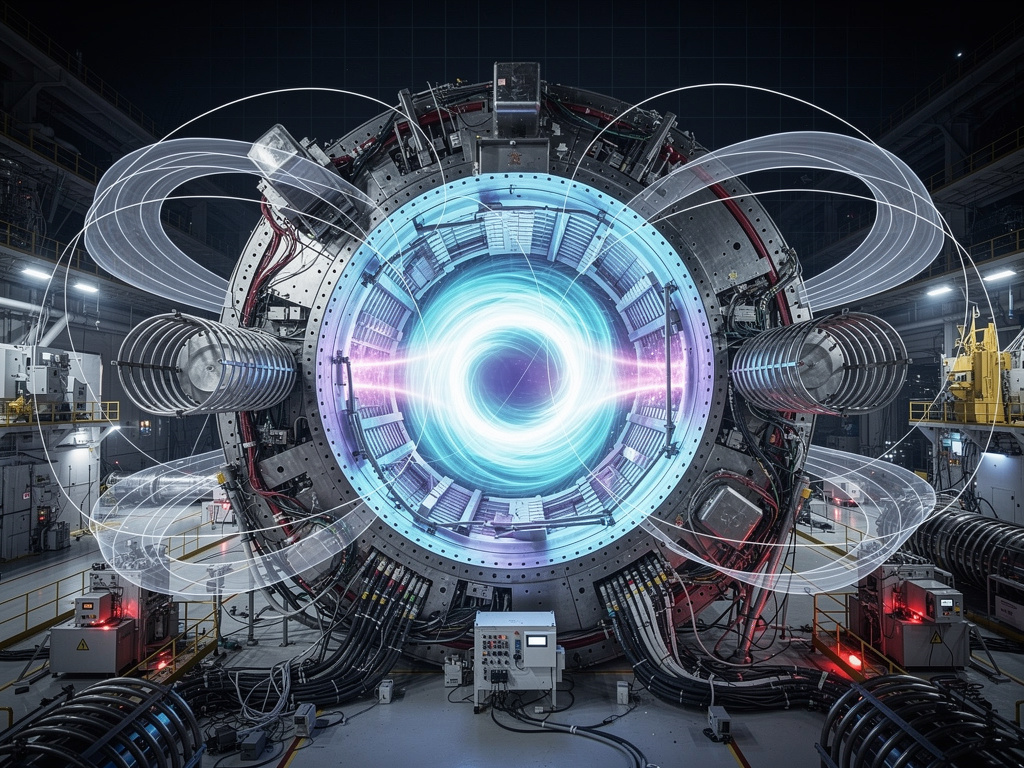
In the realm of nuclear fusion, where harnessing the power of stars has long been a tantalizing yet elusive goal, China’s Experimental Advanced Superconducting Tokamak (EAST) has emerged as a beacon of progress. Dubbed the “artificial sun,” this reactor in Hefei has recently shattered what many physicists considered an unbreakable barrier: the Greenwald density limit, a threshold that has stymied fusion efforts for decades. By achieving stable plasma densities 1.3 to 1.65 times higher than previously thought possible, EAST is rewriting the rules of fusion confinement and inching humanity closer to unlimited clean energy. This breakthrough, reported in early January 2026, stems from innovative control over plasma-wall interactions, allowing the reactor to maintain stability at extreme conditions without disruptive instabilities.
The significance of this achievement cannot be overstated for the global pursuit of fusion power. Fusion reactors like EAST aim to replicate the sun’s energy-producing process by fusing hydrogen isotopes into helium, releasing vast amounts of energy in the form of heat. Unlike fission, which powers today’s nuclear plants and produces radioactive waste, fusion promises a cleaner, safer alternative with fuel sourced from seawater. However, maintaining the superheated plasma—often exceeding 100 million degrees Celsius—has been fraught with challenges, including density limits that cause the plasma to destabilize and cool. China’s team, through meticulous experimentation, developed a self-organized model that identifies radiation instability from boundary impurities as the culprit behind these limits, enabling them to push beyond.
This isn’t EAST’s first record-breaking feat. In 2025, the reactor sustained a steady plasma loop for over 1,000 seconds, a milestone that demonstrated improved heating system stability and edge control. Building on that, the latest density breakthrough confirms plasma can thrive in a “density-free zone,” a concept now experimentally validated in tokamaks for the first time. As detailed in a report from ScienceDaily, researchers carefully managed the plasma’s interaction with reactor walls, preventing the usual cascade of failures that plague high-density operations.
Pushing Boundaries in Plasma Physics
Such advancements position China at the forefront of fusion research, outpacing international efforts like the ITER project in France, which aims for similar goals but on a larger scale. EAST’s compact design, relying on superconducting magnets, allows for rapid iterations and testing, giving Chinese scientists an edge in refining techniques. The recent experiments involved injecting impurities in controlled amounts to modulate radiation, effectively guiding the plasma into stable high-density states. This method not only exceeds the Greenwald limit but also enhances overall power output potential, crucial for commercial viability.
Industry experts note that these developments could accelerate timelines for fusion-generated electricity. While skeptics once quipped that fusion is always 30 years away, China’s progress suggests a shorter horizon. Posts on X from early 2026 highlight growing excitement, with users praising the “artificial sun” for flipping the script on long-held fusion ceilings, though such social media sentiments underscore the buzz without confirming technical details. Meanwhile, the breakthrough aligns with China’s broader energy strategy, aiming to reduce reliance on fossil fuels amid escalating climate concerns.
For fusion insiders, the technical nuances are particularly compelling. The Greenwald limit, established in the 1980s, posits that plasma density cannot exceed a certain value proportional to the plasma current divided by the minor radius squared. Breaching it typically leads to magnetohydrodynamic instabilities, but EAST’s team mitigated this through advanced divertor configurations and real-time feedback systems. As explained in coverage from GreekReporter.com, this involved a novel operating scheme that extends density without triggering disruptions, a game-changer for tokamak designs worldwide.
From Theory to Tokamak Triumphs
Delving deeper, the theoretical model underpinning this success—focusing on radiation instability—provides a roadmap for other reactors. By modeling how impurities radiate energy and destabilize the plasma edge, researchers created predictive tools to avoid these pitfalls. This isn’t mere academic exercise; it’s directly applicable to scaling up fusion devices. EAST’s ability to operate at densities beyond limits means future reactors could achieve higher fusion rates with less input power, improving efficiency metrics like the triple product of density, temperature, and confinement time.
Comparisons to other global projects reveal EAST’s unique strengths. While the U.S.-based National Ignition Facility achieved ignition via laser inertial confinement in 2022, magnetic confinement tokamaks like EAST are seen as more practical for steady-state power plants. China’s investment, exceeding billions in yuan, supports not just EAST but also the upcoming Burning Plasma Experimental Superconducting Tokamak (BEST), slated for completion in 2027. Social media discussions on X emphasize BEST’s potential to be the first to generate net-positive fusion electricity, reflecting optimism in tech circles.
The economic implications are profound. Fusion could transform energy markets by providing baseload power without carbon emissions or long-lived waste. For China, which leads in renewable deployments like solar and wind, fusion represents the next frontier in securing energy independence. A piece from Live Science on the 2025 plasma duration record notes how such sustained operations build confidence in fusion’s reliability, a key hurdle for investors wary of overhyped tech.
Engineering Innovations and Global Ramifications
At the heart of EAST’s success are engineering feats in superconductivity and materials science. The reactor’s toroidal magnets, cooled to near-absolute zero, generate the intense fields needed to confine plasma. Recent upgrades have enhanced their performance, allowing for longer runs and higher parameters. This iterative approach contrasts with more conservative international collaborations, enabling China to test bold hypotheses quickly.
Challenges remain, of course. Scaling from experimental reactors to commercial ones involves hurdles like neutron bombardment degrading materials over time. Yet, EAST’s density breakthrough addresses a core issue, as high density directly correlates with fusion yield. Insights from Phys.org highlight how maintaining high-confinement modes at these densities could lead to self-sustaining reactions, where the fusion process generates its own heat.
On the international stage, this progress fosters both competition and potential collaboration. While geopolitical tensions simmer, fusion research often transcends borders, with knowledge shared through conferences and journals. Posts circulating on X in 2026 speculate on how China’s advances might pressure Western programs to accelerate, though these are anecdotal views from the platform’s users.
Pathways to Commercial Fusion
Looking ahead, the “density-free zone” discovered by EAST opens doors to optimized reactor designs. By operating beyond traditional limits, engineers can explore smaller, more cost-effective tokamaks, potentially democratizing fusion technology. This could benefit developing nations seeking clean energy solutions without massive infrastructure investments.
China’s timeline is ambitious: with BEST on track, projections suggest commercially viable fusion by the 2030s. This aligns with national goals outlined in five-year plans, emphasizing innovation in high-tech sectors. A report from Chinadaily.com.cn details the self-organized model that elucidated the density limit mechanism, crediting it for enabling this high-density regime.
For industry insiders, the real value lies in the data. EAST’s experiments provide terabytes of plasma behavior metrics, fueling simulations and AI-driven predictions for future devices. This data-driven approach could shorten development cycles, much like how computational modeling revolutionized aerospace.
Sustaining Momentum in Fusion Research
As fusion edges toward reality, regulatory and safety considerations come into focus. Unlike fission, fusion reactors can’t meltdown in the same way, but managing tritium fuel and neutron activation requires robust protocols. China’s regulatory framework, evolving alongside its tech, positions it well to lead in safe deployment.
Collaboration with private ventures, such as those in the U.S. and U.K., could amplify progress. While EAST is state-funded, its breakthroughs inspire startups pursuing alternative confinement methods. Coverage from Colombiaone.com echoes the global ripple effects, noting how this density push removes a major obstacle to ignition.
Ultimately, EAST’s feats underscore a pivotal shift in fusion’s trajectory. By conquering density barriers, China is not just advancing science but reshaping energy futures. As one X post from a tech enthusiast put it, this is like breaking the sound barrier for clean power—heralding an era where fusion moves from labs to grids.
Broader Impacts on Energy Strategies
The environmental payoff is immense. Fusion could slash global emissions, complementing intermittents like solar. For China, facing air quality challenges, it’s a strategic imperative. Economic models suggest fusion plants could generate electricity at costs competitive with renewables by mid-century.
Skepticism persists, given past overpromises, but tangible milestones like EAST’s build credibility. A feature in Dailygalaxy.com describes the breakthrough as something scientists have chased for decades, potentially changing everything.
In the end, China’s “artificial sun” illuminates a path forward, blending cutting-edge physics with pragmatic engineering to unlock fusion’s promise. As research continues, the world watches, hopeful that this artificial star will light the way to a sustainable tomorrow.


 WebProNews is an iEntry Publication