
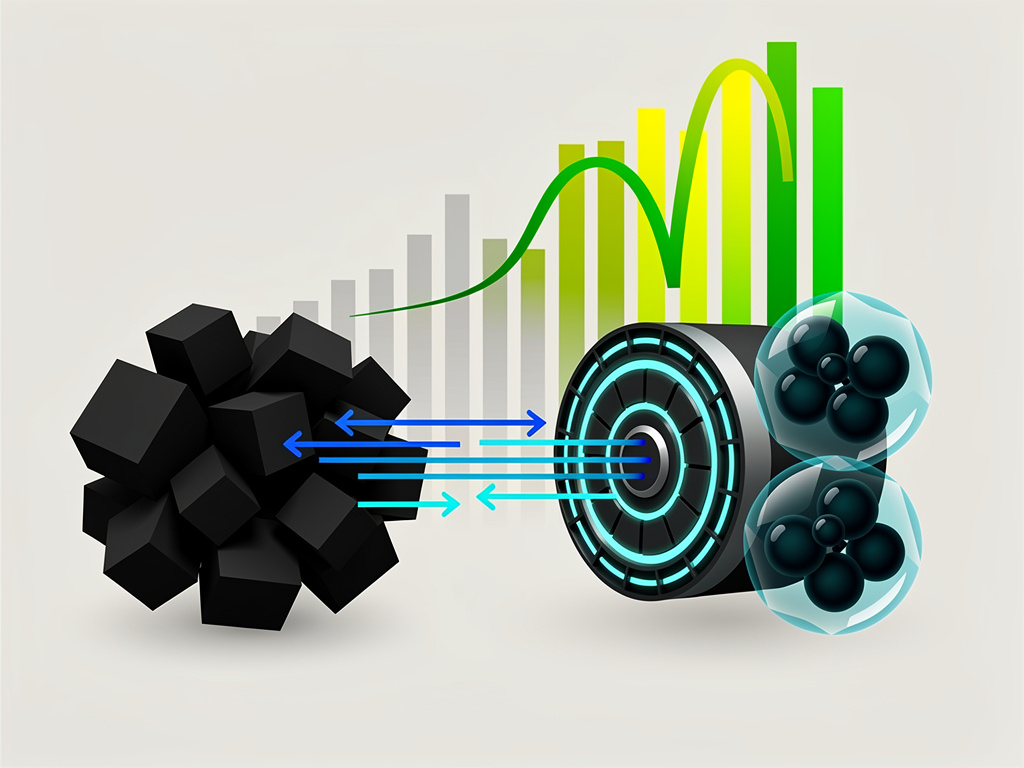
Coal powers much of the world still. China burns more than anyone. But a team at Shenzhen University wants to change that equation entirely. They’ve built a device that turns pulverized coal straight into electricity. No flames. No turbines. Just quiet electrochemical action. And the CO2? Captured right there, ready for reuse.
Xie Heping leads the effort. He’s a member of the Chinese Academy of Sciences. His group calls it the zero-carbon-emission direct coal fuel cell, or ZC-DCFC. Coal gets ground fine, dried, purified, treated for reactivity. Then it feeds into the anode chamber. Oxygen hits the cathode. An oxide membrane lets direct oxidation happen. Electrons flow out as power. Traditional plants burn coal to make steam. That spins turbines. Efficiency tops out around 40%, thanks to the Carnot limit—a thermodynamic wall no heat engine beats. “This process is bound by the Carnot cycle, capping energy efficiency at around 40 per cent,” Xie wrote in his paper. “In the ZC-DCFC, by avoiding the efficiency losses associated with combustion and thermal engines, it enables substantially higher theoretical efficiency.” South China Morning Post.
Potential? Up to 90%. That’s no small jump. The TechRadar piece spells it out: the cell “converts chemical energy directly into electricity, with potential efficiency reaching up to 90%.” TechRadar. No combustion means no heat waste. CO2 streams out pure from the anode. Catalysts turn it into synthesis gas or sodium bicarbonate—stuff for industry, not the sky. Silent operation too. Imagine power plants without the roar.
Work started in 2018. Early hurdles? Coal’s impurities gum up cells. Durability issues. Power density. Stack scaling. Long-term stability. They’ve tackled those step by step. Now a perspective paper in Energy Reviews lays out the path. It’s not a full prototype yet. But the blueprint exists. And it could tap deep seams—1.2 miles down—without mining or hauling. Drill in. Power up. Skip the surface mess.
Skeptics point fingers. Coal’s still coal. Reddit threads call it no true zero-emission since CO2 forms, just captured. Fair. But capture at source beats diluting it in flue gas. Conventional plants hit 800g CO2 per kWh. This concentrates it for easy handling. Interesting Engineering notes the bypass of Carnot opens doors: “New coal fuel cell bypasses Carnot limits to boost efficiency potential.” Interesting Engineering.
China’s play makes sense. Vast reserves. Renewables booming—360GW wind and solar last year alone. But baseload matters. This bridges the gap. No overnight fossil dump. Instead, smarter use. X posts buzz about it. James Wood highlighted the pragmatics: China’s scaling clean tech while retooling coal. Sputnik called it the world’s first zero-carbon battery. Hype? Sure. But the science holds.
Challenges loom large. Materials cost a fortune now. Durability under real loads. Scaling to gigawatts. Fuel processing eats energy too. The Energy Reviews paper admits: cell scale-up, stability, integration ahead. Commercial? Maybe 2045, per one X take. Yet if it works, coal shifts from villain to vector. Electrochemical, not explosive.
Global eyes watch. The Independent reports: “Chinese scientists have built a first-of-its-kind coal-powered fuel cell that potentially eliminates carbon dioxide emissions.” The Independent. Impact Lab adds: theoretical efficiency could top 50%, smashing 33-45% norms. Impact Lab. Times of India echoes the no-burn promise. Times of India.
So. Coal without the guilt? Possible. Xie’s team proves the principle. Industry pros know: prototypes to plants takes decades. But bypass Carnot? Capture CO2 clean? That’s no pipe dream. It’s physics applied. China bets big. The world waits to see if the power flows.


 WebProNews is an iEntry Publication