
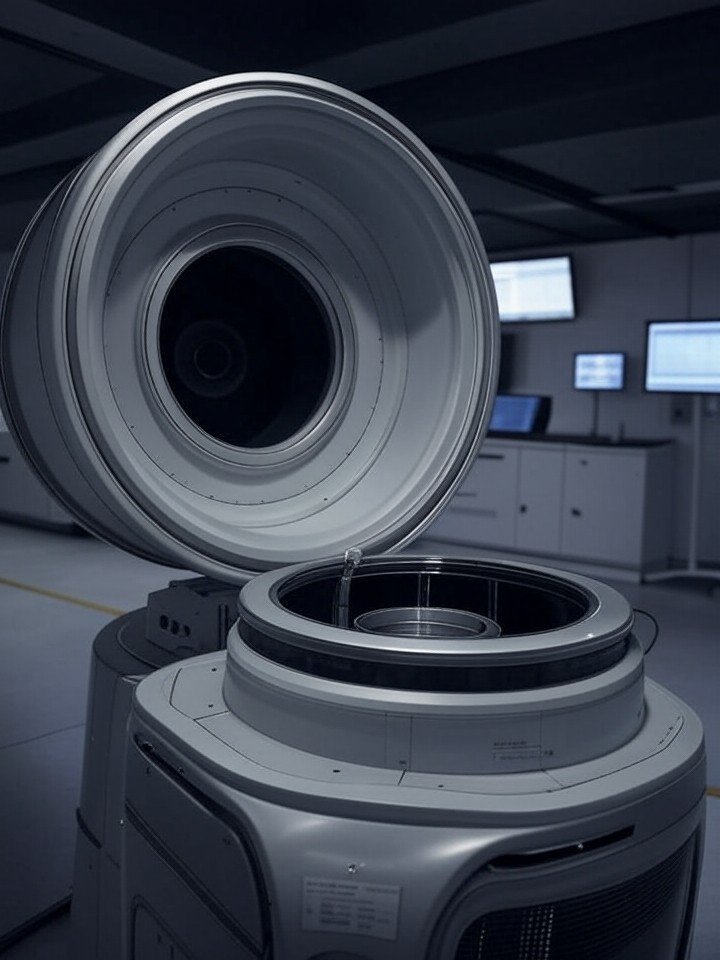
Spinning the Fabric of Reality: China’s Hypergravity Revolution
In the subterranean depths of Hangzhou, a colossal machine hums to life, defying the very forces that bind us to Earth. China’s latest engineering marvel, the CHIEF1900 hypergravity centrifuge, represents a quantum leap in simulating extreme gravitational conditions, pushing the boundaries of scientific research and industrial application. This behemoth, capable of generating forces up to 1,900 times that of Earth’s gravity, isn’t just a tool—it’s a gateway to understanding phenomena that span from geological cataclysms to the microstructures of advanced materials. As global competition in high-tech infrastructure intensifies, this development underscores Beijing’s strategic investments in cutting-edge facilities that could reshape fields like civil engineering, aerospace, and environmental science.
The centrifuge, part of the Centrifugal Hypergravity and Interdisciplinary Experiment Facility (CHIEF) at Zhejiang University, builds on a lineage of increasingly powerful devices. Its predecessor, the CHIEF1300, already set records, but the 1900 model eclipses it with a capacity of 1,900 g-tonnes—a metric that combines gravitational acceleration and payload mass. According to reports from Interesting Engineering, this machine can compress centuries of natural processes into mere days, allowing researchers to model everything from earthquake-induced landslides to the long-term stability of nuclear waste repositories. The implications are profound: by accelerating time in a controlled environment, scientists can predict and mitigate disasters without waiting for real-world calamities to unfold.
Engineered by the Shanghai Electric Nuclear Power Group, the CHIEF1900 operates on principles rooted in centrifugal force, spinning massive arms at speeds that create artificial gravity far beyond what’s possible on our planet’s surface. This isn’t mere simulation; it’s a forceful recreation of extreme conditions. Posts on X from users like tech influencers highlight the buzz, with many noting how the device “bends time and space” in ways that echo science fiction, yet it’s grounded in rigorous physics. Such social media sentiment reflects growing public fascination, but for industry experts, the real value lies in its precision engineering, which allows for experiments at scales previously unimaginable.
Unleashing Forces Beyond Earth
At its core, the hypergravity centrifuge functions like a gigantic merry-go-round on steroids. Objects placed in its rotating chambers experience centripetal acceleration, mimicking hypergravity that can reach up to 27,000 g—forces in certain configurations, as detailed in a piece from IFLScience. This capability stems from the machine’s underground design, which minimizes vibrations and allows for stable, long-duration runs. Researchers can load up to 20 tonnes of material into its arms, subjecting them to stresses that replicate the crushing pressures deep within planetary cores or the violent upheavals of seismic events.
One of the most compelling applications is in disaster preparedness. The South China Morning Post reported that the CHIEF1900 will recreate catastrophic events like dam failures and earthquakes in a lab setting, providing data that could save lives and infrastructure. For instance, by simulating the gradual erosion of soil under intensified gravity, engineers can test the resilience of bridges, tunnels, and levees over simulated decades. This is particularly vital in a country like China, prone to natural disasters, where rapid urbanization demands robust predictive tools.
Beyond geology, the machine opens doors to materials science breakthroughs. In hypergravity, atomic structures behave differently, allowing tests on alloys and composites that might one day form the backbone of hypersonic aircraft or deep-space habitats. Futurism’s coverage emphasizes how this “wild gravity machine” generates forces nearly 2,000 times Earth’s pull, enabling experiments that probe the limits of material endurance. Industry insiders see potential ripple effects in sectors from renewable energy—testing wind turbine foundations—to nuclear power, where simulating radioactive decay under stress could enhance safety protocols.
Engineering Triumphs and Global Rivalries
The construction of CHIEF1900 didn’t happen in isolation; it’s the culmination of years of investment, with China allocating over $286 million to the broader CHIEF project, as noted in various X posts tracing back to 2019 announcements. This funding reflects a national priority on self-reliance in advanced technologies, especially amid geopolitical tensions. Compared to the United States’ facilities, like NASA’s centrifuges which top out at lower capacities, China’s machine sets a new benchmark. New Atlas describes it as the “world’s most advanced hypergravity facility,” now open for interdisciplinary work that spans physics, biology, and engineering.
Operationally, the centrifuge’s design incorporates cutting-edge safety features, including reinforced underground bunkers to contain any mishaps. Its ability to “compress space and time,” as phrased in multiple sources, comes from accelerating physical processes: what takes nature centuries can be observed in hours. This temporal compression is a game-changer for research timelines, potentially fast-tracking innovations in climate modeling. For example, studying sediment deposition under hypergravity could inform strategies against coastal erosion exacerbated by rising sea levels.
Yet, the machine’s power raises ethical and practical questions. How do we ensure that such extreme simulations don’t overlook variables like temperature or humidity? Experts from Zhejiang University, as quoted in government releases via China’s official news portal, stress the facility’s role in fostering international collaboration, inviting global scientists to participate. This openness could mitigate concerns about technological silos, positioning China as a leader in shared scientific progress rather than isolation.
From Lab to Real-World Impact
Diving deeper into applications, the CHIEF1900 excels in environmental simulations. By replicating the gravitational stresses on underground aquifers, researchers can predict contamination spread from industrial sites, aiding in pollution control. India Today’s article highlights how the machine simulates “extreme disasters in a controlled lab environment,” which could revolutionize infrastructure resilience in earthquake-prone regions worldwide. This predictive power extends to urban planning, where hypergravity tests on building materials might prevent collapses like those seen in past seismic events.
In the realm of aerospace, the centrifuge’s capabilities mimic the intense g-forces encountered during rocket launches or planetary entries. This could refine designs for reusable spacecraft, reducing costs and risks. TechSpot notes that the system, built by Shanghai Electric, follows a series of upgrades, underscoring China’s iterative approach to engineering dominance. For insiders, this means opportunities for patents in hypergravity-tolerant technologies, from advanced sensors to bioengineered tissues that withstand extreme conditions.
Moreover, the biological implications are intriguing. While not designed for human testing, the machine could study cellular responses to hypergravity, informing space medicine. X discussions often speculate on futuristic uses, like training for Mars missions, though experts caution that current applications focus on inanimate systems. Still, the interdisciplinary nature of CHIEF invites biologists to explore how microorganisms evolve under such forces, potentially unlocking insights into extremophiles that thrive in harsh environments.
Strategic Investments and Future Horizons
China’s push into hypergravity isn’t just about scientific curiosity; it’s a strategic move in the global tech race. With the machine now operational as of late 2025, as per recent updates from New Atlas, it positions the nation at the forefront of experimental physics. Investments in such facilities align with broader initiatives like the Made in China 2025 plan, aiming for leadership in high-end manufacturing and innovation.
Challenges remain, including the enormous energy demands of running a device that spins at such velocities. Engineers have mitigated this through efficient motor systems, but scaling up for even larger centrifuges could strain resources. Nonetheless, the success of CHIEF1900 paves the way for hybrid facilities combining hypergravity with other simulations, like variable atmospheres or magnetic fields.
Looking ahead, collaborations could amplify its impact. Invitations to international teams, as mentioned in social media buzz, suggest a thawing in tech diplomacy. For industry players, this means watching how hypergravity data influences standards in construction and materials testing, potentially setting new global norms.
Pushing Boundaries in a Spinning World
The ripple effects of CHIEF1900 extend to economic spheres, where faster R&D cycles could accelerate product development. In pharmaceuticals, for instance, hypergravity might enhance drug crystallization processes, leading to more effective formulations. Futurism’s in-depth look at the machine’s unveiling portrays it as a “powerful hypergravity machine,” hinting at untapped potential in quantum materials research.
Critics, however, point to the opacity of some Chinese research programs, urging transparency to build trust. Yet, with publications emerging from the facility, as seen in academic circles, this concern may diminish. The machine’s ability to model 1,900 times Earth’s gravity isn’t just impressive—it’s transformative, offering a lens into processes that define our world.
Ultimately, as China continues to innovate, the CHIEF1900 stands as a testament to human ingenuity. It spins not just matter, but the very possibilities of discovery, inviting a new era where gravity’s grip is no longer a limit, but a tool for mastery. For those in the know, this is more than machinery; it’s the dawn of accelerated science.


 WebProNews is an iEntry Publication