
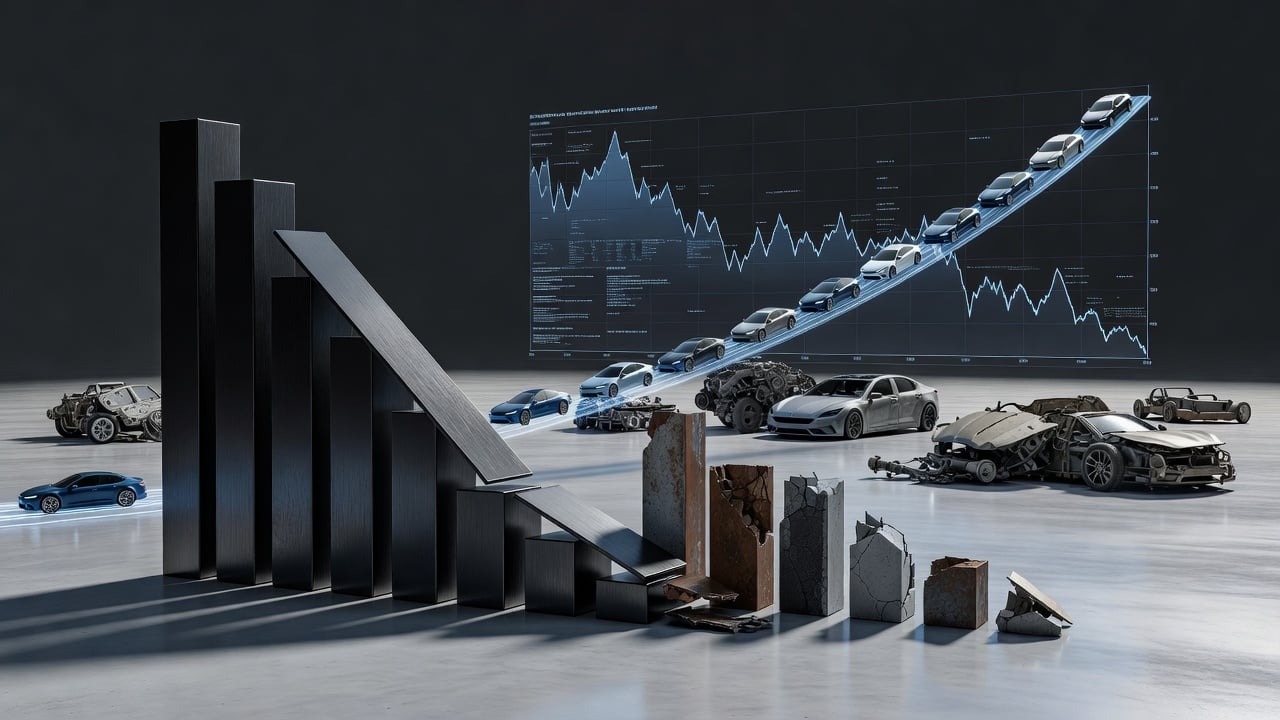
China’s passenger vehicle sales plunged 20.2% in the first half of 2026. Just 8.7 million units moved. The China Passenger Car Association slashed its full-year forecast to a 14% decline. That points to roughly 20.4 million deliveries. A far cry from the record 23.7 million sold in 2025.
Analysts see even steeper pain. Citic CLSA’s Xiao Feng expects a full-year drop near 20%. The domestic market is in free fall. Yet exports tell another story. They jumped 82.3% in June alone. To 877,000 units.
Internal combustion engine vehicles bore the brunt. Retail sales of ICE models collapsed 39% year-on-year in June. Pure gasoline cars fell 42%. Those two categories drove 78% of the month’s total decline. Soaring transportation energy costs didn’t help. They climbed 15.3% from a year earlier. Crushing demand for anything that burns fuel.
New energy vehicles fared somewhat better. Still. Beijing’s decision to pull back subsidies that fueled 2025’s boom is now reversing that momentum. NEV sales are on track to slip 5% to 6% for the year. “Policy only moves demand around,” Xiao Feng told CNBC. It doesn’t create it.
This marks the worst performance since 2021. Back then pandemic lockdowns and supply snarls hammered the industry. Today’s troubles run deeper. Persistent weakness in consumer confidence. A property market that keeps sliding. Households feel the pinch. They delay big purchases. Cars top that list.
Automakers face a margin squeeze on multiple fronts. Battery material costs have risen. Chip prices fluctuate. Industry profit margins slid to 3.4% in the first five months of 2026. Overall profits dropped 20% year-on-year. Average passenger vehicle prices fell more than 1% in June. Price wars rage on. But they yield diminishing returns.
Tu Le sees no quick relief. The founder of Sino Auto Insights delivered a blunt assessment. “This is going to continue to be a brutal year.” His words echo across boardrooms from Shanghai to Beijing. Executives scramble to cut costs. Many slash production targets. A few have already idled plants.
BYD stands out amid the chaos. The EV giant moved 1.8 million vehicles in the first half. Geely followed with 1.4 million. Leapmotor delivered 356,000. These leaders maintain scale. Most others do not. Xiao Feng laid out the math. A Chinese automaker needs at least 500,000 annual sales to break even. One million for sustainable profits. Two million to capture full economies of scale.
The inevitable shakeout looms. Xiao Feng predicts the market will consolidate to just seven or eight major players by 2030. Incumbents like Volkswagen and Toyota could survive alongside the Chinese champions. Smaller brands face extinction. Some already signaled distress. Dealer networks shrink. Inventory piles up.
Exports offer a critical buffer. First-half overseas shipments rose 70.6% to 4.28 million units. June’s 882,000 exported vehicles underscored the shift. Chinese brands flood markets in Europe, Southeast Asia and Latin America. Even with tariffs and trade barriers. Their low-cost EVs appear in American social media feeds. Often via gray imports or third-country routing.
Recent data reinforces the trend. Reuters reported June domestic sales at 1.62 million passenger cars. Down 23.3% from the prior year. That marked the ninth straight monthly decline. The China Passenger Car Association data matches earlier warnings from May. When sales slumped 22.1% to 1.5 million. ICE vehicles plummeted 39% that month too.
Industry groups revised expectations sharply. The PCA now forecasts an 11% drop for 2026 overall. A dramatic change from its prior 1% decline prediction. Yahoo Finance detailed how manufacturers followed suit. They cut production guidance. Several major groups warned investors of lower revenue.
EV-specific pressures mounted early in the year. The Wall Street Journal noted new-energy vehicle sales fell 20% in January 2026. To 596,000 units. The first year-on-year decline since early 2024. Seasonal factors played a role. Chinese New Year timing disrupted February output. Reduced tax incentives compounded the issue.
BYD felt the heat. Its deliveries dropped 41% year-on-year in February. Marking six consecutive months of decline at one point. Profits slipped. The company reported its first annual profit decline since 2001. Autoweek highlighted the broader EV boom showing strain. Pricing pressure eased somewhat. Yet overall sales momentum stalled.
Li Auto, a premium hybrid and EV maker, saw June deliveries tumble. Down 24.4% in December 2025 data that carried into the new year. The South China Morning Post warned of continued price war risks. Weak year-end 2025 sales clouded the 2026 outlook. Low-priced makers face extra pressure.
CleanTechnica captured the ICE meltdown in May figures. Overall market dropped 22% year-over-year. To about 1.5 million sales. Combustion models sat at the epicenter. Their sales fell far faster than NEVs. Market share for new-energy vehicles actually rose. Even as absolute NEV numbers softened.
Economist Intelligence Unit projected slower growth ahead. It cut 2026 and 2027 NEV sales forecasts. To 14% and 3% respectively. Down from earlier higher expectations. The five-year compound annual growth rate for NEVs revised to 8%. From 12%. EIU cited weaker demand. Reduced government support. And a surge in late-2025 buying that pulled sales forward.
Automobility’s July 2026 review painted a similar picture. Total shipments down 4.1% in the first half. Domestic sales off 20.8%. The consultancy noted persistent pressure. With few signs of near-term recovery.
Yet not all signals point down. Fleet aging could spur replacement demand in 2027. Many vehicles sold during the 2020-2022 boom now approach end of warranty. Or higher maintenance costs. Consumers may return. If economic conditions stabilize.
Global implications stretch far. Tesla sold about 631,000 cars in China in 2025. Down 4% from the year before. It faces stiff competition from local rivals. Even as those rivals struggle. Barron’s examined what slowing Chinese EV sales mean for Tesla stock. The U.S. maker pivots toward AI and robotics. China exposure remains a key variable.
Automotive News explored why China’s once-unstoppable industry suddenly loses momentum at home. It ended 2025 on a high. With shipments up 9.4% to 34.4 million. The fifth straight yearly gain. Early 2026 brought a sharp reversal. Domestic demand cooled faster than expected.
Production data from MarkLines shows mixed June results. Vehicle output and sales both declined modestly from prior year. CAAM figures confirm the trend. Exports continue to prop up overall manufacturing volumes.
The road ahead stays tough. Consolidation will prove painful. Job losses possible at weaker firms. Supply chain adjustments inevitable. Surviving players must innovate on cost. On product. On overseas strategy.
Chinese carmakers already invest heavily abroad. New plants in Europe. Partnerships in Southeast Asia. They chase volume where domestic markets falter. Success there could fund recovery at home. Failure would accelerate the shakeout.
Consumers hold the ultimate cards. Their appetite for new vehicles depends on broader economic health. Wage growth. Property values. Interest rates. Until those improve. Sales likely remain subdued. The brutal year Tu Le predicted may stretch longer than many hoped.
Still. China’s auto sector retains enormous scale. Annual sales above 20 million dwarf most other countries. Its EV technology leads in many segments. Battery costs continue to fall over time. Despite short-term spikes. The industry that rose so fast now faces a necessary correction. One that could leave it stronger. For those who endure.


 WebProNews is an iEntry Publication