
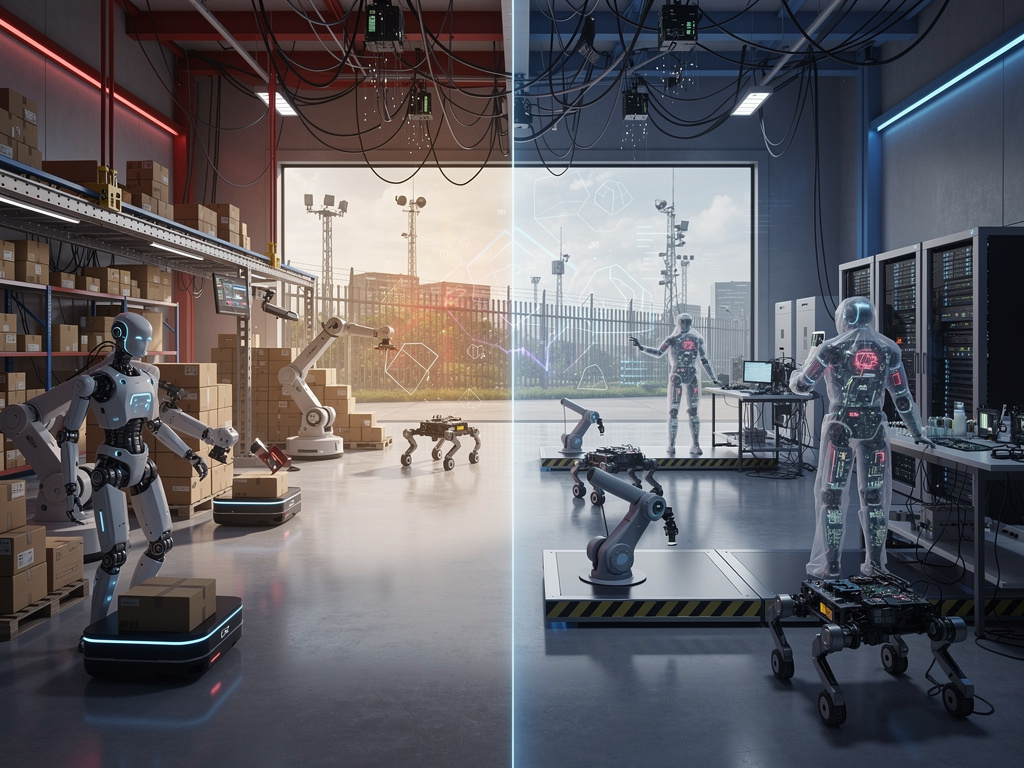
In the high-stakes race for dominance in advanced robotics, China is accelerating ahead, deploying humanoid robots into factories, warehouses and even border patrols, while the United States grapples with regulatory hurdles and slower paths to market. This disparity highlights a broader shift in technological innovation, where Beijing’s state-backed initiatives are turning prototypes into practical tools at a pace that leaves American firms playing catch-up. Recent developments underscore how China’s ecosystem of over 150 robotics companies is not just innovating but commercializing at scale, raising questions about whether the U.S. can maintain its edge in artificial intelligence without matching strides in physical automation.
At the heart of China’s push is a concerted government strategy that treats humanoid robots—machines designed to mimic human form and function—as a cornerstone of economic and technological supremacy. Beijing has poured billions into subsidies, research grants and infrastructure, fostering an environment where startups and established players alike can iterate rapidly. For instance, companies like UBTech and Unitree Robotics are already producing thousands of units annually, with applications ranging from manufacturing assembly lines to hospitality services. This isn’t mere hype; it’s a tangible rollout that’s transforming industries.
The contrast with the U.S. is stark. While American tech giants like Tesla tout ambitious visions—such as Elon Musk’s Optimus robot promising to revolutionize household chores—commercial deployment remains elusive. Tesla has yet to sell a single humanoid unit as of late 2025, bogged down by engineering challenges and a focus on software over hardware scaling. Industry experts point to a fragmented regulatory framework in the U.S., where safety standards, labor laws and ethical concerns slow progress, unlike China’s more streamlined approvals that prioritize speed to market.
China’s State-Driven Acceleration
China’s humanoid robot sector has exploded, driven by policies that integrate AI with physical hardware in ways that outpace global competitors. A recent report from Carnegie Endowment for International Peace details how Beijing views “embodied AI”—intelligent systems that interact with the real world—as the key to true dominance, allocating resources to bridge the gap between digital algorithms and mechanical execution. This approach has led to breakthroughs like Midea’s six-armed super humanoid, unveiled at a major forum, which promises 30% higher output in tasks like appliance assembly.
On the ground, these robots are moving from labs to real-world settings. In warehouses, models from AgiBot use predictive AI to handle sorting and teamwork, processing trillions of operations per second. Posts on X from industry observers highlight the buzz, with users noting China’s “dark factories” that operate without human workers, a feat enabled by low-cost production—Unitree’s advanced models sell for under $6,000, making them accessible for widespread adoption. This pricing edge stems from China’s manufacturing prowess, where supply chains for components like semiconductors and actuators are domestic and efficient.
Meanwhile, U.S. efforts face commercialization bottlenecks. A CNBC analysis reveals that while Musk envisions robots everywhere, China is realizing it first, with state priorities turning visions into reality. American startups like Figure AI and Boston Dynamics produce impressive demos, but scaling to thousands of units lags due to high costs and venture capital that favors software over hardware-intensive ventures.
US Regulatory and Investment Hurdles
The U.S. advantage in generative AI hasn’t fully translated to robotics, partly because of investment patterns that prioritize quick returns over long-term hardware development. Venture funding in American robotics has surged, but it’s concentrated in software layers, leaving physical integration underdeveloped. China’s model, by contrast, combines public funding with private innovation, as seen in the rapid growth of firms in hubs like Shenzhen and Shanghai.
Labor dynamics add another layer. In the U.S., union resistance—evident in recent dockworker strikes—creates friction around automation, fearing job displacement. China’s approach mitigates this through retraining programs and a cultural emphasis on technological progress, allowing robots like Tiangong, which completed a half-marathon, to transition seamlessly into warehouse and hospital roles. X posts from tech analysts emphasize this gap, with one noting China’s lead in sales volume, where entire armies of humanoids are already operational.
Furthermore, geopolitical tensions exacerbate the divide. U.S. export controls on chips and AI tech limit collaboration, forcing American firms to build domestic supply chains from scratch, which inflates costs. A SCSP piece questions whether America’s AI lead will suffice against China’s manufacturing might, predicting that without policy shifts, widespread humanoid deployment in the U.S. might not occur until the end of the decade.
Breakthroughs in Chinese Innovation
Delving deeper, China’s innovations are not just about quantity but quality. The “AgiBot World” dataset, with over a million robot trajectories, addresses real-world challenges like manipulation and collaboration, accelerating deployment in complex environments. This data-driven progress is supported by events like the Greater Bay Area New Economy Forum, where multi-armed robots demonstrate enhanced productivity.
Border patrol applications represent a bold frontier. Recent videos show humanoids preparing for duties along the China-Vietnam border, equipped with surveillance and mobility features that could redefine security operations. According to Earth.com, these deployments signal China’s intent to integrate robots into critical infrastructure, a step the U.S. has approached more cautiously due to privacy and ethical debates.
Investment potential is drawing global attention. A report from AInvest assesses how geopolitical tailwinds favor China, with the sector poised for explosive growth amid economic shifts. Projections from Morgan Stanley estimate the global market could reach $5 trillion by 2050, with China targeting a 60% share through aggressive scaling.
Challenges Amid the Hype
Yet, not all is seamless in China’s robot boom. Skeptics, as noted in a ThinkChina article, question whether the 150-plus companies can deliver true industrial value, pointing to overhyped demos and practical limitations like battery life and adaptability. A New York Times piece explores the possibility of a “robot bubble,” where government bets on automation might outpace actual capabilities, with bots still struggling in unstructured environments.
In the U.S., these challenges are amplified by a focus on ethical AI. Debates over job impacts and safety standards, as discussed in Los Angeles Times, highlight how China’s humanoid army is outgrowing America’s, but at the potential cost of oversight. X sentiment reflects caution, with posts warning that while China leads in production, long-term reliability remains unproven.
Despite these hurdles, China’s trajectory suggests a paradigm shift. Companies like DeepSeek are pushing boundaries with advancements in robot athletics and even niche applications, as covered in South China Morning Post, reshaping local economies through innovation.
Strategic Implications for Global Tech Rivalry
The broader implications extend to economic competitiveness. China’s humanoid surge could disrupt global supply chains, making it the go-to for automated manufacturing. For the U.S., catching up may require policy overhauls, such as the rumored 2026 executive order on robotics to streamline commercialization.
Industry insiders on X buzz about the race heating up, with China’s mass production—aiming for 10,000 units from firms like UBTech—contrasting Tesla’s slower ramp-up. This gap isn’t just technological; it’s systemic, with China’s integrated ecosystem allowing for faster iteration.
Looking ahead, collaborations or rivalries will define the field. While U.S. firms excel in AI brains, China’s hardware edge could lead to hybrid models, but trade barriers complicate this. A International Business Times UK report warns that Musk might lose the race unless commercialization accelerates.
Pathways to Bridging the Divide
To bridge this divide, U.S. policymakers are eyeing incentives for domestic production, inspired by China’s model. Investments in embodied AI could mirror Beijing’s, fostering startups that combine American software prowess with scalable hardware.
China’s year-end reviews, like those from Xinhua, celebrate the shift from spectacle to industrial reality, with robots stepping into scalable roles. This momentum positions China for 2026 leadership, as X posts predict.
Ultimately, the humanoid robot arena reflects larger tech rivalries, where speed and strategy determine winners. As both nations advance, the fusion of AI and robotics promises to redefine work, but the current lag underscores the need for the U.S. to adapt swiftly.


 WebProNews is an iEntry Publication