
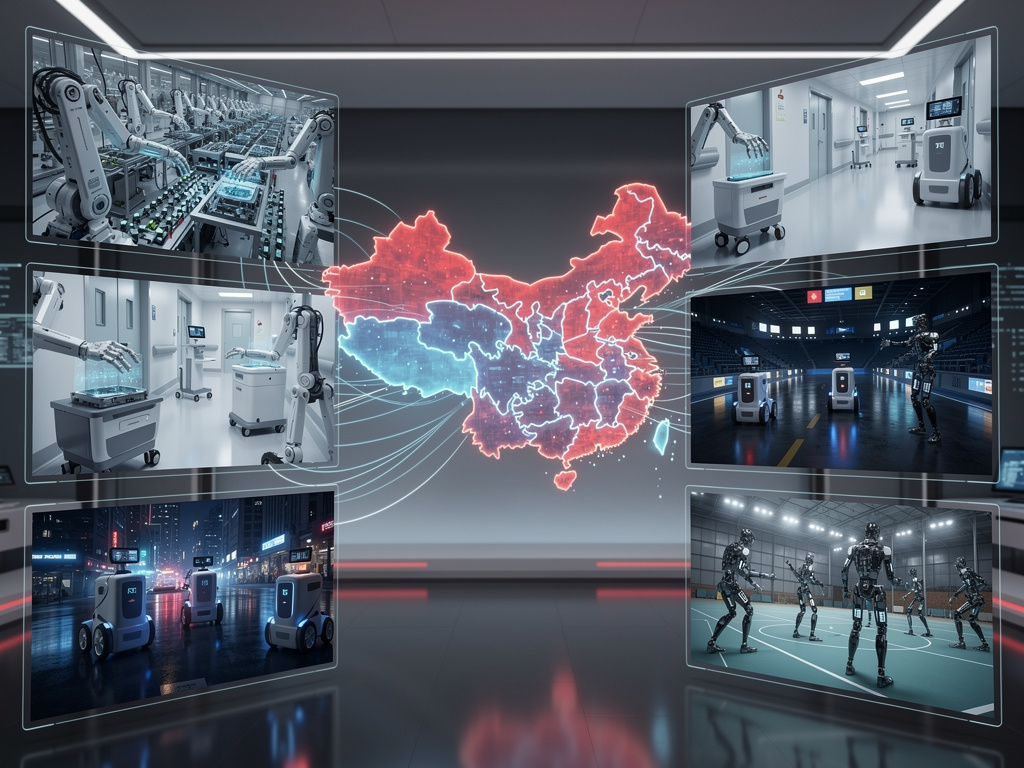
The Dawn of Robotic Colleagues: China’s Push to Reshape Workforces Worldwide
In the bustling factories of Shanghai and the high-tech labs of Beijing, a new breed of worker is emerging—not flesh and blood, but circuits and servos. Humanoid robots, designed to mimic human form and function, are rapidly transitioning from science fiction to everyday reality, with China at the forefront of this transformation. Recent developments show these machines are not just prototypes but are being deployed in real-world settings, from manufacturing floors to service industries. This shift is driven by a combination of government strategy, technological innovation, and economic necessity, positioning China as a leader in what could become a multi-trillion-dollar industry.
The momentum began building in earnest over the past few years, accelerated by national priorities. Beijing has declared humanoid robotics a key area in its technological rivalry with the West, pouring resources into research and development. Companies like UBTech Robotics and Unitree are producing robots capable of complex tasks, from sorting packages to assisting in healthcare. A recent order from Airbus SE for humanoid robots sent UBTech’s shares surging, highlighting the global appetite for these technologies. As reported in Bloomberg, this deal underscores the potential for widespread adoption in manufacturing, where precision and endurance are paramount.
Beyond factories, these robots are infiltrating daily life in unexpected ways. In Wuhu City, AI-powered humanoid police officers patrol streets, issuing orders and maintaining order around the clock. This deployment, detailed in a Daily Mail Online article, represents an early foray into public safety roles, raising questions about privacy and human oversight. Meanwhile, in entertainment and sports, robots are being trained to play soccer, as entrepreneurs like Cheng Hao of Booster Robotics demonstrate in Beijing suburbs, according to coverage from CNN.
Strategic Priorities Fueling Innovation
China’s government has made embodied AI—intelligence that interacts with the physical world—a national imperative. This focus stems from a belief that true artificial intelligence dominance lies in systems that can operate autonomously in real environments. A report from the Carnegie Endowment for International Peace outlines how Beijing is investing heavily in this sector, viewing it as a pathway to economic resilience amid demographic challenges like an aging population and labor shortages.
Training these robots requires vast amounts of data, leading to the establishment of specialized facilities. In Shanghai, data collection factories employ young operators to remotely guide robots through mundane tasks, generating the information needed for machine learning. As described in Sixth Tone, these centers are quietly revolutionizing how robots learn, turning repetitive human actions into algorithmic gold. Similarly, local governments are building training hubs to address data shortages, with embodied intelligence now a priority, per insights from Rest of World.
The scale of this effort is staggering. Projections suggest that by 2035, annual shipments of humanoid robots could reach 10 million units globally, with China expected to host nearly a third of them by 2050. Bank of America and Morgan Stanley analysts, cited in various reports, paint a picture of a future where these machines outnumber humans in certain sectors. Posts on X reflect growing public sentiment, with users noting China’s lead in deployment, including tens of thousands of units already in use last year, far surpassing Western efforts.
Showcasing at Global Stages
At international events like CES in Las Vegas, Chinese humanoid robots stole the spotlight. They demonstrated abilities ranging from playing table tennis to practicing kung fu, drawing crowds and concerns alike. Elon Musk’s visions of ubiquitous robots seem closer to realization in China, where development is a strategic priority in the tech competition with the U.S., as explored in a CNBC piece. The presence of these bots at America’s top tech show, as covered by Bloomberg in another report, highlights Musk’s worries about Chinese dominance in this field.
Back home, the integration is even more pronounced. Robots like Tiangong, which completed a half-marathon, are now handling warehouse duties and hospital assistance. X posts from industry observers emphasize China’s edge in AI, mechatronics, and manufacturing scale, crediting figures like Nvidia’s Jensen Huang for spotlighting this advantage. The market is exploding, with orders projected to hit 30,000 units this year—a massive increase from previous levels.
However, not all views are unanimously optimistic. Industry insiders, as shared in X discussions, caution that while media hype portrays China as leaps ahead, practical challenges remain. Former employees of companies like DJI and Agibot point to hurdles in achieving reliable household applications by 2030, suggesting the path to widespread domestic use is longer than portrayed.
Challenges in Dexterity and Safety
One of the primary obstacles is dexterity. Many current models excel in speed and strength but falter in fine motor skills, a point vividly illustrated in the WIRED article that warns of “explosive acceleration, limited dexterity, eyes in the back of its head.” This mix could lead to workplace mishaps if not addressed. Safety concerns are paramount, especially as these robots move into shared spaces with humans.
Regulatory frameworks are evolving, but gaps persist. In critical sectors, the potential for disruption is high, yet China’s rapid deployment suggests a willingness to iterate in real time. X trends indicate geopolitical tensions, with discussions on how China’s 80% market share could influence global work dynamics, prompting questions about job displacement and ethical integration.
Economically, the implications are profound. Humanoid robots promise to fill labor gaps in industries facing shortages, from elder care to logistics. Airbus’s adoption signals confidence in their reliability for precision tasks, potentially reshaping supply chains worldwide.
Market Expansion and Global Reach
Overseas markets are warming to Chinese robots, with sales at CES 2026 exhausting inventories and the Middle East emerging as a premium buyer, growing at 32%. X posts from business insiders note that international expansion is key for 2026, amid consolidation pressures in the domestic market.
The sports craze, including robot soccer leagues, serves as a testing ground for advanced AI, potentially leading to home applications. CNN’s coverage of Booster Robotics illustrates how play is informing practical skills like coordination and decision-making.
In data factories, workers teach robots “boring tasks,” building the foundation for versatile coworkers. Rest of World’s reporting reveals how these centers are scaling up to meet demand, ensuring robots can handle everything from folding laundry to assembling components.
Future Trajectories and Industry Impacts
Looking ahead, the convergence of AI and robotics could redefine productivity. China’s bet on embodied AI, as per the Carnegie report, positions it to lead in autonomous systems, influencing everything from transportation to healthcare.
Public adaptation is underway, with robots becoming fixtures in daily life. X sentiments suggest that by this year, acceptance is growing, though entertainment value must evolve into utility.
Geopolitically, this leadership raises stakes in tech rivalries. While the U.S. innovates through companies like Tesla, China’s manufacturing prowess and data ecosystem give it an edge, as Huang noted.
Balancing Hype with Reality
Amid the excitement, tempered perspectives are essential. X threads from experts like Rui Ma highlight discrepancies between hype and insider knowledge, urging caution on timelines for mass adoption.
Nevertheless, milestones like the Airbus order and police deployments signal accelerating progress. Daily Mail’s depiction of “robocops” exemplifies bold applications, blending innovation with societal integration.
As humanoid robots proliferate, their role as coworkers will demand new norms for collaboration, ethics, and governance. China’s trajectory suggests a world where machines not only assist but integrate seamlessly into human endeavors.
Emerging Applications and Societal Shifts
In healthcare, robots are managing corridors and patient interactions, reducing burdens on staff. Mario Nawfal’s X posts detail Tiangong’s capabilities, processing trillions of operations per second for predictive tasks.
Warehouses benefit from tireless sorters, enhancing efficiency. The AgiBot dataset, with over a million trajectories, aims to solve teamwork and manipulation challenges, pushing toward mass production.
Sports training, as in CNN’s Beijing feature, fosters AI that could translate to domestic helpers, making robots relatable and functional.
Economic Projections and Investments
Analysts forecast a billion humanoids by 2050, with China dominating. WIRED cites Bank of America and Morgan Stanley on shipment volumes, emphasizing Asia’s lead.
Investments pour in, with government-backed centers addressing data needs. Sixth Tone’s inside look at Shanghai factories shows human-robot symbiosis in training.
Global orders, like Airbus’s, boost stocks and confidence, per Bloomberg. This financial uptick reflects broadening acceptance.
Visions of a Robotic Future
Elon Musk’s dreams, contrasted with China’s actions in CNBC, illustrate the gap between aspiration and execution. Chinese firms are making ubiquity a reality.
X discussions on labor shortages echo Huang’s views, positioning robots as timely solutions.
As 2026 unfolds, China’s humanoid robots promise to transform industries, blending human ingenuity with mechanical precision for a new era of work.


 WebProNews is an iEntry Publication