
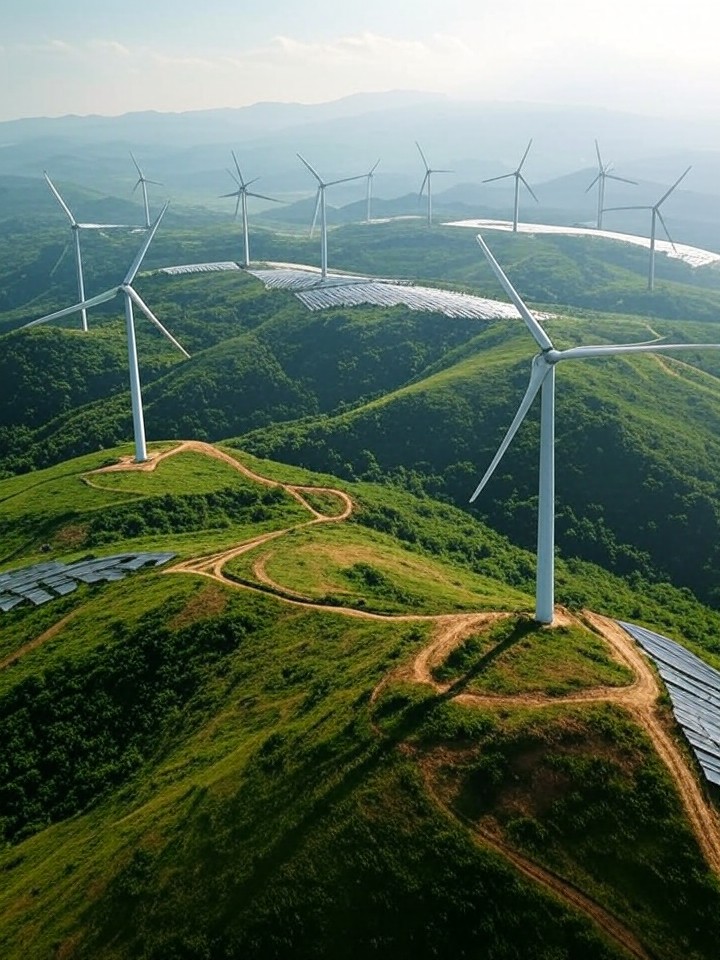
China’s Colossal Green Surge: Inside the World’s Largest Renewable Revolution
China’s push into renewable energy has transformed vast expanses of its terrain into hubs of innovation and power generation, with wind farms and solar arrays stretching across provinces like Qinghai and Inner Mongolia. A recent photo essay from Yale Environment 360 captures this immense scale, showcasing images of towering wind turbines amid arid plateaus and endless rows of photovoltaic panels under expansive skies. These visuals highlight how China installed more than half of the world’s new wind and solar capacity last year, adding renewables at a pace equivalent to powering entire nations like Poland in a single month.
The drive is fueled by aggressive government policies and massive investments, positioning China as the undisputed leader in clean energy deployment. According to a report from Yale E360, the country has seen stunning growth in installed capacity over the past two decades, outpacing global competitors. This expansion isn’t just about quantity; it’s reshaping energy systems, with solar panels being installed at a rate of roughly 100 every second during peak periods.
Yet, challenges persist in integrating this surge into the national grid. Curtailment issues, where excess power can’t be transmitted, have plagued some regions, but recent reforms aim to address these bottlenecks. As detailed in an analysis by Yale Climate Connections, China’s transition involves not only building capacity but also modernizing infrastructure to handle variable renewable outputs.
Scaling Up Amid Grid Strains
In the windswept highlands of Qinghai Province, near the Heidu Mountain Scenic Area, wind farms exemplify China’s ambition. Photographs reveal clusters of turbines harnessing gusts across elevated plains, contributing to the nation’s goal of carbon neutrality by 2060. This visual narrative underscores a broader trend: China’s renewable installations doubled the rest of the world’s combined efforts in recent years, as noted in a digest from Yale E360.
Solar developments are equally impressive, with vast arrays in desert-like zones capturing sunlight to generate gigawatts of electricity. These projects often integrate with local economies, turning unused areas into productive energy zones. Industry insiders point to innovations like bifacial panels and advanced tracking systems that boost efficiency in harsh conditions.
However, the rapid buildup has led to overcapacity in manufacturing, prompting concerns about sustainability. A piece from Eco-Business outlines five key challenges for 2026, including energy wastage and the need to tame excess production. Balancing supply chains while maintaining momentum requires nuanced policy adjustments.
Technological Leaps and Global Implications
Offshore wind is another frontier where China is breaking records. The recent activation of the world’s first 20-megawatt turbine off Fujian Province, capable of powering 44,000 homes annually, marks a significant milestone. Posts on X highlight this achievement, with users noting its potential to accelerate coastal energy independence.
Onshore, mega-projects like the 6GW wind and solar complex in Shanxi Province, complete with 3.4GWh storage, demonstrate integrated approaches to renewables. Built on former coal mining sites, these initiatives symbolize a shift from fossil fuels, as shared in various online discussions reflecting public sentiment on platforms like X.
Internationally, China’s dominance raises trade tensions. The EU’s imposition of barriers on Chinese renewable imports, detailed in an article from Editorialge, reflects efforts to protect domestic industries amid Beijing’s VAT rebate cuts on wind and solar exports. This “great green decoupling” could reshape global markets.
Overcoming Infrastructure Hurdles
Grid modernization is crucial for sustaining growth. An East Asia Forum analysis emphasizes that China’s clean energy success over the past 20 years now demands innovative solutions to grid constraints, such as enhanced transmission lines and smart grid technologies. Without these, the full potential of renewables remains untapped.
Battery storage is emerging as a key enabler. Drawing parallels with California’s progress, a report from Climate Change News suggests China could reduce coal reliance by expanding storage, allowing renewables to cover peak demands without fossil backups.
Moreover, airborne wind power systems, tested in Sichuan Province, represent cutting-edge experimentation. Described as “giant power banks in the clouds,” these innovations could provide flexible generation in urban-adjacent areas, as reported in recent X posts capturing excitement around this breakthrough.
Environmental and Social Dimensions
While the scale is awe-inspiring, environmental costs abroad are under scrutiny. Chinese investments in overseas clean energy projects, while boosting global capacity, have led to human rights and ecological concerns, as explored in a Wired feature. Balancing expansion with responsible practices is essential for long-term credibility.
Domestically, retrofitting coal plants and expanding storage align with broader carbon goals. A collaborative piece from FinanceAsia details how these efforts are changing energy demands across sectors, fostering a greener manufacturing base.
Public sentiment on X reflects optimism, with posts praising China’s addition of 120GW annual wind capacity starting this year and solar surpassing coal by 2026. Such milestones indicate renewables are not just supplementing but overtaking traditional sources.
Economic Drivers and Future Trajectories
Economically, the renewable sector has become a powerhouse, driving job creation and technological exports. Yale E360’s coverage notes that solar manufacturing has quadrupled in some regions, spurred by incentives similar to those in the U.S. Inflation Reduction Act.
Yet, older analyses, like one from 2019 in Yale E360, warned of slowing momentum due to funding shortfalls and grid lags. Today’s reality shows resilience, with 2024 seeing renewables account for 92% of new power capacity, as per recent X updates.
Looking ahead, Science magazine declared the unstoppable rise of renewables as its 2025 Breakthrough of the Year, crediting China’s leadership. This accolade underscores the global significance of Beijing’s strategies.
Innovations in Integration and Storage
Integration challenges are being met with hybrid systems combining wind, solar, and storage. Mega bases in desert regions, planned under the 14th Five-Year Plan, total around 100GW, transforming arid expanses into energy oases.
Energy storage advancements, including large-scale batteries, are critical for stability. California’s model, with its strides in reducing fossil “peakers,” offers lessons for China, potentially accelerating the phase-out of coal.
X posts from experts like Mark Z. Jacobson highlight China’s plans to add massive wind capacity annually, reinforcing the narrative of unrelenting progress.
Trade Dynamics and Domestic Reforms
Trade barriers from the EU, including the Net Zero Industry Act and Carbon Border Adjustment Mechanism, aim to counter China’s dominance. Editorialge’s in-depth look reveals how these measures, alongside China’s policy shifts, are redefining international renewable trade.
Domestically, addressing overcapacity involves curbing wasteful production and enhancing efficiency. Eco-Business identifies taming manufacturing excess as a top priority for meeting climate targets.
Sentiment on X echoes this, with users celebrating milestones like hitting 1,206GW of wind and solar capacity six years early, signaling accelerated timelines.
Sustaining Momentum Through Policy and Innovation
Policy reforms are pivotal. East Asia Forum stresses the need for grid innovations to match the clean energy boom, ensuring reliable power delivery.
Overseas investments, while beneficial for climate goals, must mitigate social impacts. Wired’s investigation into environmental and human rights costs calls for greater accountability in projects funded by Chinese firms.
Finally, as solar continues to defy predictions—with China installing more in half a year than entire previous annual totals, per Yale E360—the world watches. This revolution not only powers China but influences global energy strategies, promising a cleaner future if challenges are navigated wisely.


 WebProNews is an iEntry Publication