
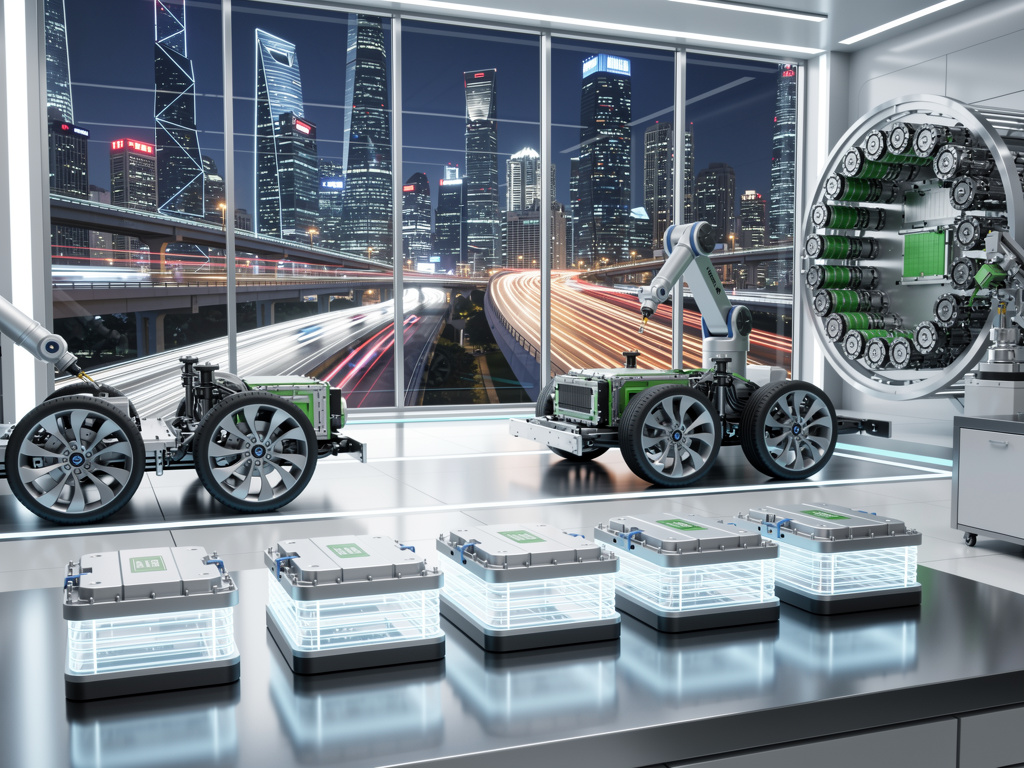
China’s Battery Revolution: Defining the Future of Electric Vehicles with Groundbreaking Standards
In the rapidly evolving world of electric vehicles, China has once again positioned itself at the forefront of innovation. Late last year, the country unveiled the world’s first national standards for solid-state batteries, a technology long hailed as the “dream battery” for its potential to transform energy storage. This move not only sets a benchmark for the global automotive industry but also signals Beijing’s ambition to dominate the next generation of EV technology. As automakers worldwide grapple with range anxiety, safety concerns, and recycling challenges, these new rules could redefine how batteries are designed, produced, and integrated into vehicles.
Solid-state batteries promise higher energy density, faster charging times, and enhanced safety compared to traditional lithium-ion counterparts. By replacing liquid electrolytes with solid materials, they reduce the risk of fires and explosions, addressing a critical pain point in the EV market. China’s standards, introduced in a draft by the National Technical Committee of Auto Standardization, specify criteria such as energy density thresholds and testing protocols, aiming for mass commercialization within two years. This regulatory framework is seen as a catalyst for accelerating adoption, with industry giants like BYD and CATL already ramping up their efforts.
The implications extend beyond China’s borders. As the largest producer and consumer of electric vehicles, China’s policies often ripple through global supply chains. Western automakers, including Tesla and Ford, may need to adapt to these standards to remain competitive, especially as trade tensions heighten. Recent reports indicate that Beijing’s focus on battery safety and efficiency is part of a broader strategy to bolster its technological sovereignty amid international scrutiny.
Regulatory Milestones and Technological Breakthroughs
The journey to these standards has been marked by significant advancements. For instance, Chinese researchers have developed self-adaptive interphases that maintain contact between lithium metal anodes and solid electrolytes without external pressure, overcoming a major hurdle in solid-state technology. This breakthrough, highlighted in various industry discussions, paves the way for more reliable and efficient batteries. Moreover, companies like ChangAn have announced plans for mass-producing solid-state batteries with energy densities up to 400 Wh/kg by 2027, signaling a shift from prototypes to production lines.
In parallel, China has tightened regulations on EV battery safety. Earlier in 2025, new rules mandated “no fire, no explosion” standards for batteries, as reported by CarExpert. These measures require automakers to comply with rigorous testing to minimize risks, a response to incidents of battery fires that have plagued the industry. The government’s proactive stance is evident in its licensing requirements for transferring battery manufacturing technologies abroad, as detailed in a New York Times article from July 2025.
Furthermore, the push for solid-state batteries aligns with China’s environmental goals. With hundreds of thousands of used EV batteries entering the market, Beijing is scrambling to establish orderly recycling systems. An in-depth piece from MIT Technology Review explores how early electric cars are aging out, fueling a gray market while manufacturers build formal recycling infrastructures. This holistic approach ensures that the battery lifecycle—from production to disposal—is sustainable.
Impact on Global EV Markets and Competition
The introduction of these standards comes at a pivotal moment. Just days ago, on January 3, 2026, industry sources noted China’s first national standard for solid-state EV batteries, describing it as a step toward the “holy grail” of battery tech. According to Electrek, the standards cover sulfide or oxide electrolytes, promising safer and denser power sources. This development has sparked excitement on social platforms, with posts on X highlighting how it could lead to mass production by 2030, potentially ending the era of liquid-based limitations.
Competitively, Chinese firms are surging ahead. BYD recently overtook Tesla as the world’s top EV seller, as per reports from The New York Times and BBC. This shift is attributed to China’s efficient manufacturing and now, its regulatory edge. The new energy consumption rules, effective January 1, 2026, cap efficiency for two-tonne models at 15.1 kWh per 100 km, pushing for smarter designs rather than larger batteries, as explained in a CarNewsChina article.
However, challenges remain. The transition to solid-state batteries requires overcoming production scalability and cost barriers. Industry insiders point out that while prototypes show promise, achieving commercial viability demands substantial investment. Posts on X from experts emphasize that China’s regulatory framework defines solid-state batteries as those with residual liquid content below 0.5%, setting a clear metric that could influence international standards.
Safety Enhancements and Recycling Imperatives
Safety is a cornerstone of these new regulations. Building on April 2025’s tightened rules, which aimed to reduce fire and explosion risks, the latest standards incorporate advanced testing for solid-state designs. Reuters reported on these efforts, noting how they target the fast-growing EV sector. By mandating higher safety thresholds, China is not only protecting consumers but also enhancing the appeal of its vehicles in export markets.
Recycling is another critical facet. As EV adoption skyrockets, the influx of spent batteries poses environmental risks. The MIT Technology Review piece underscores Beijing’s efforts to formalize recycling amid a burgeoning gray economy. Innovations like injectable electrolytes, mentioned in X discussions, could extend battery life, reducing waste. Chinese scientists’ work on batteries lasting six times longer challenges the notion of planned obsolescence, potentially revolutionizing consumer electronics beyond EVs.
Moreover, energy efficiency rules are tightening. A new mandatory standard for EV energy consumption, detailed by Electrive, enforces limits that promote longer driving ranges without oversized batteries. This, combined with solid-state advancements, could make EVs more accessible and efficient, addressing criticisms of current models’ limitations.
Economic Ramifications and Future Prospects
Economically, these standards bolster China’s position in the global supply chain. With control over critical minerals and manufacturing, Beijing’s rules could force foreign firms to license technologies or establish local partnerships. The China-Global South Project highlights how the 2026 rules replace voluntary frameworks with binding ones, benefiting drivers through improved range.
On the innovation front, breakthroughs like using table salt in battery production, as noted in X posts, demonstrate China’s resourceful approach. Companies are completing large-capacity solid-state production lines, planning vehicle tests in 2026 and mass production by 2030. This timeline suggests a rapid scale-up, potentially outpacing Western efforts where regulatory hurdles slow progress.
Yet, geopolitical tensions add complexity. Restrictions on technology transfers, as per the New York Times report, reflect Beijing’s guarded stance. As the U.S. and Europe impose tariffs on Chinese EVs, these battery standards could become a bargaining chip in trade negotiations, influencing everything from silver exports—crucial for solid-state tech—to broader supply chain dynamics.
Industry Responses and Strategic Adaptations
Automakers are responding swiftly. BYD and CATL are leading with investments in solid-state R&D, aiming for 1000km ranges that could render gas-powered cars obsolete. X sentiments echo this, with users predicting a “final nail in the coffin” for internal combustion engines. Western firms, facing subsidy cuts like Tesla’s loss of federal incentives, may accelerate collaborations or domestic innovations to keep pace.
The standards also emphasize definitions: what constitutes a solid-state battery? By setting parameters like minimal liquid content, China is shaping terminology before others, as covered in an Carscoops analysis. This preemptive move ensures Chinese tech aligns with global perceptions, facilitating exports.
Looking ahead, the integration of these batteries into EVs promises transformative changes. Enhanced safety and efficiency could lower insurance costs and boost consumer confidence, driving adoption in emerging markets. As per Electrify’s insights, the rules tighten energy consumption, compelling smarter engineering that benefits the entire ecosystem.
Broader Implications for Sustainability and Innovation
Sustainability is woven into this narrative. By addressing recycling early, China avoids pitfalls seen in other tech booms. The gray market for batteries, as per MIT Technology Review, underscores the need for robust systems, which these standards support through lifecycle considerations.
Innovation cycles are accelerating. Breakthroughs in self-adaptive materials and high-density designs, shared across platforms like X, indicate a fertile ground for further advancements. Chinese firms’ ability to mass-produce at scale contrasts with Western prototyping, potentially widening the gap.
Ultimately, these developments position China as the arbiter of EV futures. As the world watches, the “dream battery” edges closer to reality, promising a safer, more efficient era for electric mobility. With standards now in place, the race is on for implementation, where execution will determine true leadership in this high-stakes field.


 WebProNews is an iEntry Publication