
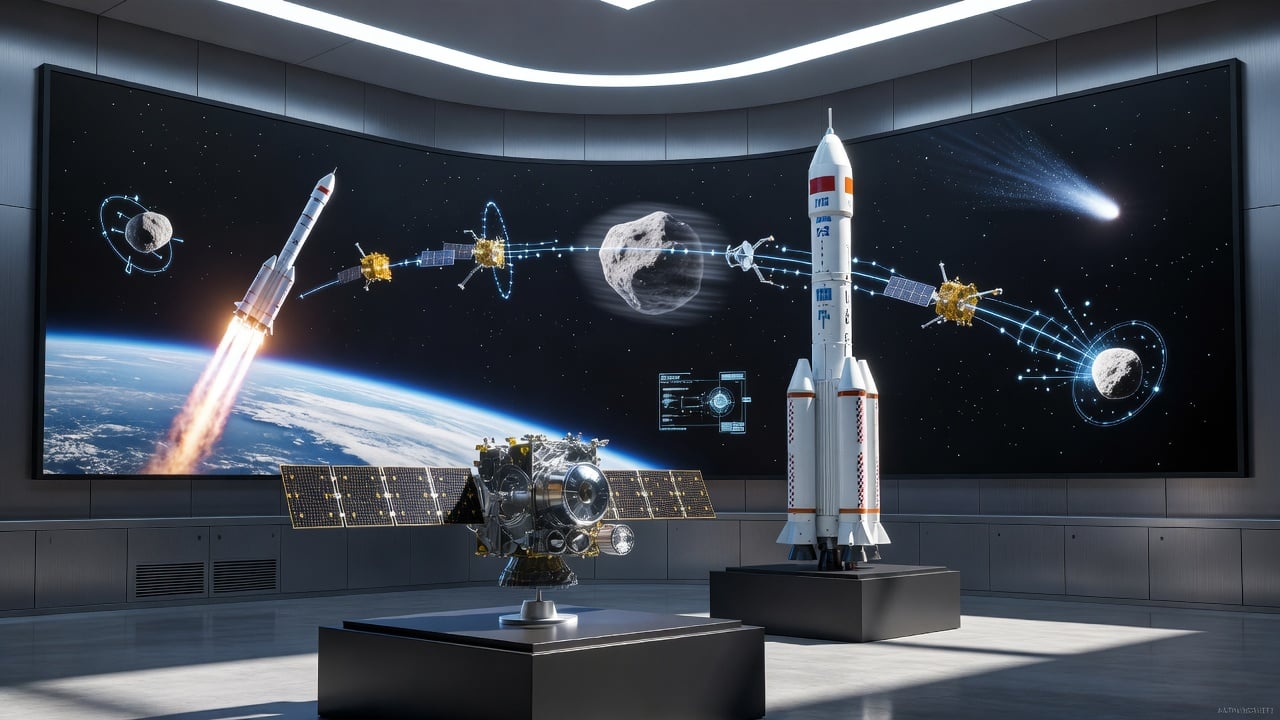
China has taken another bold step in its expanding space program with the recent launch of the Tianwen-2 spacecraft, a sophisticated mission designed to study the near-Earth asteroid 469219 Kamo‘oalewa and later collect samples from a comet. The probe lifted off aboard a Long March 3B rocket from the Xichang Satellite Launch Center on a clear morning in late May, marking the start of a complex multi-year expedition that blends asteroid exploration with comet sample return technology.
The spacecraft carries an array of scientific instruments including high-resolution cameras, spectrometers, and a sampling mechanism that will attempt to gather surface material without landing. Mission planners at the Chinese Academy of Sciences designed Tianwen-2 to conduct a close flyby and detailed survey of Kamo‘oalewa before proceeding to its secondary target, a periodic comet whose name has not been publicly confirmed. This dual-objective approach demonstrates the growing confidence of Chinese engineers in planning extended deep-space operations that stretch across different celestial bodies.
Kamo‘oalewa itself presents an intriguing scientific target. Discovered in 2016 by astronomers at the Pan-STARRS telescope in Hawaii, the asteroid measures roughly 150 to 190 meters across and follows an orbit that keeps it relatively close to Earth for an object of its type. Some researchers have speculated that it might be a fragment ejected from the Moon during an ancient impact event, though that theory remains under investigation. The asteroid’s unusual stability near Earth’s orbit makes it an accessible destination for robotic missions while offering clues about the formation and evolution of the inner solar system.
Tianwen-2 will spend several months studying the asteroid from various distances, capturing detailed images and analyzing its surface composition, rotation rate, and thermal properties. Scientists hope the data will help determine whether Kamo‘oalewa truly shares a lunar origin or if it represents a more typical carbonaceous or silicate asteroid from the main belt that wandered inward. The spacecraft’s spectrometers are expected to identify minerals and organic compounds that could shed light on the distribution of water and prebiotic materials throughout the early solar system.
After completing its primary observations, Tianwen-2 will fire its engines to break free of its current trajectory and head toward the comet. There the probe will deploy a sampling device that uses a high-speed projectile to dislodge surface material, which will then be collected and stored in a sealed capsule. This technique builds on methods tested during China’s successful Chang’e-5 lunar sample return and the earlier Chang’e-6 far-side mission. If all proceeds according to plan, the spacecraft will eventually return the collected samples to Earth sometime in the mid-2030s, providing scientists with material that has remained largely unaltered since the solar system’s formation.
The mission reflects China’s systematic approach to planetary exploration. Following the Tianwen-1 Mars orbiter and rover in 2021 and the pair of highly successful lunar sample return missions, Tianwen-2 represents the next logical progression in an increasingly ambitious roadmap. Chinese space officials have outlined plans for additional asteroid missions, potential Mars sample return, and even crewed lunar landings within the next decade. Each successive project incorporates lessons learned from previous flights while introducing new technical capabilities.
Engineers faced several significant challenges in designing Tianwen-2. The spacecraft must operate reliably for more than a decade, enduring extreme temperature variations, radiation exposure, and long periods of autonomous navigation far from Earth. Communication delays increase dramatically the farther the probe travels, requiring sophisticated onboard artificial intelligence systems to handle navigation, hazard avoidance, and instrument operations without constant human direction. The sampling mechanism itself represents a substantial engineering achievement, as it must function perfectly on a small, low-gravity body after years in space.
International interest in near-Earth objects has grown considerably in recent years. The United States, Japan, and the European Space Agency have all launched or planned missions to asteroids and comets. NASA’s OSIRIS-REx mission successfully returned samples from Bennu in 2023, while Japan’s Hayabusa2 brought back material from Ryugu in 2020. These efforts have demonstrated both the technical feasibility of sample return and the immense scientific value of such pristine specimens. Tianwen-2 will add to this growing collection of extraterrestrial material available for laboratory study.
Beyond the purely scientific objectives, the mission carries strategic significance for China’s broader space ambitions. Successful execution would further establish the country as a major player in deep-space exploration alongside traditional leaders like the United States and Russia. The technological developments required for Tianwen-2, particularly in propulsion, autonomous navigation, and sample handling, will likely find applications in future crewed missions and more complex robotic expeditions.
Public engagement with the mission has been strong within China. State media provided extensive coverage of the launch, and educational programs have highlighted the scientific questions the spacecraft aims to answer. Students across the country have followed the mission’s progress through interactive apps and classroom materials developed specifically for Tianwen-2. This outreach effort mirrors similar initiatives by other space agencies seeking to maintain public support for expensive exploration programs.
The asteroid Kamo‘oalewa holds particular cultural resonance for some observers because its Hawaiian name refers to a celestial offspring of the Earth goddess. The name evokes the object’s close relationship with our planet, even though the asteroid poses no current collision risk. Its orbit brings it within about 15 million kilometers of Earth at closest approach, close enough to be classified as a potentially hazardous asteroid despite the extremely low probability of impact.
Mission scientists anticipate that data from Tianwen-2 will contribute to improved models of asteroid composition and behavior. Understanding the physical properties of objects like Kamo‘oalewa becomes increasingly relevant as astronomers continue to discover more near-Earth asteroids. Some researchers have proposed future missions that could redirect small asteroids or mine them for resources, concepts that depend on detailed knowledge of their internal structure and surface characteristics.
The spacecraft’s journey will also test new solar electric propulsion technology that Chinese engineers incorporated into the design. These efficient ion thrusters should allow Tianwen-2 to accomplish its ambitious itinerary while carrying a relatively modest amount of chemical propellant. If the system performs well, similar propulsion units could appear on future Chinese missions to the outer solar system or on cargo vessels supporting lunar bases.
As Tianwen-2 continues its long voyage, scientists on the ground have begun calibrating their instruments and planning the detailed observation sequences that will occur at each target. The mission control team at the Beijing Aerospace Flight Control Center will monitor the spacecraft’s health through regular telemetry sessions while preparing for the critical maneuvers required to reach both the asteroid and the comet.
The samples eventually returned from the comet could prove especially valuable. Comets contain frozen volatiles and complex organic molecules that may have played a role in delivering water and the building blocks of life to early Earth. Laboratory analysis using modern instrumentation can reveal isotopic ratios, mineral structures, and molecular compositions that preserve a record of conditions in the outer solar system more than four billion years ago.
China’s space program has demonstrated remarkable progress over the past two decades. From its first crewed flight in 2003 to the construction of the Tiangong space station and multiple successful robotic missions to the Moon and Mars, the country has moved from being a newcomer in space to a nation with comprehensive capabilities across nearly all aspects of spaceflight. Tianwen-2 fits into this pattern of steady advancement and increasing technical sophistication.
The mission also highlights growing international collaboration in space science even amid geopolitical tensions. While China operates its program largely independently, data from Tianwen-2 will likely be shared with the global scientific community through established channels. Many instruments aboard the spacecraft have international counterparts, allowing for direct comparison of measurements and strengthening the overall body of knowledge about small solar system bodies.
Engineers continue to refine the spacecraft’s trajectory as it travels through the inner solar system. Small course corrections will be necessary to ensure optimal flyby geometry at Kamo‘oalewa and to set up the proper encounter conditions at the comet. Each adjustment requires precise calculation and careful execution to preserve the limited propellant supply for later critical phases of the mission.
The successful launch of Tianwen-2 adds momentum to China’s plans for an extensive program of robotic exploration throughout the 2030s. Officials have discussed follow-on missions that would target main-belt asteroids, Jupiter’s Trojan asteroids, and possibly even the ice giants Uranus and Neptune. Each new mission builds upon the foundation established by its predecessors while expanding the reach and scientific return of Chinese space science.
For now, the focus remains on the current mission and its demanding schedule of observations and maneuvers. Tianwen-2 represents a significant investment of resources and expertise, and its outcome will influence the direction of China’s planetary exploration efforts for years to come. As the spacecraft accelerates away from Earth on its interplanetary trajectory, it carries with it not only advanced scientific instruments but also the expectations of a growing community of researchers eager to study the returned data and samples.
The coming years will bring regular updates as Tianwen-2 reaches each milestone in its complex journey. From the first images of Kamo‘oalewa to the dramatic sampling attempt at the comet and finally the high-speed reentry of the sample capsule back on Earth, the mission promises to deliver both spectacular visuals and substantial scientific discoveries. Chinese space scientists have set an ambitious goal with Tianwen-2, and the global space community will be watching closely to see how this latest chapter in planetary exploration unfolds.


 WebProNews is an iEntry Publication