
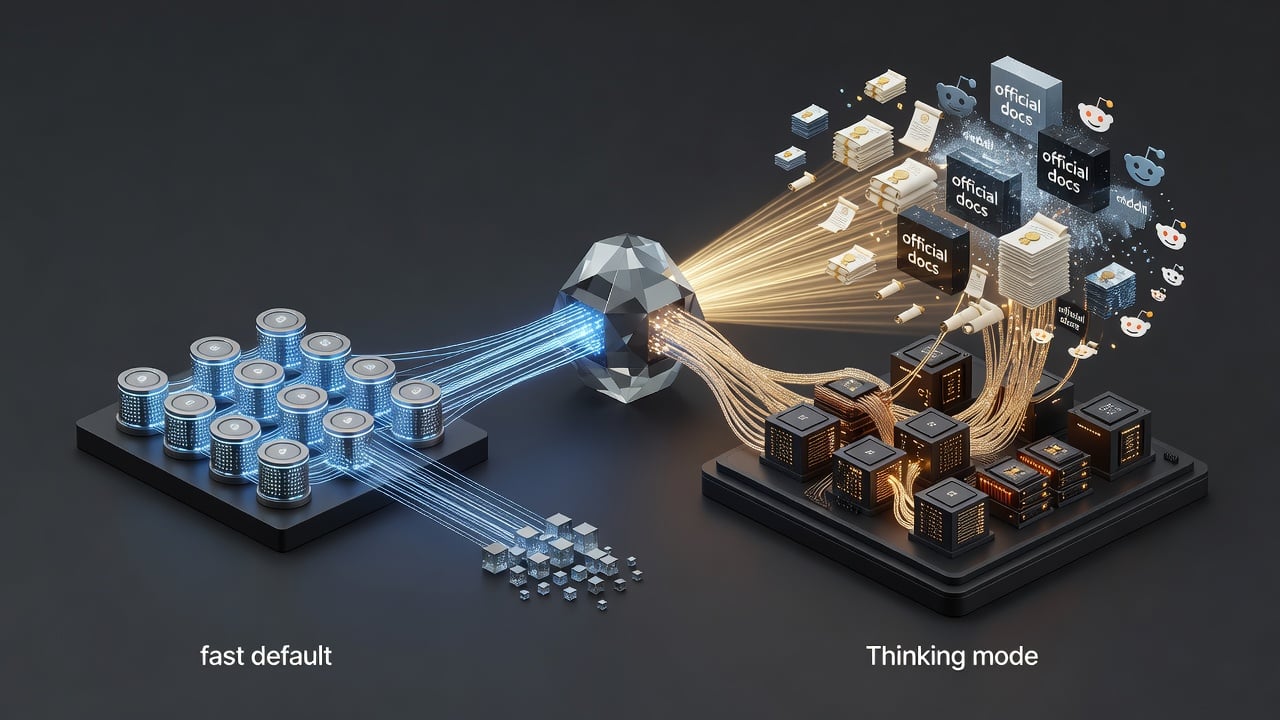
ChatGPT doesn’t treat every question the same. Flip on its Thinking mode and the sources it cites shift dramatically. Brands that dominate quick answers often vanish in deeper queries. Others surge forward. The difference isn’t subtle. It’s structural.
A new study from Semrush lays it bare. Only 25.6% of cited sources overlap between minimal reasoning, the fast default, and high reasoning, the deliberate Thinking mode. Nearly three in four sources change. (Search Engine Land, July 1, 2026)
Citation rates climb from 50% to 68%. The number of sources per cited answer jumps from 2.6 to 4.5. High-reasoning runs 1,130 web searches across the test set. Minimal reasoning manages just 245. The model doesn’t just think harder. It searches wider and pulls from different corners of the web.
Reddit’s share of citations halves, from 15% to 7%. User-generated content and review sites drop from 14.3% to 6%. Government, academic, and official documentation pages gain. Their combined presence rises sharply. Brands themselves appear at similar overall rates. Yet the specific brands and the pages cited differ sharply.
The data reveals two distinct search engines inside one product.
Kevin Indig, growth advisor and collaborator on the Semrush analysis, put it plainly. “The brand that wins under minimal reasoning is not the brand that wins under high reasoning. The mix of source types is different. The stages where citations appear are different. These are two different systems.” (Semrush, June 30, 2026)
The test covered 100 prompts across 20 buyer journeys in B2B SaaS, finance, consumer tech, and health and lifestyle. Each journey broke into five stages: problem recognition, exploration, comparison, validation, and selection. Prompts ran once in each mode. Analysts tracked citations, domains, sub-queries, and persistence across the funnel.
Comparison prompts triggered the biggest divergence. High reasoning fired an average of 24 sub-queries. Minimal reasoning ran 5.5. Citations peaked at 9.8 per response versus 5.8. The model decomposes complex evaluations into pricing checks, integration reviews, security assessments, and support documentation. A single buyer question spawns a web of targeted searches.
Finance saw the largest citation lift, up 28 percentage points. Health and lifestyle followed at 24 points. B2B SaaS gained 16. Consumer tech moved only 4 points, even though high reasoning ran more sub-queries there. The model already holds strong internal knowledge of common consumer tech topics. Extra computation changes little.
High reasoning also creates persistence. A brand cited early in the journey often carries through to selection. This happened in four of 20 journeys under Thinking mode. Zero journeys showed that continuity in minimal reasoning. The same domain appeared multiple times within single answers 51 times out of 100 with high reasoning. Minimal reasoning did so only 26 times.
Top-of-funnel content gains new weight. Early citations anchor later decisions when the model reasons deeply. Brands that earn mentions during problem recognition stand a better chance of remaining visible at purchase time. But only if the user triggers Thinking mode.
Separate research reinforces the split. After OpenAI made GPT-5.3 Instant the default in early March 2026, average unique domains cited per response fell from 19.1 to 15.2. URLs dropped from 24.1 to 19.1. The faster model tightened its net. (Search Engine Journal)
Premium GPT-5.4 Thinking behaves differently. One analysis of 1,161 citations across 119 conversations found it sent 56% of citations to brand websites. The default GPT-5.3 sent just 8%. Overlap between the two models sat at 7%. On 22 of 50 identical prompts, the sets of cited domains shared nothing. (Writesonic, March 2026)
GPT-5.4 decomposes prompts into 8.5 fan-out queries on average. It applies site: operators and domain restrictions to hit trusted sources directly. Pricing pages, homepages, and product documentation appear far more often. The default model leans on third-party roundups, Forbes, TechRadar, Reddit. Fresh content under 30 days old makes up only 6% of its citations.
These patterns matter because ChatGPT routes complex prompts to higher-reasoning automatically, even for free users. A casual query might stay in fast mode. A detailed comparison or regulatory question flips the switch. Marketers can’t assume one optimization approach covers both.
But. The overlap is low. The source types diverge. Brands must now optimize for two parallel citation systems. Official documentation and support pages rise in value under Thinking. Original research that academics and government sites reference becomes strategic. Clear entity mentions, structured data, and explicit claims help the model pull exact passages during sub-queries.
UGC strategies that worked for quick answers lose ground when reasoning deepens. Partnerships that land brand mentions in .gov or .edu resources pay dividends. Content that persists across funnel stages compounds. A problem-stage mention can influence selection if the conversation triggers high reasoning.
And the gap keeps evolving. Later analyses show GPT-5.4 Thinking bypasses traditional search rankings. Seventy-five percent of domains it cites do not appear in top Bing or Google results for related queries. The model constructs its own path through the web.
Publishers and brands face a fragmented attention economy. Visibility in one mode does not guarantee it in the other. Teams that test prompts in both Instant and Thinking modes will spot the differences fastest. Those that audit full buyer journeys rather than isolated questions will map the persistence effect.
The numbers don’t lie. Citation volume rises. Source diversity expands. Yet the winners change. Reddit fades. Documentation surges. Early content anchors decisions. Finance and health feel the shift most. Consumer tech barely registers it.
ChatGPT’s dual nature forces a sharper strategy. Brands can no longer treat the chatbot as a single surface. They must win the fast answer and the deliberate one. The overlap is only 25%. The opportunity sits in the 75% that changes.


 WebProNews is an iEntry Publication