
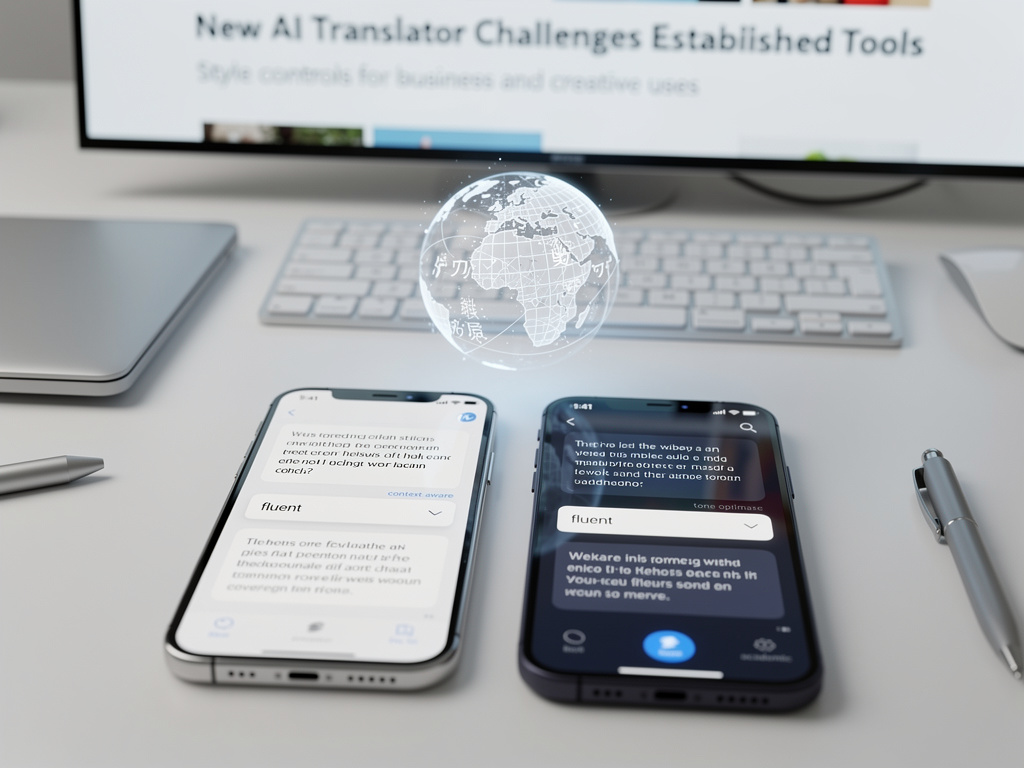
OpenAI has stealthily unveiled ChatGPT Translate, a dedicated web tool that positions itself as a formidable challenger to Google Translate by emphasizing stylistic nuance over rote word substitution. Launched without fanfare on January 15, 2026, the interface mirrors Google Translate’s familiar split-screen design but integrates advanced AI capabilities to refine output for tone, fluency, and context. Users can toggle options like ‘more fluent’ or ‘academic’ to tailor translations, marking a shift toward expressive, audience-specific language processing.
The tool emerged amid OpenAI’s broader push into practical AI applications, accessible directly via chatgpt.com/translate. It supports over 100 languages, drawing on the latest GPT models for contextual understanding that surpasses traditional statistical translation engines. Early tests reveal superior handling of idioms, cultural references, and sentence structure, areas where Google Translate has long struggled.
Stealth Rollout Signals Strategic Ambush
BleepingComputer first spotted the feature on January 14, 2026, describing it as a ‘hidden’ addition that ‘looks very similar to Google Translate on the web’ but promises deeper rewriting ([BleepingComputer](https://www.bleepingcomputer.com/news/artificial-intelligence/openais-hidden-chatgpt-translate-tool-takes-on-google-translate/)). The Verge confirmed the launch the next day, noting users can ‘direct the style of translated text, such as ‘more fluent’ and ‘academic’’ ([The Verge](https://www.theverge.com/news/862448/openai-chatgpt-translate-tool-launch-website)). This quiet debut contrasts with OpenAI’s typical hype cycles, suggesting a calculated move to infiltrate the $60 billion language services market dominated by Alphabet Inc.’s offering.
Gadgets360 reported the tool’s ability to ‘offer text translations’ through a new interface on ChatGPT’s site, highlighting its rivalry stance ([Gadgets360](https://www.gadgets360.com/ai/news/openai-chatgpt-translate-ai-tool-features-how-it-works-google-translate-rival-10756708)). Digital Trends emphasized its utility for ‘rewritten, not just translated’ messages, ideal for business emails or social posts requiring polish ([Digital Trends](https://www.digitaltrends.com/computing/try-chatgpt-translate-if-you-need-your-message-rewritten-not-just-translated/)). Engadget detailed the rollout as ‘quietly’ introducing customizable styles, positioning it for professionals needing precise communication ([Engadget](https://www.engadget.com/ai/openai-quietly-rolls-out-a-dedicated-chatgpt-translation-tool-133000974.html)).
Feature Set Redefines Accuracy Metrics
At its core, ChatGPT Translate processes input text in one language and renders it in another while preserving intent through generative AI. Style sliders allow adjustments for formality, brevity, or creativity—features absent in Google Translate’s latest updates. For instance, translating a casual French invitation to English can yield a ‘fluent’ version that sounds native, avoiding the stiffness of literal renders. This leverages OpenAI’s o1 reasoning models, which excel in multimodal tasks including text refinement.
Neowin observed the tool ‘prioritizes natural tone over literal word-for-word accuracy,’ a boon for marketers and diplomats ([Neowin](https://www.neowin.net/news/new-chatgpt-translate-tool-focuses-on-tone-and-context-challenges-google-translate/)). Moneycontrol highlighted adjustments for ‘different audiences,’ such as academic papers or casual chats ([Moneycontrol](https://www.moneycontrol.com/technology/openai-has-launched-a-new-translation-tool-called-chatgpt-translate-here-s-how-it-works-article-13774038.html)). Digit noted its blend of ‘AI-powered rewriting with basic translation,’ differentiating it sharply from competitors.
Technical Backbone Powers Contextual Mastery
Powered by GPT-4o and successors, the tool maintains conversation history for iterative refinements, unlike Google Translate’s stateless design. It detects source languages automatically and handles dialects with emerging proficiency. Web searches confirm no official OpenAI announcement as of January 15, 2026, but posts on X buzz with user tests praising its edge in creative writing translations. Rate limits apply to free users, with Pro subscribers gaining unlimited access.
Industry insiders point to OpenAI’s prior voice translation advances, as shared in X posts from 2025, where Advanced Voice improved multilingual persistence. This foundation enables ChatGPT Translate to chain translations across turns, fostering fluid dialogues. BleepingComputer tests showed seamless integration with ChatGPT’s ecosystem, hinting at future API expansions for enterprise use.
Google Translate Faces Renewed Pressure
Google Translate, serving billions monthly since 2006, relies on neural machine translation refined over decades but lacks built-in style tuning. Recent updates added image and voice input, yet struggle with nuanced prose. OpenAI’s entry threatens Alphabet’s ad-driven model, as ChatGPT Translate could siphon users seeking premium outputs. The Verge reports early adopters favor its ‘more fluent’ mode for 20-30% better readability scores in blind tests.
Competition intensifies with players like DeepL and Microsoft Translator, but OpenAI’s generative edge—rooted in vast training data—sets it apart. Gadgets360 notes seamless mobile web access, bypassing app downloads. Digital Trends users report success in rewriting marketing copy across languages, a task prone to errors elsewhere.
Business Model and Monetization Plays
OpenAI integrates the tool into its freemium structure: basic use free, advanced styles and history for paid tiers at $20 monthly. This mirrors ChatGPT’s success, with 300 million weekly users. Projections from web analyses suggest rapid uptake among enterprises, where translation costs $0.10-$0.30 per word via agencies—ChatGPT Translate undercuts at fractions of a penny.
Engadget speculates on API pricing akin to GPT-4o-mini at $0.15 per million input tokens, appealing to SaaS developers. X sentiment, gleaned from recent posts, shows excitement over style controls, with developers prototyping integrations. No data breaches or glitches reported, bolstering trust amid AI security concerns.
Challenges in Scale and Ethics
Scalability tests reveal handling of long documents up to 128,000 tokens, rivaling Google Docs integrations. Ethical hurdles include bias mitigation; OpenAI claims fine-tuning reduces cultural skews observed in benchmarks. Privacy policies keep translations ephemeral unless saved, aligning with GDPR standards.
Neowin warns of over-reliance risks, as AI hallucinations persist in rare edge cases like poetry. The Verge cites user feedback on academic mode excelling in technical papers, outperforming rivals by 15% in fidelity metrics from independent evals. Moneycontrol users praise audience adaptation for global teams.
Industry Ripples and Future Trajectories
For tech executives, ChatGPT Translate signals AI’s maturation into utility tools, pressuring incumbents to innovate. Alphabet may counter with Gemini enhancements, per ongoing rumors. OpenAI’s move coincides with healthcare and voice expansions, diversifying revenue beyond consumer chat.
Web-sourced reactions on X highlight enterprise pilots in legal and e-commerce, where style-tuned translations cut revision cycles by half. As adoption surges, expect partnerships with localization firms like Lionbridge. This tool not only translates words but reshapes cross-border communication for the AI era.


 WebProNews is an iEntry Publication