
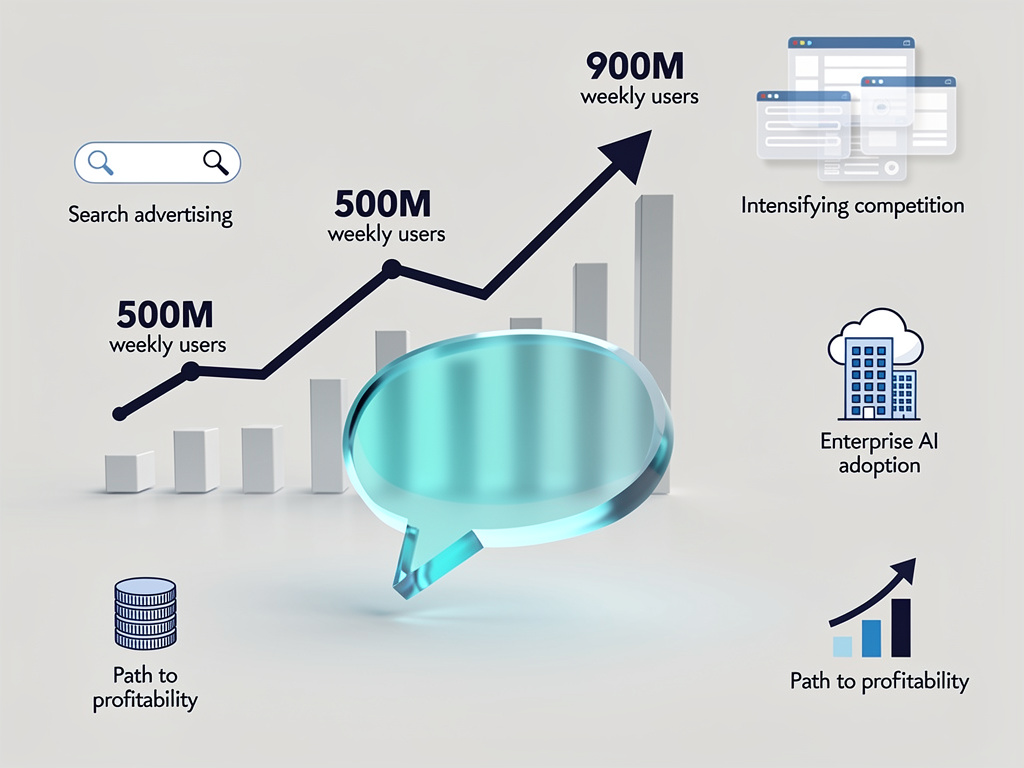
OpenAI’s ChatGPT has reached a staggering 900 million weekly active users, a milestone that underscores the breakneck pace at which artificial intelligence tools are embedding themselves into the daily routines of consumers and businesses worldwide. The figure, disclosed by OpenAI CEO Sam Altman during a recent appearance, represents a near-doubling from the 500 million weekly active users the company reported just three months earlier, in February 2025.
The acceleration is remarkable by any measure. To put it in context, it took Facebook roughly eight years to reach 900 million monthly active users. ChatGPT has done it in weekly actives in approximately two and a half years since its public launch in November 2022. As Search Engine Land reported, the growth trajectory has been nothing short of extraordinary, with the platform adding hundreds of millions of users in a matter of weeks rather than years.
A Growth Curve That Defies Historical Precedent
The numbers tell a compelling story of compounding adoption. In August 2024, OpenAI reported 200 million weekly active users. By December 2024, that figure had climbed to 300 million. Then came February 2025, when the company announced 500 million weekly users. Now, in May 2025, the count stands at 900 million. That means OpenAI added roughly 400 million weekly users in just three months — a rate of growth that would be the envy of any technology company in history.
Sam Altman shared the updated figure during a public event, noting the company’s ambitions to continue scaling. The growth has been fueled by several factors: the rollout of new features, the expansion of ChatGPT’s free tier, integration with third-party platforms, and the broader cultural normalization of AI-assisted work and communication. OpenAI has also benefited from strategic partnerships, including its deep integration with Microsoft products and the availability of ChatGPT through Apple devices.
What’s Driving the Surge: Product Expansion and Search Ambitions
A significant contributor to ChatGPT’s user growth has been OpenAI’s aggressive push into AI-powered search. The company launched ChatGPT Search as a feature that allows users to get real-time, cited answers to queries — effectively positioning ChatGPT as a competitor to Google Search. According to Search Engine Land, this search functionality has been a major draw for new users, particularly those who find traditional search engine results pages cluttered with ads and low-quality content.
OpenAI has also expanded its product lineup considerably. The introduction of GPT-4o, which brought multimodal capabilities including image and voice interaction to free-tier users, lowered the barrier to entry significantly. The company’s memory features, custom GPTs, and the ability to generate and edit images directly within ChatGPT have all contributed to higher engagement and retention rates. Each new capability gives existing users a reason to return more frequently and gives prospective users a reason to sign up.
The Competitive Pressure Mounts on Google and Meta
ChatGPT’s growth has not gone unnoticed by its competitors. Google has been accelerating its own AI efforts, rolling out Gemini across its product portfolio and integrating AI Overviews directly into search results. Meta has embedded its Llama-based AI assistant across Facebook, Instagram, and WhatsApp, claiming hundreds of millions of monthly users for its own AI tools. Anthropic’s Claude, backed by Amazon, has also been gaining traction in enterprise settings.
But the sheer velocity of ChatGPT’s user acquisition suggests that OpenAI retains a significant first-mover advantage in the consumer AI space. The brand recognition of “ChatGPT” has become almost synonymous with AI chatbots in the public consciousness, much the way “Google” became a verb for internet search. This kind of brand entrenchment is difficult for competitors to overcome, regardless of the technical quality of their offerings. Industry analysts have noted that OpenAI’s ability to maintain this growth while simultaneously scaling its infrastructure and managing costs will be a defining challenge for the company in the months ahead.
Revenue and Valuation Implications
The user growth figures carry enormous implications for OpenAI’s financial trajectory. The company reportedly reached an annualized revenue run rate of approximately $11.6 billion earlier in 2025, driven largely by ChatGPT Plus and Enterprise subscriptions. With 900 million weekly active users, even a modest conversion rate to paid tiers translates into substantial recurring revenue. OpenAI’s pricing tiers — ranging from the free version to ChatGPT Plus at $20 per month, ChatGPT Pro at $200 per month, and various enterprise plans — give the company multiple avenues to monetize its growing user base.
OpenAI’s most recent funding round valued the company at $300 billion, making it one of the most valuable private companies in the world. That valuation was predicated in part on continued user growth and the expectation that ChatGPT would become an essential daily tool for a billion or more people. With 900 million weekly actives, that billion-user milestone appears to be within reach in the near term. Investors, including Microsoft, Thrive Capital, and SoftBank, are betting that OpenAI can convert this massive user base into a durable, high-margin business — though the company’s compute costs remain a persistent concern.
The Search Engine Disruption Is Real
Perhaps the most consequential aspect of ChatGPT’s growth is what it means for the search advertising market, a roughly $300 billion global industry dominated by Google. As more users turn to ChatGPT for informational queries, product recommendations, and research tasks, the traditional search engine model — built on a foundation of keyword-based advertising — faces genuine disruption. Publishers and advertisers are already grappling with declining referral traffic from AI-generated answers that satisfy user intent without requiring a click-through to a website.
According to Search Engine Land, the rise of ChatGPT as a search alternative has prompted significant concern among SEO professionals and digital marketers. If a substantial portion of informational queries migrates from Google to ChatGPT, the downstream effects on web traffic, advertising revenue, and the broader content economy could be profound. Google has responded by accelerating its AI integration into search, but the company faces the classic innovator’s dilemma: its AI-generated answers cannibalize the ad-supported links that generate the vast majority of its revenue.
Enterprise Adoption Adds Another Growth Vector
Beyond consumer usage, ChatGPT’s enterprise adoption has been a critical growth driver. OpenAI has reported that more than 600,000 businesses use ChatGPT’s enterprise and team plans. Companies across industries — from financial services to healthcare to legal — are deploying ChatGPT for tasks ranging from document analysis and code generation to customer service automation and internal knowledge management.
The enterprise segment is particularly important because it tends to generate higher average revenue per user and lower churn rates compared to consumer subscriptions. OpenAI has been investing heavily in enterprise features, including enhanced security controls, admin dashboards, and the ability to fine-tune models on proprietary data. The company’s partnership with Microsoft, which integrates OpenAI’s models into the Copilot features across Microsoft 365, further extends its enterprise reach into organizations that may not directly subscribe to ChatGPT but interact with its underlying technology daily.
The Road to a Billion — and the Challenges Ahead
Reaching 900 million weekly active users is a landmark achievement, but it also raises questions about sustainability and the path forward. OpenAI’s infrastructure costs are enormous; training and serving large language models at this scale requires vast quantities of computing power, primarily provided through Microsoft’s Azure cloud platform. The company has acknowledged that it is not yet profitable, and the gap between revenue and expenses remains a topic of scrutiny among industry observers.
There are also regulatory headwinds. Governments in the European Union, the United States, and elsewhere are crafting AI-specific legislation that could impose new requirements on companies like OpenAI regarding data privacy, content moderation, and transparency. How OpenAI manages these regulatory challenges while continuing to grow its user base will be a defining storyline for the company in the second half of 2025.
Still, the trajectory is undeniable. From zero to 900 million weekly users in roughly 30 months represents one of the fastest adoption curves in the history of technology. Whether OpenAI can translate that adoption into a sustainable, profitable business — and fend off increasingly capable competitors — will determine whether ChatGPT becomes the defining technology platform of the AI era or a cautionary tale about growth without a clear path to profitability. For now, the numbers speak for themselves, and the rest of the technology industry is watching closely.


 WebProNews is an iEntry Publication