
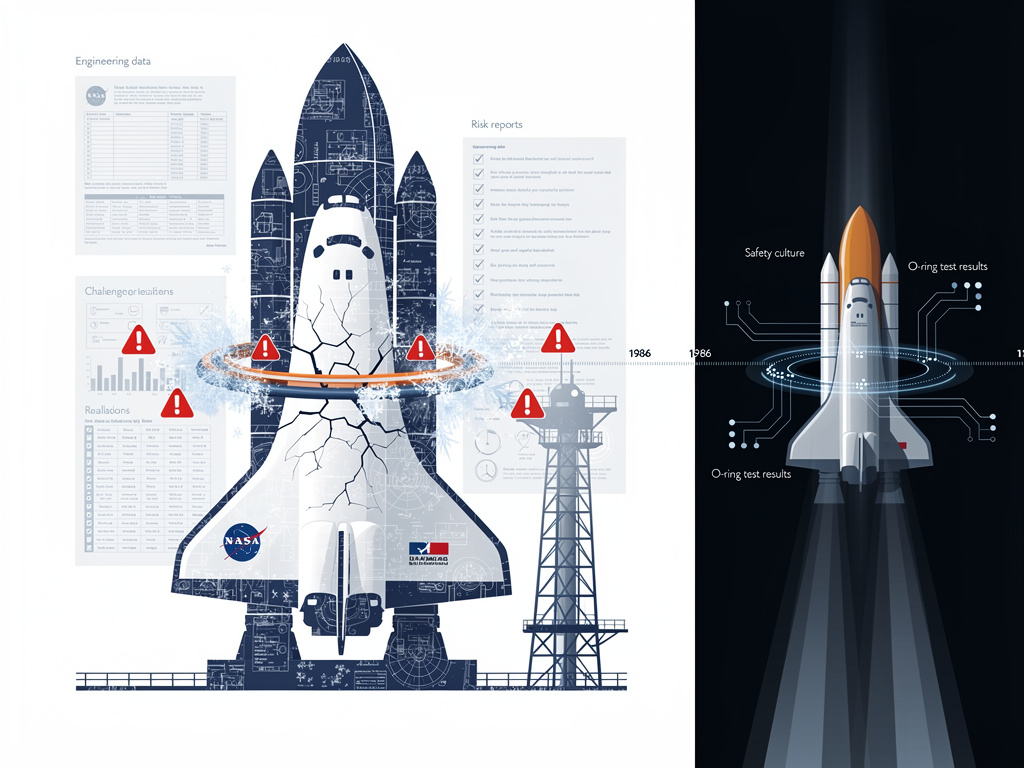
On January 28, 1986, the space shuttle Challenger lifted off from Kennedy Space Center in Cape Canaveral, Florida, under unusually cold conditions, with temperatures dipping to -5°C at sunrise. Icicles clung to the launch pad, yet the countdown proceeded. Seventy-three seconds after launch, at 46,000 feet, the shuttle disintegrated in a fireball, killing all seven crew members aboard. This was NASA’s first in-flight fatality, watched live by millions, including schoolchildren tuned in for the “Teacher in Space” mission.
The crew included Commander Dick Scobee, Pilot Michael Smith, Mission Specialists Ellison Onizuka, Judith Resnik, Ronald McNair, Payload Specialist Gregory Jarvis, and Christa McAuliffe, a 37-year-old social studies teacher from Concord High School in New Hampshire. Selected from over 11,000 applicants, McAuliffe was set to teach lessons on science topics like Newton’s laws and chromatography to students via closed-circuit TV, embodying President Ronald Reagan’s 1984 Teacher in Space Project.
The O-Ring’s Fatal Flaw
Engineers at Morton Thiokol in Utah had flagged risks for years. O-rings—7mm-thick, 12m-long synthetic rubber seals in the solid rocket boosters (SRBs)—prevented scorching gases from leaking through joints. Cold weather stiffened the rubber, impairing its sealing under the flex of launch stresses. A January 1985 Discovery launch at under 12°C showed worsened O-ring erosion, prompting a task force, yet warmer subsequent flights normalized the deviance, as sociologist Diane Vaughan later termed it in her 1996 analysis.
On January 27, 1986, five Thiokol engineers—Bob Ebeling, Brian Russell, Roger Boisjoly, Al McDonald, and Arnie Thompson—met and unanimously recommended delaying until temperatures hit 12°C. Ebeling warned his boss, “We can’t launch. It’s going to be a catastrophic event.” During an evening teleconference with NASA, engineers presented data showing cold reduced the O-rings’ “rubbery” quality, risking leaks.
Management Overrides Engineers
NASA’s Larry Mulloy dismissed concerns: “My God, Thiokol. When do you want me to launch? Next April?” Thiokol managers, after 35 minutes of deliberation, reversed course. General Manager Jerry Mason told engineering head Robert Lund, “Bob, it’s time to take off your engineering hat and put on your management hat.” Launch was approved after 11 p.m. Florida time. Brian Russell, then 31, later reflected, “I’m never going to be in that position again. I am never going to be afraid to speak up when I believe that a different view needs to be expressed,” as recounted in a 2026 ABC News article.
Launch day dawned frigid. As Challenger rose, mission control said, “Challenger, go at throttle up.” Static crackled, smoke puffed from the right SRB, flame flashed, and the vehicle broke apart. Debris rained into the Atlantic. In Utah, engineers watched in horror; Ebeling whispered, “It’s not over yet,” then sobbed as reality hit. He reportedly said, “They’re gonna die!” The five engineers, dubbed “the five lepers” by Ebeling, faced sidelining and guilt. Ebeling carried it until his 2016 death, finding some closure via public sympathy after a 30th anniversary NPR interview.
Immediate Aftermath and Reagan’s Words
A memorial on January 31 at Johnson Space Center drew families, Reagan, and dignitaries. Reagan addressed the nation: “Across America we are reaching out, holding hands, and finding comfort in one another.” Flights halted for 2.5 years. The Rogers Commission, including Neil Armstrong, Sally Ride, and Richard Feynman, probed in 1986. Feynman famously demonstrated O-ring brittleness in ice water on TV. The June report confirmed O-ring failure and slammed NASA’s culture, where schedule pressures trumped safety. Boosters were redesigned; NASA created the Office of Safety, Reliability, and Quality Assurance.
Shuttle flights resumed in 1988 with Discovery, completing 87 missions issue-free until Columbia’s 2003 loss from ignored heat shield damage—echoing Challenger’s organizational failures. NASA veteran Jon Clark noted in 2026, “When you dig deep enough, there’s no question that the organisational culture was implicated in both Columbia and Challenger mishaps,” per ABC News.
McAuliffe’s Enduring Legacy
McAuliffe’s death devastated New Hampshire. Her widower, Judge Steven McAuliffe, said of a 2021 commemorative coin, “She would insist that all teachers see and accept this new U.S. coin commemoration for what it actually is: A tribute to them.” A 2024 bronze statue outside the New Hampshire State House honors her, unveiled near her would-be 76th birthday. The McAuliffe-Shepard Discovery Center in Concord, expanded in 2009, stands as a state memorial. Her planned lessons were filmed in 2018 by astronauts Joe Acaba and Ricky Arnold for the Challenger Center.
Over 40 schools bear her name worldwide. Finalist Bob Foerster, a teacher, told ABC News in 2026, he’s grateful space education blossomed, avoiding the crew becoming mere “martyrs.” Challenger Centers now operate nationwide, inspiring STEM via simulations.
40th Anniversary Reflections
In January 2026, NASA held a Day of Remembrance on January 22 at Kennedy Space Center Visitor Complex. Families laid flowers at the granite memorial etching 25 names from Challenger, Columbia, and Apollo 1. Jane Smith-Wolcott, widow of pilot Michael Smith, participated. Brian Russell, 71 and the sole surviving engineer of the five, shared his resolve in interviews, his voice cracking at explosion memories, as detailed in ABC News.
NPR’s 2026 coverage revisited engineers’ guilt and lessons like Vaughan’s “normalization of deviance,” where repeated risks without catastrophe breed complacency. Florida State University historian Ronald Doel noted the disaster reminded the world of spaceflight’s dangers, contrasting shuttle’s “routine” promise with reality. The 40th falls amid Artemis II preparations from the same pad, using Utah SRBs—now redesigned.
Cultural Scars and Modern Echoes
Many recall classrooms frozen in shock; one X post from @miles_commodore asked, “Do you remember where you were?” Washington Post revisited Russell spreading lessons. Florida memorials, like Titusville’s 1986 plaza, held ceremonies. Challenger Learning Centers launched 2026 Legacy Campaigns for STEM upgrades, per FSU News.
Recent finds include 2022 Challenger wreckage off Florida by divers. As NASA eyes the moon, engineers’ pleas resonate: heed warnings amid pressures. Shuttle’s 135 missions advanced science, but Challenger etched that ambition demands unyielding safety vigilance. Families and survivors ensure the seven’s sacrifice drives progress.
Reforms That Stuck—and Didn’t
Post-Challenger, NASA shifted commercial satellites to expendable rockets, built Endeavour orbiter by 1992. Yet Columbia repeated errors. Today’s Artemis program emphasizes transparent debate, as Florida Today noted amid 2026 preparations. CU Boulder’s David Klaus, a former shuttle engineer, called it a “generationally defining moment.” The Rogers report’s call for cultural overhaul endures as NASA’s mantra.


 WebProNews is an iEntry Publication