
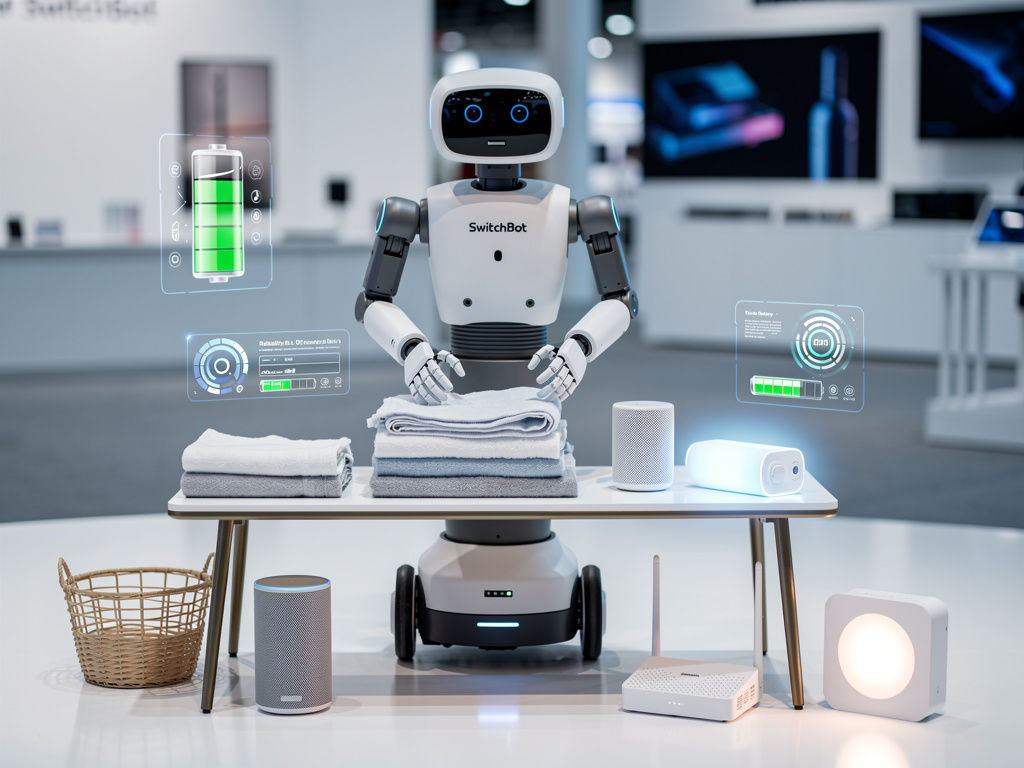
In the bustling halls of CES 2026, where the future of consumer technology unfolds amid flashing lights and ambitious demos, SwitchBot made a bold entrance into the realm of humanoid robotics. The company, long known for its affordable smart home gadgets like automated curtains and locks, unveiled the Onero H1, a wheeled robot designed to tackle everyday household chores with a blend of AI smarts and mechanical dexterity. This isn’t just another vacuum bot or security camera on wheels; it’s pitched as a versatile “robot butler” that could redefine how we interact with our living spaces. Drawing from recent announcements, the Onero H1 promises to handle tasks from laundry folding to object manipulation, all while integrating seamlessly with SwitchBot’s existing ecosystem.
At its core, the Onero H1 stands about 1.3 meters tall, equipped with two articulated arms offering 22 degrees of freedom, allowing for precise movements that mimic human-like actions. It’s powered by an on-device AI model called OmniSense VLA, which processes visual, depth, and tactile data to understand and interact with the environment. Unlike specialized robots that excel in one area—say, mopping floors—the Onero H1 is built for adaptability, learning from user interactions and coordinating with other devices like SwitchBot’s vacuum cleaners or smart hubs. This shift toward embodied AI, where robots don’t just follow scripts but adapt to real-world scenarios, marks a significant evolution in home automation.
Early reports from the show floor highlight its potential in mundane but time-consuming tasks. For instance, the robot can sort laundry, pick up scattered items, or even deliver snacks from the kitchen to the couch. SwitchBot’s CEO emphasized during the keynote that the Onero H1 isn’t meant to replace human effort entirely but to augment it, especially for aging populations or busy households. Priced competitively—rumors suggest around $1,500 upon release later this year—it’s positioned as an accessible entry into advanced robotics, not the ultra-premium territory occupied by competitors like Tesla’s Optimus.
Unveiling at CES: Technical Specifications and AI Integration
To grasp the Onero H1’s capabilities, one must delve into its hardware. The robot features a wheeled base for mobility, eschewing legs for stability and cost-efficiency, much like early models from other firms. Its arms, with multiple joints, enable fine-motor skills such as grasping delicate objects or folding clothes. Integrated cameras provide 360-degree vision, while depth sensors help navigate cluttered spaces without collisions. According to details shared in a press release from PR Newswire, the on-device processing ensures privacy, as data isn’t constantly uploaded to the cloud, addressing growing concerns in the smart home sector.
The AI backbone, OmniSense VLA, is a visual-language-action model that allows the robot to interpret commands in natural language. Users might say, “Fold the towels in the basket,” and the Onero H1 would use its sensors to locate, identify, and manipulate the items. This is a step up from voice assistants like Alexa, which direct other devices but lack physical agency. SwitchBot claims the robot can learn new tasks through demonstration, a feature reminiscent of machine learning techniques in industrial robotics but scaled down for consumer use.
Integration with SwitchBot’s broader lineup is a key selling point. The Onero H1 can team up with the company’s robot vacuums for coordinated cleaning or sync with smart locks for security patrols. As noted in coverage from Android Authority, this ecosystem approach could give SwitchBot an edge over standalone robots, fostering a “smart home 2.0” where devices collaborate intelligently.
Market Context and Competitive Challenges
The timing of the Onero H1’s debut couldn’t be more strategic. The home robotics field is heating up, with players like LG unveiling their own AI agents and startups pushing boundaries in embodied intelligence. SwitchBot, a Chinese firm founded in 2016, has built its reputation on budget-friendly IoT devices, amassing a user base through platforms like Amazon. Now, venturing into humanoid forms, it aims to capture a slice of a market projected to grow exponentially, driven by advancements in AI and declining component costs.
However, challenges abound. Early demos at CES, as reported by The Verge, showed the robot capably folding laundry but struggling with unpredictable elements like wrinkled fabrics or uneven surfaces. Reliability in diverse home environments—think narrow apartments or homes with pets—remains a hurdle. Battery life is another concern; the Onero H1 reportedly lasts about four hours on a charge, necessitating frequent docking, which could limit its utility for all-day assistance.
Competition is fierce. Tesla’s Optimus, still in prototype stages, promises more advanced bipedal movement, while Amazon’s Astro focuses on security and companionship. SwitchBot differentiates by emphasizing affordability and integration, but scaling production and ensuring software updates will be crucial. Industry insiders whisper about potential partnerships, perhaps with AI giants like Google, to enhance the robot’s learning capabilities.
Consumer Reactions and Social Media Buzz
Public sentiment, gleaned from posts on X (formerly Twitter), paints a picture of excitement mixed with skepticism. Users have shared videos of similar multitasking robots, praising the convenience of having a device that vacuums, monitors pets, and delivers items without human intervention. One viral thread highlighted how such bots could transform elderly care, allowing independent living with robotic support. However, concerns about job displacement in domestic services and privacy risks from always-on cameras echo in discussions, reflecting broader societal debates on AI’s role in homes.
SwitchBot has actively engaged this buzz, with company accounts retweeting user concepts for the Onero H1, such as using it for light cooking prep or organizing closets. This grassroots enthusiasm contrasts with more measured takes from tech reviewers, who note that while the hardware impresses, the AI’s real-world adaptability needs proving beyond controlled demos.
In deeper dives, experts point to the robot’s tactile feedback system as a game-changer. By sensing pressure and texture, the Onero H1 avoids damaging fragile items, a common pitfall in earlier robots. Coverage from Android Headlines details how this integrates with 3D face-mapping locks unveiled alongside, creating a cohesive smart home suite where the robot could, theoretically, unlock doors for deliveries or guests.
Broader Implications for Home Automation
Looking ahead, the Onero H1 embodies a pivot toward multi-functional robotics that could disrupt traditional appliances. Imagine a future where one device replaces a vacuum, a security system, and a personal assistant. SwitchBot’s vision, as articulated in a Morningstar report via Morningstar, is to make embodied AI commonplace, starting with accessible pricing to democratize the technology.
Yet, regulatory hurdles loom. In the U.S., safety standards for home robots are evolving, with agencies like the Consumer Product Safety Commission scrutinizing AI-driven devices for risks like hacking or malfunctions. SwitchBot, operating globally, must navigate varying privacy laws, especially in Europe under GDPR.
Economically, the robot could boost productivity in households, freeing time for work or leisure. Analysts estimate that widespread adoption might add billions to the smart home market, currently dominated by giants like Google and Apple. For SwitchBot, success hinges on user feedback loops—software updates based on real usage data—to refine the Onero H1’s performance.
Innovation Drivers and Future Roadmap
Behind the scenes, SwitchBot’s R&D draws from open-source advancements in mobile manipulation, as seen in academic papers on open-vocabulary tasks. This allows the robot to handle “any object in any environment,” a lofty goal that requires robust training data. The company’s investment in AI, reportedly over $50 million in the past year, underscores its commitment.
Critics, however, question longevity. Will the Onero H1 become obsolete as AI evolves, or will modular designs allow upgrades? SwitchBot hints at expandable arms and software ecosystems, potentially future-proofing the device.
For industry insiders, the real intrigue lies in supply chain dynamics. Sourcing components like actuators and sensors from Asia gives SwitchBot a cost advantage, but geopolitical tensions could disrupt this. Partnerships with chipmakers for efficient on-device AI will be key to maintaining edge over rivals.
Societal Impact and Ethical Considerations
As robots like the Onero H1 enter homes, ethical questions arise. Who bears responsibility if the robot damages property or invades privacy? SwitchBot addresses this with opt-in data sharing and transparent AI decision-making, but broader industry standards are needed.
On the positive side, accessibility features could aid those with disabilities, enabling tasks like retrieving items from high shelves. Posts on X celebrate this, with users envisioning customized bots for specific needs.
Ultimately, the Onero H1 represents a tangible step toward AI companions that blend into daily life. While not perfect, its debut at CES 2026 signals SwitchBot’s ambition to lead in this emerging domain, challenging established players and inviting consumers to rethink the boundaries of home technology.
Path Forward: Adoption and Evolution
Adoption will depend on real-world testing. Beta programs, planned for mid-2026, will gather data to iterate on the design. Early adopters, likely tech enthusiasts, could shape its trajectory through forums and reviews.
In comparison to peers, as explored in Homecrux, the Onero H1’s wheeled design prioritizes practicality over humanoid aesthetics, potentially accelerating market entry.
For now, as CES wraps, the buzz around SwitchBot’s creation underscores a pivotal moment: robotics moving from novelty to necessity in modern living. With refinements, the Onero H1 might just become the household staple its makers envision, bridging the gap between sci-fi dreams and everyday reality.


 WebProNews is an iEntry Publication