
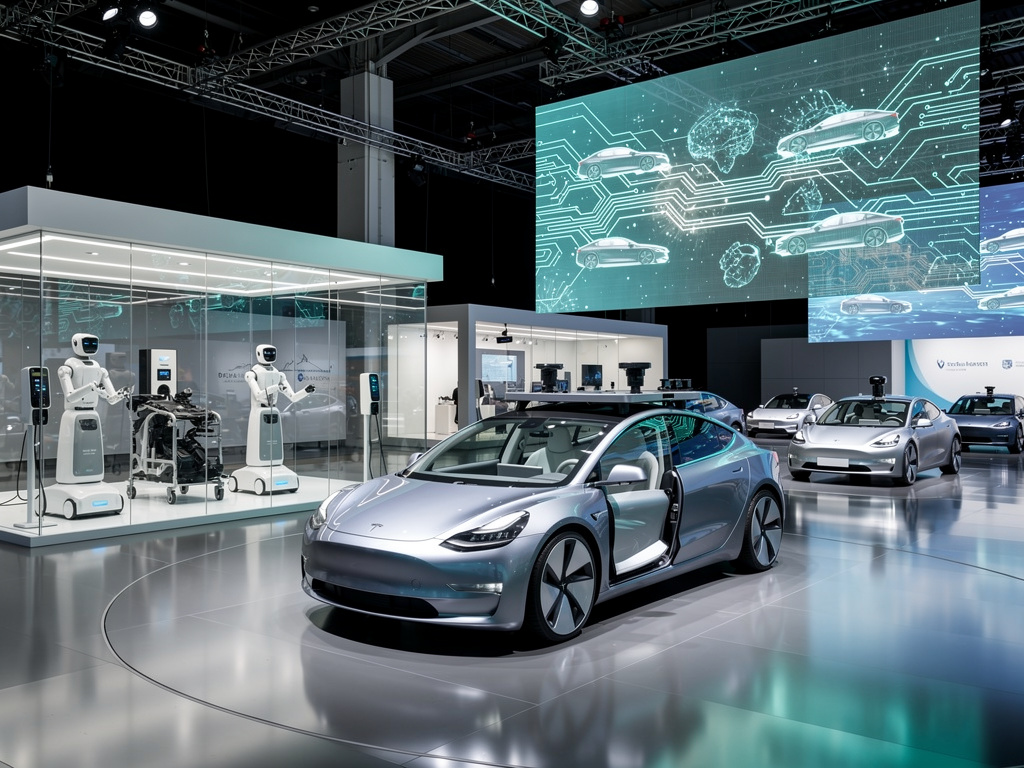
Robotaxis Eclipse EVs: AI’s Triumphant March at CES 2026
As the neon lights of Las Vegas illuminated the opening of CES 2026, a palpable shift was underway in the automotive sector. Gone were the days when electric vehicles dominated the show floor with flashy prototypes and bold range promises. Instead, autonomous driving technologies and artificial intelligence integrations took center stage, signaling a pivot toward smarter, self-reliant mobility solutions. Industry executives and investors alike buzzed about the potential of AI to overcome longstanding hurdles in autonomous vehicles, from regulatory barriers to safety concerns.
This year’s event, held from January 6 to 9, showcased a flurry of announcements that underscored the growing emphasis on robotaxis—fully autonomous vehicles designed for ride-sharing without human intervention. Companies like Lucid Group, Nuro, and Uber unveiled a production-intent robotaxi, a collaboration that promises to bring Level 4 autonomy to urban streets as early as later this year. According to reports from Reuters, the vehicle features advanced sensor suites and AI-driven navigation, marking a significant step toward commercial deployment.
The enthusiasm stems from recent advancements in AI, which investors believe can accelerate the development of self-driving tech amid previous setbacks like high costs and incidents. As one analyst noted, the integration of generative AI models could enhance decision-making in complex driving scenarios, potentially reducing errors that have plagued earlier prototypes.
Shifting Priorities in Auto Innovation
Beyond the Lucid-Nuro-Uber partnership, Nvidia made headlines with its announcements at CES, revealing plans to power robotaxi fleets with specialized chips and software by 2027. The company’s CEO, Jensen Huang, emphasized robotics as a key growth area, second only to AI itself. Details from CNBC highlight Nvidia’s Alpamayo family of open-source AI models aimed at fostering safer autonomous vehicle development through collaborative tools.
This focus on AI extends to humanoid robots and physical AI applications, as seen in Nvidia’s broader CES showcase. The company also announced initiatives for humanoid robots, blending AI with mechanical engineering to create assistants that could complement autonomous vehicles in logistics and delivery. Such integrations point to a future where AI not only drives cars but also manages entire ecosystems of mobility services.
Meanwhile, traditional automakers appeared to dial back on pure EV concepts, opting instead for enhancements that incorporate AI for better user experiences. For instance, ZF Group and Qualcomm’s collaboration, as posted on X by industry analysts, involves developing next-generation computing platforms for autonomous driving, suggesting a convergence of hardware and software innovations.
The Rise of Physical AI in Mobility
Delving deeper, the CES narrative revealed a broader trend toward “physical AI,” a term gaining traction for AI systems that interact with the real world. InsideEVs described this era as transformative for the auto industry, with exhibits featuring robotaxis equipped with advanced perception systems that learn from vast datasets to navigate unpredictable environments.
One standout reveal was the adaptation of Lucid’s Gravity SUV into a robotaxi platform, complete with roof-mounted sensors including cameras, lidar, and radars powered by Nvidia’s DRIVE AGX Thor compute. Posts on X from automotive enthusiasts highlighted the vehicle’s Level 4 capabilities, which allow it to operate without human oversight in designated areas, a leap forward from current ride-hailing services.
This shift away from concept EVs toward practical AI applications reflects market realities. With EV adoption facing headwinds like charging infrastructure limitations and consumer hesitancy, companies are betting on autonomy to reinvigorate interest. As The Verge observed, CES 2026 largely ditched elaborate car concepts in favor of AI-powered self-driving features and even humanoid robots wandering the show floor.
Investor Bets and Regulatory Realities
Investors are pouring funds into these technologies, optimistic that AI can address the slow progress that has characterized the autonomous vehicle space. Reuters reported that self-driving tech is expected to dominate discussions, with AI seen as a catalyst to mitigate high costs and safety incidents that have drawn regulatory scrutiny.
For example, Nvidia’s push includes testing a robotaxi service in 2027, leveraging its expertise in AI chips to create scalable solutions for fleets. This aligns with broader industry efforts, such as those from Tesla, which, though not directly at CES, influenced the conversation through prior events like its “We, Robot” unveiling of the Cybercab—a steering-wheel-free vehicle priced around $30,000, as detailed in various X posts recapping its features.
However, challenges remain. Regulatory approval for widespread robotaxi deployment varies by region, with safety standards demanding rigorous testing. Industry insiders at CES discussed how AI’s ability to simulate millions of driving miles could expedite this process, but concerns about data privacy and ethical AI decision-making persist.
Collaborations Driving Future Mobility
Partnerships emerged as a key theme, exemplified by the Lucid-Nuro-Uber robotaxi. This vehicle not only boasts 360-degree high-resolution sensors but also innovative features like halo LEDs displaying rider initials, enhancing the user experience in shared mobility. X users noted the premium in-cabin tech, suggesting a luxury angle to autonomous ride-hailing.
Similarly, Sony Honda Mobility teased updates to its Afeela EV with AI integrations, while BMW showcased concepts blending EVs with autonomous capabilities. These efforts indicate that while EVs aren’t disappearing, they’re evolving to incorporate AI as a core component rather than a mere add-on.
The sentiment on X reflects excitement, with posts praising the “insane” tech drops, including solid-state batteries and robotaxi launches. Yet, experts caution that true scalability depends on overcoming infrastructure barriers, such as widespread 5G connectivity for real-time AI processing.
Humanoid Robots and Broader Implications
Extending beyond vehicles, CES 2026 highlighted humanoid robots as companions to autonomous tech. Nvidia’s announcements in this area, covered by Yahoo Finance, include AI models that enable robots to perform tasks like package handling, potentially integrating with robotaxi fleets for end-to-end delivery services.
This convergence raises questions about job displacement in transportation sectors, but proponents argue it could enhance efficiency and safety. For instance, autonomous cleaning features in robotaxis, as seen in Tesla’s designs and echoed in CES exhibits, promise lower operational costs.
Moreover, the event featured discussions on voice assistants and large language models in vehicles, drawing parallels to Tesla’s Grok integration. Such features could personalize rides, from route optimization to entertainment, making autonomy more appealing to consumers.
Economic and Societal Impacts Ahead
Economically, the pivot to AI-driven mobility could reshape urban planning, with robotaxis reducing the need for personal car ownership. Analysts project that by 2030, autonomous vehicles might capture a significant share of the ride-sharing market, valued in trillions.
Socially, accessibility improves for non-drivers, including the elderly and disabled, but equity concerns arise regarding service availability in underserved areas. CES panels addressed these, emphasizing inclusive AI design.
Looking forward, the innovations at CES 2026 suggest a maturing field where AI not only powers vehicles but redefines transportation paradigms. As companies like Nvidia and Lucid push boundaries, the coming years will test whether these technologies can deliver on their promises amid evolving regulations and market demands.
Industry Voices and Forward Outlook
Industry voices at CES echoed optimism tempered with realism. One executive from ZF Group, in collaboration with Qualcomm, shared on X how their joint efforts aim to standardize AI platforms for broader adoption.
Comparisons to past CES events, like those covered by CNET, note the progression from flying car prototypes to practical AI implementations, indicating a grounded approach.
Ultimately, CES 2026 marks a watershed moment, where AI’s ascendancy over traditional EV hype signals a more intelligent path forward for mobility. With robotaxis on the horizon, the industry stands poised for transformation, driven by innovation and strategic collaborations.


 WebProNews is an iEntry Publication