
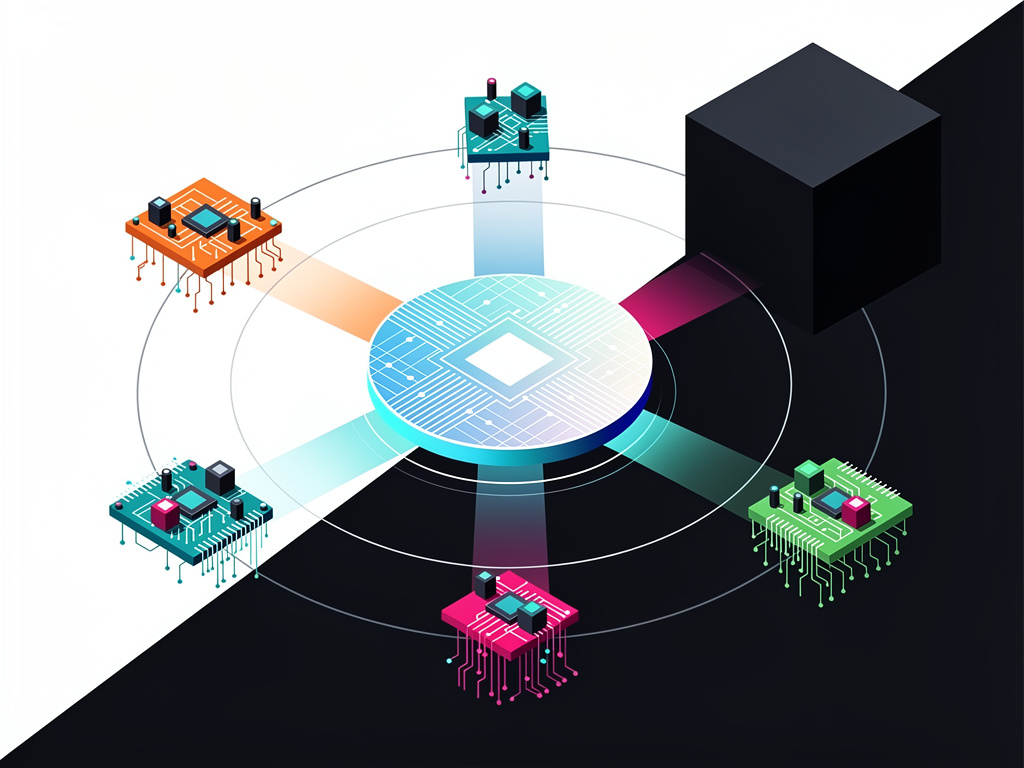
Andrew Feldman stood before an audience at the Bloomberg Tech conference in San Francisco on June 4 and delivered a message that cut through the usual corporate caution. Cerebras Systems, the company he leads, stands ready to partner with every major player supplying components for AI data centers. Everyone, that is, except one. “The AI chipmaker is working with everyone apart from Nvidia Corp.,” Feldman said, according to a report in Bloomberg.
The declaration comes days after Cerebras wrapped up the largest technology initial public offering of 2026. Shares surged nearly 70 percent on their first day of trading in mid-May before pulling back. The offering raised $5.55 billion and briefly pushed the company’s valuation above $60 billion. Investors piled in. They bet that demand for alternatives to Nvidia’s graphics processors has grown intense enough to support a standalone powerhouse focused on massive, wafer-scale chips.
But the stance toward Nvidia reveals more than marketing bravado. It signals a deliberate strategy to organize the fragmented opposition. Cerebras doesn’t just sell its own hardware. It aims to integrate into broader systems built around processors from AMD, custom silicon from cloud providers, and other specialized accelerators. The Amazon partnership offers the template. There, Cerebras CS-3 systems sit alongside Amazon’s Trainium chips in a disaggregated setup. Trainium manages the compute-heavy prefill stage of inference. Cerebras handles the memory-bandwidth-intensive decode phase where its on-chip SRAM delivers clear speed advantages.
Feldman didn’t frame the exclusion as hostility. He presented it as practical reality. Nvidia already dominates. Its CUDA software platform locks in developers and data scientists. Most organizations build their AI infrastructure assuming Nvidia hardware will sit at the center. Why help the incumbent expand its reach? Instead, Cerebras courts the rest of the field. Partnerships with Oracle, IBM, the U.S. Department of Energy, Cognition, and Mistral illustrate the point. OpenAI stands out as the marquee customer. The ChatGPT maker committed more than $10 billion in compute capacity through 2028, according to Reuters. It even extended a $1 billion loan backed by warrants that could yield the startup 33 million shares.
That relationship highlights both the opportunity and the constraints. As detailed in a TechCrunch analysis of Cerebras’ S-1 filing, the OpenAI deal includes temporary restrictions. Cerebras agreed not to sell certain capacity to specific OpenAI rivals during the loan period. Feldman declined to name names but acknowledged the obvious candidate: Anthropic. “It’s limited in time,” he told the publication. The arrangement gives OpenAI priority access while Cerebras scales production.
The wafer-scale approach sets Cerebras apart from conventional designs. Traditional chips get diced from silicon wafers into hundreds of smaller dies. Interconnects between those dies create bottlenecks, especially for models that demand rapid movement of massive amounts of data. Cerebras keeps the entire wafer intact. The latest WSE-3 contains more than a million cores and vast amounts of on-chip SRAM. Memory sits right next to compute. Latency drops. Throughput climbs. Independent tests and customer reports show the CS-3 delivering 2,500 tokens per second per user on a 400-billion-parameter Llama model. That figure more than doubles what Nvidia’s DGX B200 Blackwell systems achieve on identical workloads, according to technical comparisons circulating in industry research.
Yet Cerebras nearly collapsed before it could prove the concept. In 2019 the company burned through $8 million a month. It had “incinerated nearly $200 million” solving packaging and manufacturing challenges for a chip 58 times larger and 40 times more power-hungry than anything the industry had attempted. Engineers destroyed wafer after wafer before inventing a novel multi-screw bolting system that finally worked. The team gathered around a monitor in July of that year and watched the first functional giant chip come alive. Survival depended on landing the right customers at the right moment. A major contract with G42 in the United Arab Emirates provided a lifeline, though it later complicated the original IPO attempt due to national security reviews.
The 2026 public debut looks different. Revenue reached $510 million last year, up 75 percent, and the company swung to a $238 million annual profit. Those figures come from the prospectus filed with regulators and covered by The New York Times. Still, the business remains capital intensive. Building out cloud capacity to offer inference-as-a-service requires heavy spending. Post-IPO share price swings reflect that tension. The stock opened near $350, hit $385, then closed its first day at $311 before sliding further in subsequent sessions.
Analysts debate whether wafer-scale economics can scale. Each CS-3 system consumes about 25 kilowatts and carries an estimated price tag between $2 million and $3 million. Power delivery, cooling, and yield management present persistent headaches. Nvidia, by contrast, benefits from mature supply chains, broad software support, and decades of iterative improvement. Its acquisition of Groq brings SRAM-based inference technology in-house, creating a combined offering that could blunt some of Cerebras’ edge in latency-sensitive workloads.
And yet the market shows unmistakable hunger for options. Hyperscalers and AI labs worry about over-reliance on a single supplier. Export controls, geopolitical tensions, and raw production limits on advanced chips only heighten those concerns. TSMC executives have warned that supply won’t meet AI-driven demand for years. In that environment, a credible second source gains strategic value. Feldman positioned Cerebras exactly there. The company won’t try to replace Nvidia everywhere. It will carve out the workloads where its architecture delivers unmistakable gains and partner with others to fill the remaining gaps.
OpenAI’s decision to debut a model running on Cerebras chips, reported by Bloomberg in February, sent a powerful signal. The world’s leading AI lab now validates multiple hardware paths. AWS integration inside Bedrock does the same for enterprise users. These wins accumulate. They build the case that a non-Nvidia stack can achieve production scale.
Challenges remain. Developers must adapt code for the new hardware. Inference APIs help abstract some differences, but deep optimization still demands expertise. Cerebras counters with strong performance numbers and the promise of lower total cost on targeted tasks. Early customers report 6 times higher inference speeds than Groq’s LPU systems on frontier models, along with better accuracy and lower power draw at comparable prices. Such claims appear in Cerebras’ own technical blogs but find echoes in third-party benchmarks.
The IPO proceeds will fund further expansion. More fabrication runs. Larger cloud clusters. Software tools that ease adoption. Feldman and co-founder Andrew Feldman, now both billionaires, have skin in the game. Their early brush with failure taught patience and focus. The current moment rewards bold architecture bets. Demand for AI compute grows faster than any single company can satisfy.
So Cerebras presses its advantage. It works with AMD on hybrid clusters. It collaborates with custom ASIC developers. It supplies national labs pursuing sovereign AI capabilities. Each relationship reinforces the narrative that the industry has room for specialists. Nvidia retains the lion’s share. Its ecosystem moat looks formidable. But concentration risk has become a boardroom topic. Executives seek hedges. Feldman offers one. Not through confrontation, but through selective cooperation that leaves the dominant player on the outside.
Whether that approach sustains a $60 billion company depends on execution. Performance must stay ahead. Costs must come down. Software barriers must erode. The recent stock volatility serves as reminder that public markets demand proof, not promises. Yet the initial pop and the flood of inbound interest during the roadshow suggest investors see the logic. In an age of trillion-parameter models and insatiable appetite for tokens, one giant chipmaker may not suffice. The rest of the hardware buffet needs a coordinator. Cerebras just volunteered.


 WebProNews is an iEntry Publication