
Sky-High Connectivity Clash: Why Mobile Networks Are Outpacing Wi-Fi at America’s Busiest Airports
In the bustling terminals of U.S. airports, where travelers juggle layovers and last-minute emails, the quest for reliable internet has become a high-stakes game. Recent data reveals a surprising twist: cellular networks are increasingly leaving traditional Wi-Fi in the dust, offering faster speeds and more consistent performance. This shift is reshaping how passengers stay connected, prompting a reevaluation of old habits like automatically joining free airport hotspots. As air travel surges post-pandemic, with millions passing through hubs like Atlanta’s Hartsfield-Jackson or Los Angeles International, the demand for seamless data access has never been higher.
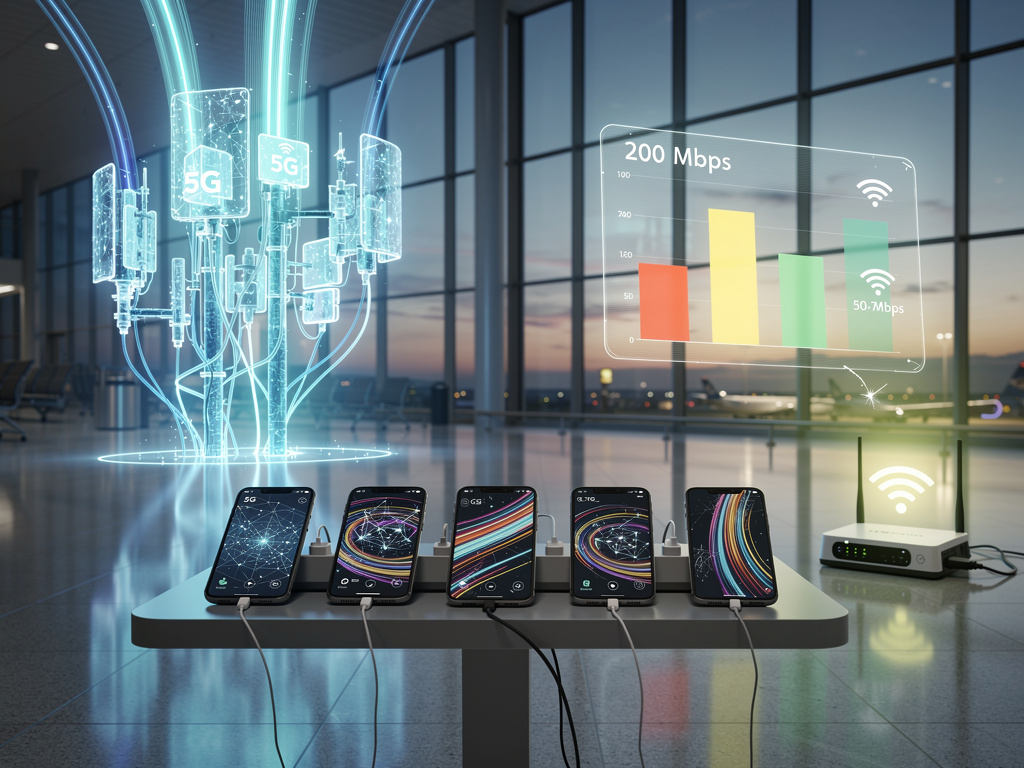
At the heart of this transformation is a comprehensive analysis from speed-testing firm Ookla, which examined performance across the 20 busiest U.S. airports. Their findings, detailed in a report from Ookla, show that mobile carriers delivered median download speeds of up to 200 Mbps in some locations, far surpassing the often sluggish Wi-Fi offerings. For instance, at Chicago’s O’Hare International Airport, cellular options clocked in at averages well above 150 Mbps, while Wi-Fi lagged behind with inconsistent connections plagued by overcrowding and outdated infrastructure.
This isn’t just about raw numbers; it’s about real-world usability. Travelers report smoother streaming, quicker file uploads, and fewer interruptions when relying on their phone’s data plan rather than public networks. Industry experts point to advancements in 5G technology as a key driver, with carriers investing billions to bolster coverage in high-traffic areas like airports. Yet, this evolution raises questions about the future role of Wi-Fi, which has long been marketed as a complimentary perk but now faces scrutiny for its vulnerabilities, including security risks and bandwidth limitations.
Carrier Showdown: Verizon Takes the Lead in Airport Dominance
Among the major players, Verizon emerges as the frontrunner, topping the charts at 16 out of 20 airports surveyed. According to insights from Android Authority, Verizon’s network achieved blistering speeds, such as 240 Mbps at New York’s JFK, thanks to its extensive deployment of mid-band spectrum and small-cell technology tailored for dense environments. This dominance isn’t accidental; Verizon has poured resources into airport-specific enhancements, including partnerships with infrastructure providers to embed antennas directly into terminal structures.
T-Mobile, often hailed for its nationwide 5G rollout, secures second place in many locations, with strong showings at airports like Denver International, where it averaged 180 Mbps. The carrier’s use of low-band frequencies ensures better penetration through walls and crowds, making it a reliable choice for indoor connectivity. AT&T, while competitive, trails in several key metrics, particularly in upload speeds, which are crucial for video calls or sharing large files during delays.
What sets these cellular performances apart is their consistency across peak hours. Unlike Wi-Fi, which can degrade as more users log on, mobile networks leverage dynamic spectrum allocation to maintain quality. This reliability is echoed in user anecdotes shared across social platforms, where travelers praise the ability to conduct business seamlessly without the frustration of buffering or dropped signals. As one frequent flyer noted in online discussions, the difference feels like upgrading from dial-up to fiber-optic in the sky-bound chaos of an airport lounge.
Wi-Fi’s Waning Edge: Security Concerns and Performance Gaps
Public Wi-Fi at airports, once a lifeline for budget-conscious travelers, is now under fire for more than just speed. Security experts warn of inherent risks, such as man-in-the-middle attacks where hackers intercept data on unsecured networks. A recent advisory from cybersecurity firms highlights how airport hotspots, often managed by third-party vendors, lack robust encryption, making them prime targets for data theft. This vulnerability is particularly acute in international terminals, where global travelers might unknowingly expose sensitive information.
Performance-wise, the data paints a stark picture. Ookla’s analysis indicates that Wi-Fi median speeds hover around 50-70 Mbps at best in major hubs, a fraction of what cellular can provide. Factors like outdated routers and high user density contribute to this lag, with some airports still relying on legacy systems installed over a decade ago. Efforts to upgrade, such as those at San Francisco International, involve rolling out Wi-Fi 6E, but adoption is uneven, leaving many passengers frustrated.
Moreover, the economic model of airport Wi-Fi is shifting. While free access is common, premium tiers for faster speeds are emerging, yet they often fail to compete with unlimited data plans from carriers. This disparity is prompting airports to rethink partnerships, potentially integrating cellular boosters or hybrid systems to bridge the gap. Industry insiders suggest that without significant investments, Wi-Fi could become a relic, overshadowed by the ubiquity of 5G.
Regional Variations: How Airport Size and Location Influence Speeds
Not all airports are created equal in this connectivity contest. Mega-hubs like Dallas/Fort Worth International benefit from their sprawl, allowing carriers to deploy more towers and achieve peaks of 250 Mbps on Verizon’s network. In contrast, more compact facilities like Newark Liberty face challenges from urban interference, where speeds dip but still outpace Wi-Fi by a wide margin. Geographic factors play a role too; coastal airports often see better performance due to proximity to carrier backbones, while inland ones lag in infrastructure upgrades.
Drilling down into specific examples, Las Vegas’s Harry Reid International stands out for its entertainment-driven traffic, where high data demands for streaming and gaming push carriers to excel. Here, T-Mobile’s edge in low-latency connections makes it ideal for real-time applications. Conversely, at smaller yet busy spots like Orlando International, family-oriented crowds strain networks, but recent 5G expansions have mitigated bottlenecks, as noted in carrier reports.
These variations underscore a broader trend: airports in tech-savvy regions, such as those on the West Coast, are quicker to adopt innovations. For instance, Seattle-Tacoma International has piloted integrated cellular-Wi-Fi meshes, blending the best of both worlds to deliver hybrid speeds approaching 300 Mbps. Such experiments could set precedents for nationwide improvements, influencing how operators allocate spectrum in regulated environments.
In-Flight Extensions: Bridging Ground and Air Connectivity
The superiority of cellular at airports naturally extends to in-flight experiences, where emerging technologies like Starlink are revolutionizing Wi-Fi aloft. Posts from travelers on platforms like X highlight speeds exceeding 300 Mbps on Starlink-equipped flights, a quantum leap from traditional satellite systems. United Airlines, an early adopter, reports passenger satisfaction soaring with latency under 30 milliseconds, enabling everything from video conferences to live gaming mid-air.
This ground-to-air continuity is crucial for business travelers who need uninterrupted workflows. Carriers like Delta and American are following suit, announcing rollouts of high-speed in-flight options by 2026, often powered by satellite networks that rival terrestrial broadband. Insights from Business Traveller rank these services, with Starlink leading the pack for its global coverage and reliability.
However, challenges remain, including regulatory hurdles for satellite integration and the cost of retrofitting aircraft. As more airlines commit, the ripple effect could pressure airports to enhance their ground networks, creating a seamless ecosystem from check-in to cruising altitude.
Future Horizons: Investments and Innovations Shaping Airport Networks
Looking ahead, the battle for airport supremacy is fueling massive investments. Verizon’s $10 billion commitment to 5G infrastructure includes targeted airport enhancements, aiming for ubiquitous millimeter-wave coverage by 2027. T-Mobile, leveraging its merger with Sprint, is expanding mid-band spectrum to handle surging data loads, as detailed in Ookla’s quarterly reports on fixed wireless access.
Emerging technologies like private 5G networks are also gaining traction, allowing airports to create dedicated lanes for operational needs while boosting public access. Partnerships with tech giants, such as Google’s involvement in smart airport initiatives, promise AI-driven optimizations that predict and alleviate congestion.
For consumers, this means more choices but also the need for savvy decision-making. Unlimited data plans with airport perks are becoming standard, encouraging a shift away from risky Wi-Fi. As one analyst from ZDNET observed in their 2025 carrier rankings, available at ZDNET, the focus is on holistic performance, where speed meets security and reliability.
Global Comparisons and Lessons for U.S. Airports
While U.S. airports lead in cellular prowess, international benchmarks offer valuable insights. A global study from Ookla, found at Ookla’s global report, shows Asian hubs like Seoul’s Incheon achieving Wi-Fi speeds over 100 Mbps through aggressive fiber deployments. European airports, such as London’s Heathrow, blend cellular and Wi-Fi effectively, often outperforming American counterparts in latency.
These examples highlight opportunities for U.S. improvements, including federal incentives for infrastructure grants. The FAA’s push for modernized air traffic systems indirectly supports better connectivity, tying into broader digital transformations.
Ultimately, as travel volumes climb toward pre-2020 levels, the emphasis on robust networks will define passenger experiences. Carriers that adapt swiftly will capture loyalty, while laggards risk obsolescence in an era where connectivity is as essential as the flight itself.
Strategic Implications for Travelers and Industry Players
For industry insiders, this data signals a pivot toward cellular-centric strategies. Airports might renegotiate Wi-Fi contracts, favoring vendors that integrate with mobile ecosystems. Carriers, in turn, could bundle airport-specific boosts into premium plans, monetizing their edge.
Travelers, armed with this knowledge, are ditching Wi-Fi for data, especially with VPNs adding security layers. Social sentiment on X reflects growing awareness, with users sharing speed tests that validate carrier claims.
In this evolving arena, the winners will be those who prioritize innovation, ensuring that staying connected at 30,000 feet starts firmly on the ground.


 WebProNews is an iEntry Publication