
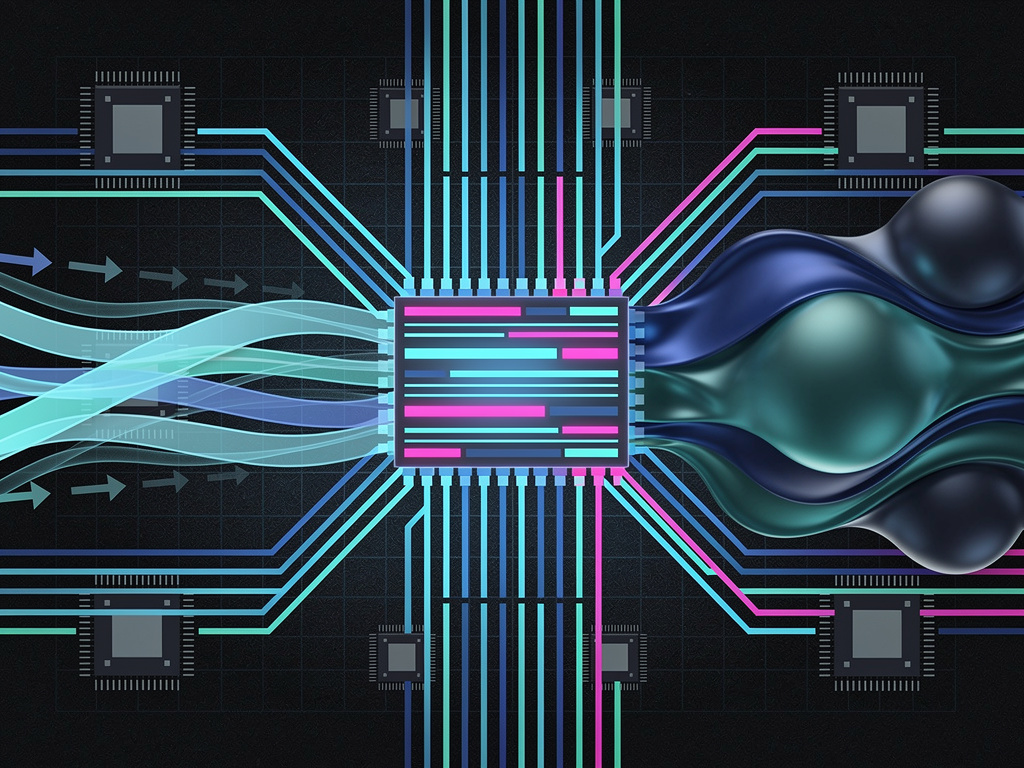
Bandwidth demands in AI data centers just hit a new peak. Celestica Inc. started taking orders this week for its DS6000-series switches, each cramming 64 ports of 1.6 terabits per second into a single box. That’s 102.4 Tbps of non-blocking capacity, powered by Broadcom’s Tomahawk 6 silicon—the first chip with 200 Gbps SerDes lanes.
Each OSFP224 port aggregates eight 200 Gbps links. Breakout cables let operators split them for more connections. The lineup includes a 3U air-cooled model for standard 19-inch racks and a 2OU hybrid-cooled version for 21-inch OCP ORv3 setups. Both target the backend networks of AI factories, where massive GPU clusters train models without choking on data flows.
Celestica’s move comes as hyperscalers race to scale. Nvidia’s ConnectX-9 superNICs deliver 1.6 Tbps across two 800 Gbps links for redundancy. AMD pairs its MI455X GPUs with three 800 Gbps Pensando Vulcano NICs per card. These setups demand switches that match the pace. The Register called it a boon for bandwidth hogs.
Tomahawk 6 Fuels the Speed Surge
Broadcom’s Tomahawk 6 ASIC anchors the DS6000. It packs 102.4 Tbps throughput, doubling prior generations. The 200 Gbps SerDes enables those fat 1.6 Tbps ports. Celestica supports copper and optical interconnects, plus Ultra Ethernet Consortium and OCP ESUN standards for scale-up and scale-out.
“The DS6000-series is available in two versatile form factors to match specific cooling infrastructures,” the company said in its April 29 press release. Orders opened immediately for early customers. This follows Celestica’s earlier 800G lineup, like the DS5000 with 51.2 Tbps across 64 ports on Tomahawk 5. Now, 1.6T doubles down.
AI training clusters can’t afford bottlenecks. A single DS6000 handles the flood from thousands of GPUs. Liquid cooling options fit dense racks where air alone fails. Open-source SONiC compatibility gives operators software choice—no vendor lock-in.
But speed has limits. PCIe 6.0 caps NICs at 800 Gbps on x16 slots. Future 400 Gbps SerDes could push 3.2 Tbps ports, though full 204.8 Tbps switches wait on optical DSP advances. Celestica eyes that horizon. Its recent Q1 2026 earnings flagged a co-packaged optics Ethernet switch win with a hyperscaler, ramping in 2027 using 1.6T silicon and liquid cooling, per Celestica’s investor site.
Industry chatter backs the hype. On X, @allday_stocks noted the launch: “DS6000-series now available to order… Supports SONiC and open networking standards.” alldaystocks. HPCwire echoed the details hours later.
From 800G Foundations to 1.6T Dominance
Celestica didn’t stumble into this. Its 800G switches, like DS5000 and DS4100, shipped 1.6 million ports in Q1 2025 alone, grabbing top market share per Dell’Oro. Revenue from 800G platforms jumped 82% year-over-year in Q2 2025. Partnerships followed: AMD tapped Celestica in March 2026 for Helios rack-scale switches using OCP and Ultra Accelerator Link over Ethernet for MI450 GPUs, as reported by Yahoo Finance.
And supply chains align. Hyperscalers awarded Celestica a second 1.6T program ramping this year, complete with advanced cooling racks. CEO Rob Mionis highlighted 800G success giving an edge in upgrades. Stock dipped post-Q1 earnings despite 53% revenue growth and 80% EPS rise—market priced in the boom, watching free cash flow and ramps.
Competition heats up. Broadcom’s chip leads, but optics bottlenecks loom—InP lasers for 800G/1.6T transceivers face shortages into 2028. Celestica’s open designs help. DS6000 ports flex from 50GbE to 800GbE, with LPO/LRO optics support.
Operators get flexibility. Air-cooled for legacy sites. Hybrid for power-hungry AI halls. Every port configurable. That’s the pitch to cloud giants building million-GPU clusters.
So where next? Celestica’s CPO program signals silicon photonics integration, slashing power and latency. Production hits 2027. Meanwhile, DS6000 ships now. AI infrastructure demands don’t pause. Celestica just loaded the next clip.


 WebProNews is an iEntry Publication