
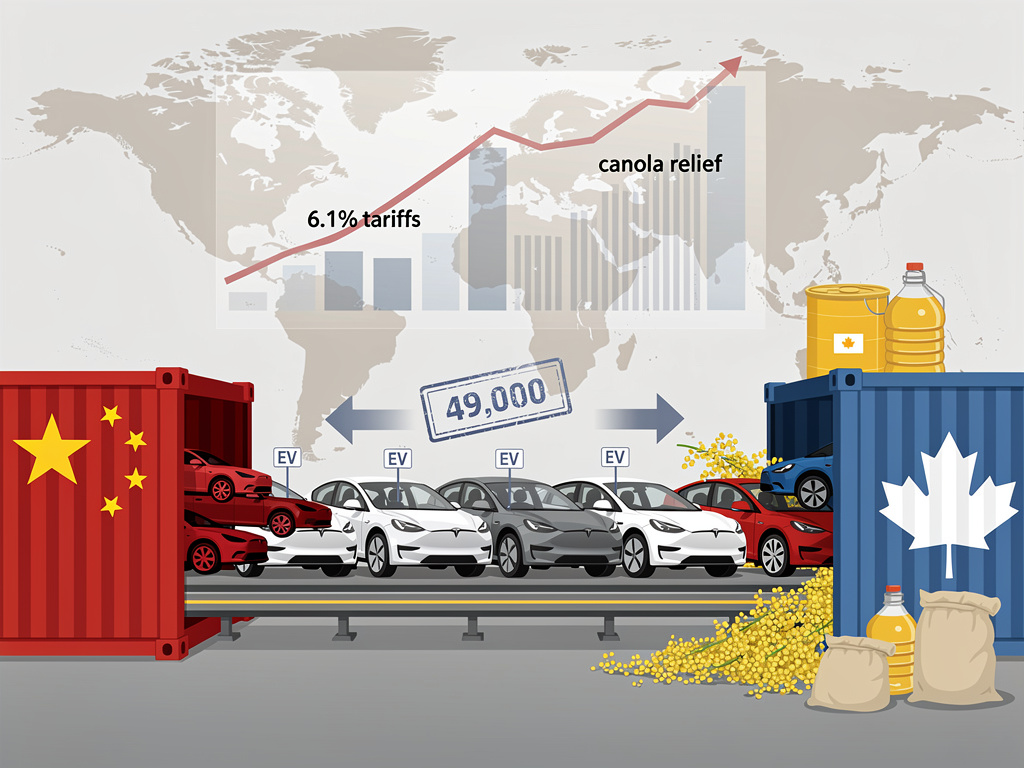
OTTAWA—Prime Minister Mark Carney’s surprise trade pact with Beijing, sealed during his January 16, 2026, meeting with President Xi Jinping, has slashed tariffs on Chinese electric vehicles from 100% to 6.1% for an initial quota of 49,000 units annually, igniting fury in Canada’s auto sector. The deal, part of a broader “strategic partnership,” exchanges this market access for China’s reduction of canola tariffs from 85% to 15% by March 1 and relief on seafood and peas, unlocking billions in agricultural exports. Yet, with details scarce and no prior industry consultation, executives warn of job losses and investment flight at a time when U.S. tariffs already batter Ontario’s factories.
The agreement reverts to pre-2024 import levels, matching 2023 volumes from Tesla, Volvo, and Polestar—brands with Chinese production—representing under 3% of Canada’s 1.9 million annual vehicle sales but potentially 25% of the EV market, where penetration fell to 9-10% in 2025 from 15% in 2024, per Financial Post. Carney insists it will spur “considerable new Chinese joint-venture investment in Canada within three years,” with over 50% of imports under $35,000 by year five, as stated in his office’s release. Critics, however, see a hard quota controlled by Chinese export licenses, offering Canada limited say over models.
Sector Scrambles Amid Policy Fog
David Adams, CEO of Global Automakers of Canada, captured the bewilderment: “The larger reality is we don’t know anything about it. This announcement just throws a wrench in the gears. Nobody knows anything. Nobody can tell you anything, not even the minister’s office,” he told the Financial Post. Flavio Volpe, president of the Canadian Automotive Parts Manufacturers’ Association, decried potential EV mandate credits flowing to Chinese firms: “You cannot have a system where you’re creating value for the Chinese state through EV credits.”
The federal EV sales mandate—20% by 2026, paused for 2025—looms large, with non-compliant automakers possibly buying credits from high-volume Chinese importers, costing tens of millions. Louis Jahn, president of the Canadian Tooling & Machining Association, dismissed factory promises: “I know they’re saying they’re going to build a factory here, but we’re saying baloney. The lion’s share of the commerce is going to come from China.” Recent setbacks, like Honda’s delayed $15 billion Ontario battery plant and Stellantis halting Brampton renovations, amplify fears, as reported by Bloomberg.
Ontario Premier Doug Ford, whose province hosts most auto jobs, lambasted the deal as unconsulted and harmful: “It’s going to hurt every single auto manufacturer, every single supply chain that has anything to do with the auto sector. This was not thought out properly,” per CBC News. He urged a boycott, calling them “Chinese subsidized spy cars,” and noted learning of it hours before announcement.
U.S. Shadow Looms Over North American Unity
Carney’s divergence from U.S. policy—where 100% tariffs persist—risks retaliatory measures amid USMCA reviews. U.S. Trade Representative Jamieson Greer called it “problematic,” warning Canada would regret it, according to Al Jazeera. Yet President Trump praised Carney: “That’s what he should be doing. It’s a good thing for him to sign a trade deal.” Ontario’s industry, exporting 85% to the U.S., faces compounded threats from Trump’s vehicle tariffs.
Carney, speaking in Doha, framed it as an “opportunity” for Ontario: “We’ve had direct conversations… with explicit interest and intention to partner with Canadian companies,” via Yahoo Finance Canada. A senior official told CBC News Canada aims to be North America’s first to build EVs with Chinese tech, eyeing joint ventures. Chinese firms like Chery and BYD met Industry Minister Mélanie Joly, signaling expansion, per The Globe and Mail.
Saskatchewan Premier Scott Moe hailed canola relief as “very good news,” highlighting prairie wins, while Ford fumed over Ontario’s exclusion, as in CBC News. Unifor president Lana Payne warned: “Given China’s massive overcapacity… little reason for those companies to establish real and meaningful manufacturing operations.”
Barriers Delay the Chinese Surge
Regulatory hurdles temper immediacy: New models face 12-18 month safety certifications, per Meredith Lilly of Carleton University in the Financial Post. Only Tesla, Volvo, and Polestar are certified now. The quota escalates ~6% yearly, potentially to 70,000 by year five, though officials clarified no fixed escalator.
China’s state subsidies—grants, cheap land, financing—enable dominance (70% global EV production), undercutting Western firms, as OECD data cited in Toronto Star shows. Carney argues for affordable, efficient options: “China produces some of the most affordable and energy-efficient vehicles in the world,” per BBC.
Experts like McGill’s Vivek Astvansh predict 10% Canadian EV sales to Chinese brands, pressuring Tesla, via BBC. Gal Raz of Western University sees consumer price drops.
Investments or Illusions?
Promises hinge on scale: Viable plants need 150,000 units yearly, per anonymous sources in Financial Post, unlikely without U.S. access. TD economist Beata Caranci doubts full plants but sees supply chain partnerships, in BNN Bloomberg. S&P notes 15 Chinese plants abroad since 2022.
Conservative Leader Pierre Poilievre assailed Carney’s shift from calling China a threat to partnership, per The Globe and Mail. Carney eyes 50% export growth to China by 2030, per PMO.
As factories idle and premiers feud, Carney’s bet tests whether cheap EVs and vague ventures rebuild or ravage Canada’s auto powerhouse.


 WebProNews is an iEntry Publication