
Revolutionizing Focus: Carnegie Mellon’s Breakthrough in Adaptive Camera Technology
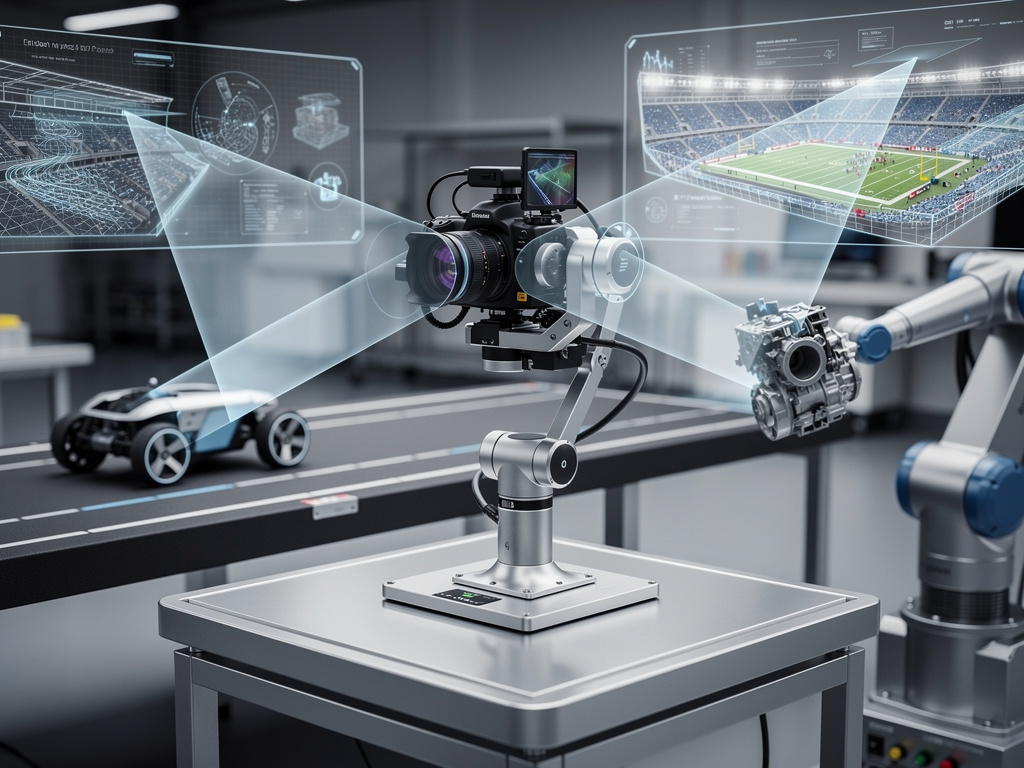
In the fast-evolving world of imaging and robotics, Carnegie Mellon University has unveiled a groundbreaking camera system that promises to redefine how machines capture the world. Dubbed “The Perfect Shot,” this innovation allows a lens to focus on multiple objects at varying distances simultaneously, eliminating the traditional trade-offs in depth of field. Developed by researchers in the College of Engineering, the technology leverages spatially selective focusing, a method that could transform applications from autonomous vehicles to sports photography.
At its core, the system integrates advanced optics with computational algorithms, enabling precise control over focus across different regions of an image. Unlike conventional cameras that require mechanical adjustments or post-processing to achieve sharpness in complex scenes, this camera dynamically adapts its focus in real time. The research team, led by experts in electrical and computer engineering, has demonstrated how this spatially variant focus can capture intricate details without compromising on speed or clarity.
The implications extend far beyond consumer gadgets. In robotics, where visual perception is critical for tasks like navigation and object manipulation, this technology could enhance accuracy in dynamic environments. For instance, a robot navigating uneven terrain might need to focus on both nearby obstacles and distant landmarks simultaneously, a challenge that current systems struggle with due to fixed focal lengths.
Unlocking New Possibilities in Robotics Integration
Carnegie Mellon’s Robotics Institute, a pioneer since its founding in 1979, provides the perfect backdrop for such innovations. The institute’s emphasis on integrating artificial intelligence with physical systems aligns seamlessly with this camera’s capabilities. According to details from the College of Engineering at Carnegie Mellon University, the camera uses a novel lens design combined with machine learning to selectively blur or sharpen parts of the frame, mimicking human visual attention more effectively.
This isn’t just theoretical; practical demonstrations show the camera capturing fast-moving subjects in sports, where traditional setups often miss the mark. Imagine a basketball game where the ball, players in the foreground, and coaches on the sideline are all in sharp focus—without multiple cameras or extensive editing. The system’s ability to process depth information on the fly opens doors to enhanced augmented reality experiences and more intuitive human-robot interactions.
Industry insiders note that this advancement builds on CMU’s legacy in computer vision. The university’s research overview highlights breakthroughs in 3D scene reconstruction and object recognition, which are foundational to this project. By incorporating elements of visual-inertial bundle adjustment, as discussed in various technical forums, the camera maintains accuracy even in motion-heavy scenarios.
From Lab to Real-World Applications
Recent posts on X have buzzed with excitement about similar perceptual advancements in robotics. Users have shared examples of robots predicting movements up to five seconds ahead using forward dynamics models, which could pair excellently with this focusing technology for safer navigation in rough terrains. One post highlighted a system that achieved precise 3D goals without visual demonstrations, relying solely on geometric models—echoing the computational efficiency of CMU’s approach.
On the web, news from Electrical and Computer Engineering at Carnegie Mellon University elaborates that the camera’s spatially selective focusing was first detailed in November 2025, setting the stage for broader adoption. This aligns with Google’s 2025 research breakthroughs in AI and robotics, as reported in their year-in-review blog, where transformative products in science and automation are emphasized.
For precision tasks, the integration of AI with such imaging tech is crucial. CMU researchers have evaluated how large language models behave in robotic contexts, revealing limitations in handling personal data but strengths in perceptual tasks. This camera could mitigate some risks by providing clearer, more context-aware visuals, reducing reliance on potentially biased AI interpretations.
Engineering Challenges and Innovations
Developing this technology wasn’t without hurdles. Engineers had to overcome issues with light diffraction and computational load, ensuring the system operates efficiently on standard hardware. The lens design incorporates micro-structures that manipulate light paths selectively, a feat achieved through iterative simulations and prototyping.
Collaboration across departments at CMU has been key. The Robotics Academy, known for its STEM education programs, could incorporate this tech into training modules, preparing the next generation for advanced robotic systems. Meanwhile, the institute’s doctoral programs in robotics and computer vision continue to fuel such innovations, attracting top talent globally.
Looking at broader trends, articles from The Robot Report discuss CMU’s findings on AI models’ readiness for robotics, underscoring the need for robust perceptual tools like this camera to bridge gaps in safety and reliability.
Impact on Sports and Entertainment Industries
In sports engineering, where capturing the “perfect shot” is literal, this technology could revolutionize broadcasting. Traditional cameras struggle with the depth variations in arenas, often requiring teams of operators to switch focuses manually. CMU’s system automates this, potentially reducing costs and improving viewer experiences with hyper-detailed footage.
Enthusiasts on X have drawn parallels to hydrogel “robot eyes” developed elsewhere, which focus without power sources and detect minute details. While not directly related, these discussions highlight a growing interest in bio-inspired optics that could complement CMU’s work, perhaps leading to hybrid systems for even greater precision.
News from Carnegie Mellon University emphasizes physical AI’s role in future machines, with dean Martial Hebert noting its transformative potential across industries. This camera exemplifies that vision, merging hardware innovation with AI to create smarter, more adaptive devices.
Broader Economic and Ethical Considerations
Economically, the technology could spur growth in sectors like autonomous transportation. By enabling better depth perception, it enhances safety in self-driving cars, addressing current limitations in variable lighting and distances. The Robotics Institute’s research overview points to applications in agricultural monitoring, where focusing on crops at different growth stages could optimize yields.
Ethically, as with any AI-integrated tool, questions arise about privacy and data usage. CMU’s studies on AI models accessing personal information stress the importance of safeguards. This camera, by focusing on visual data processing rather than storage, might offer a more privacy-conscious alternative for surveillance or monitoring tasks.
Global hubs for robotics, as detailed in Robotics and Automation News, position places like Pittsburgh—home to CMU—as emerging leaders, rivaling Silicon Valley in innovation and funding.
Future Directions and Collaborative Efforts
Looking ahead, the research team plans to miniaturize the system for integration into drones and wearables. Partnerships with industry giants could accelerate this, bringing the technology to market sooner. The Pathways Fellowship at the Robotics Institute supports non-traditional entrepreneurs, potentially fostering startups around this focusing tech.
X posts about video diffusion models for refocusing and zero-shot reconstruction from videos suggest complementary advancements. These could enhance post-capture editing, allowing users to adjust focuses after the fact, building on CMU’s real-time capabilities.
In healthcare, precise imaging is vital for robotic surgery. Insights from posts on X about Intuitive Surgical show how robotic precision enhances procedures; pairing it with adaptive focusing could improve outcomes by providing surgeons with multifaceted views.
Advancing Education and Research Ecosystems
Educationally, CMU’s Bachelor of Science in Robotics program, launched in 2023, equips students with skills to tackle such projects. The curriculum’s focus on sensing, thinking, and acting in real-world scenarios directly supports innovations like this camera.
Web discussions on AI and robotics integration, such as those from ThinkRobotics.com, highlight emerging technologies like embodied AI and swarm intelligence, which could amplify the camera’s impact in multi-robot systems.
Moreover, CMU’s news on quantum physics blending with robotics and machine learning opens avenues for even more sophisticated imaging, perhaps incorporating quantum sensors for unprecedented resolution.
Pushing Boundaries in Precision Tasks
For precision tasks in manufacturing, the camera’s ability to maintain focus on assembly lines with varying component distances could minimize errors and boost efficiency. This ties into broader automation trends, where machine learning and robotics converge, as explored in TechFuturism.
X users have marveled at robots achieving high precision without visual aids, using sampling techniques. Integrating CMU’s camera could elevate this to new heights, enabling vision-based refinements in real time.
The technology also holds promise for environmental monitoring, focusing on ecological details at multiple scales to track changes in biodiversity or climate impacts.
Industry Adoption and Market Potential
Adoption by tech companies is likely swift, given CMU’s track record of commercial spin-offs. The camera’s efficiency in power usage makes it suitable for battery-powered devices, expanding its reach.
In entertainment, filmmakers could capture scenes with natural depth variations, reducing CGI reliance. Posts on X about photoreal scene reconstruction from egocentric devices underscore the demand for such tools in virtual reality production.
Finally, as global research hubs evolve, CMU’s contributions solidify its role in driving robotics forward, inspiring a new era of intelligent, adaptive technologies that see the world in sharper, more nuanced ways. This “perfect shot” isn’t just a snapshot—it’s a leap toward machines that perceive as dynamically as we do.


 WebProNews is an iEntry Publication