
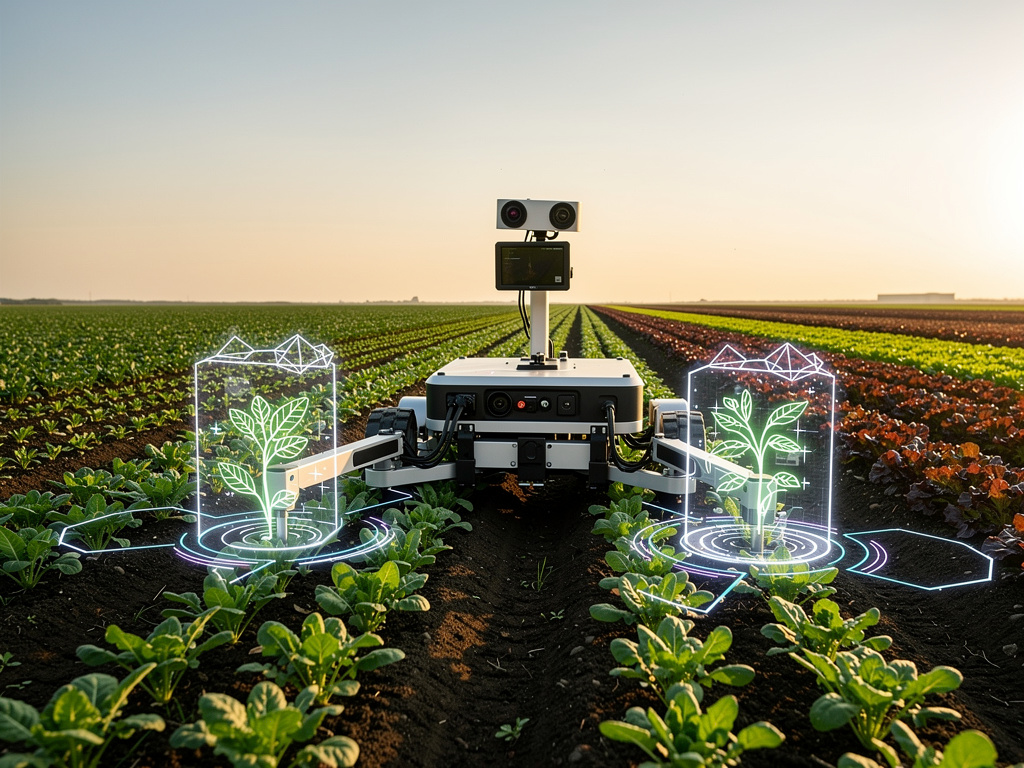
In a significant leap forward for agricultural technology, Carbon Robotics has unveiled a proprietary artificial intelligence model capable of detecting and identifying individual plants with unprecedented accuracy, marking a pivotal moment in the evolution of precision farming. The Seattle-based company, which has already deployed laser-equipped autonomous weeding machines across thousands of acres, is now positioning itself to transform how farmers approach crop management through advanced computer vision technology.
According to TechCrunch, the new AI model represents years of development and training on millions of plant images captured in real-world agricultural settings. Unlike existing solutions that rely on generic computer vision frameworks, Carbon Robotics has built its system from the ground up specifically for the unique challenges of field conditions, where variables like lighting, soil conditions, growth stages, and plant density create complexity that general-purpose AI models struggle to handle effectively.
The implications extend far beyond simple weed identification. Carbon Robotics’ technology can distinguish between crop varieties, assess plant health, identify disease symptoms, and even predict yield potential based on visual characteristics. This granular level of plant-by-plant intelligence enables farmers to make data-driven decisions about irrigation, fertilization, and pest management with a precision previously unattainable at commercial scale.
Training AI in the Field: A Data-Driven Agricultural Revolution
The development of Carbon Robotics’ AI model required an extraordinary data collection effort. The company’s fleet of autonomous robots has traversed millions of row-feet across diverse growing regions, capturing high-resolution imagery under varying conditions throughout multiple growing seasons. This massive dataset, encompassing dozens of crop types and hundreds of weed species, provides the foundation for a machine learning system that can generalize across different agricultural environments.
What distinguishes this approach from academic or laboratory-based AI development is its grounding in operational reality. The training data reflects actual field conditions that farmers encounter daily: plants at different growth stages, varying weather conditions, diverse soil types, and the complex interplay of multiple species growing in proximity. This real-world training regimen has produced an AI model that demonstrates robust performance across the wide spectrum of scenarios that characterize modern agriculture.
Beyond Weed Control: The Expanding Application Horizon
While Carbon Robotics initially gained recognition for its laser weeding technology—which uses AI-guided lasers to eliminate weeds without herbicides—the company’s new plant identification model opens pathways to applications far beyond weed management. The ability to identify and characterize individual plants at scale creates opportunities in crop breeding, disease monitoring, harvest optimization, and agricultural research that were previously impractical or impossible.
Plant breeders, for instance, could leverage this technology to evaluate thousands of genetic variants across test plots, identifying superior performers based on visual characteristics correlated with desirable traits. Disease surveillance becomes feasible at a scale that enables early intervention before pathogens spread across entire fields. Harvest timing can be optimized on a plant-by-plant basis, ensuring that crops are collected at peak quality rather than averaged across entire fields.
The Economics of Precision: Reducing Inputs While Increasing Yields
The economic case for AI-powered plant identification rests on a fundamental shift in agricultural resource allocation. Traditional farming operates on a broadcast model: inputs like water, fertilizer, and pesticides are applied uniformly across fields, with the implicit assumption that all areas require similar treatment. This approach inevitably wastes resources, applying excess inputs to areas that don’t need them while potentially under-serving areas with greater requirements.
Carbon Robotics’ technology enables a transition to targeted intervention, where resources are allocated based on the specific needs of individual plants or small zones within fields. This precision reduces input costs while simultaneously improving outcomes. Farmers can apply fertilizer only where nutrient deficiencies are detected, irrigate based on actual plant stress rather than calendar schedules, and target pest control interventions to affected areas rather than treating entire fields prophylactically.
The environmental benefits align with economic advantages. Reduced fertilizer application means less nutrient runoff into waterways, a major source of agricultural pollution. Targeted pest management reduces the volume of chemicals released into the environment. Water conservation becomes achievable at meaningful scale, a critical consideration as agriculture faces increasing pressure from drought and competing demands for limited water resources.
Integration Challenges and the Path to Widespread Adoption
Despite the technological sophistication of Carbon Robotics’ AI model, translating innovation into widespread agricultural practice presents substantial challenges. Farming operations vary enormously in scale, crop focus, technological sophistication, and financial resources. A solution that works seamlessly for large-scale specialty crop growers in California may require significant adaptation for row crop farmers in the Midwest or small-holder operations in other regions.
The capital investment required for autonomous robotic systems remains a barrier for many farmers, particularly those operating on thin margins or lacking access to financing for technology adoption. Carbon Robotics and similar companies must navigate this reality through creative business models, including equipment leasing, service contracts, or partnerships with agricultural cooperatives that can spread costs across multiple growers.
Competitive Dynamics in Agricultural AI
Carbon Robotics operates in an increasingly crowded field of agricultural technology companies developing AI-powered solutions. Competitors range from established agricultural equipment manufacturers adding AI capabilities to their existing product lines, to startups focused on specific niches within precision agriculture. The company’s vertical integration—controlling both the hardware platform and the AI software—provides competitive advantages in terms of data collection and system optimization, but also requires substantial capital investment across multiple domains.
The strategic question facing Carbon Robotics involves whether to maintain this integrated approach or potentially license its AI technology to other equipment manufacturers, trading exclusivity for market reach. The company’s decisions on this front will shape not only its own trajectory but potentially the broader evolution of AI adoption in agriculture.
Data Ownership and Privacy in Agricultural AI
As AI systems become more central to farm operations, questions of data ownership, privacy, and competitive advantage grow increasingly important. The detailed plant-level data collected by Carbon Robotics’ systems contains valuable information about farming practices, crop performance, and field conditions. Who owns this data, how it can be used, and what protections exist against its exploitation represent critical concerns for farmers considering AI adoption.
Carbon Robotics must navigate these concerns transparently, establishing clear policies that give farmers confidence in how their data will be handled. The agricultural technology industry has seen pushback from farmers wary of providing detailed operational data to technology companies, particularly when those companies might use aggregated data to benefit competitors or sell insights to third parties. Building trust requires not just technical capability but also business practices that align with farmer interests.
The Road Ahead: AI as Agricultural Infrastructure
Looking forward, Carbon Robotics’ plant identification AI represents a building block in what may become essential agricultural infrastructure. As climate change increases weather variability, as input costs rise, and as environmental regulations tighten, the ability to manage crops with plant-level precision transitions from competitive advantage to operational necessity. The farmers who adopt these technologies early may gain experience and data advantages that compound over time, creating potential disparities between technology adopters and those who maintain traditional practices.
The broader agricultural ecosystem must adapt to support this technological transition. Extension services need to develop expertise in AI-powered farming systems. Financing mechanisms must evolve to accommodate technology investments with multi-year payback periods. Regulatory frameworks should encourage sustainable intensification enabled by precision technology while ensuring that benefits accrue broadly rather than concentrating among large operations alone.
Carbon Robotics’ achievement in developing a robust plant identification AI model demonstrates that the technical challenges of bringing artificial intelligence to agriculture, while substantial, are surmountable. The harder questions involve how this technology integrates into the complex social, economic, and environmental systems that constitute modern agriculture. The answers will determine whether AI-powered precision farming fulfills its promise of producing more food with fewer resources, or becomes another technology that widens gaps between agricultural haves and have-nots. For an industry facing unprecedented pressures from climate change, resource constraints, and growing global food demand, getting these answers right has never been more important.


 WebProNews is an iEntry Publication