
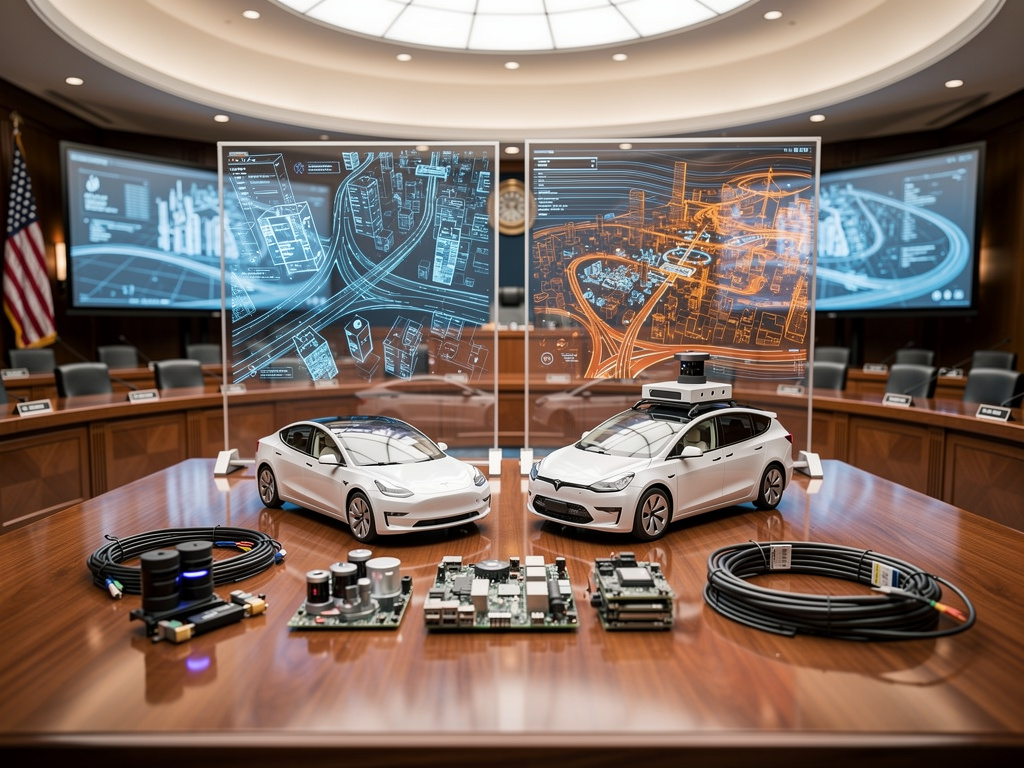
The autonomous vehicle industry stands at a critical juncture as federal lawmakers grapple with creating a regulatory framework that could either accelerate or stifle one of the most transformative technologies of the 21st century. A recent Senate hearing exposed deep divisions not only between legislators but also among industry leaders, safety advocates, and the companies racing to deploy self-driving vehicles across American roads.
According to The Verge, the Senate Commerce Committee convened to examine the current state of autonomous vehicle technology and the pressing need for federal legislation. The hearing revealed a stark contrast between companies like Waymo, which has logged millions of miles with its fully autonomous robotaxis, and Tesla, whose driver-assistance system continues to generate controversy despite CEO Elon Musk’s ambitious promises about full self-driving capabilities.
The testimony highlighted a fundamental tension in American innovation policy: how to foster technological advancement while ensuring public safety. Waymo’s co-CEO Tekedra Mawakana emphasized the company’s methodical approach, noting that their vehicles have completed over 20 million fully autonomous miles in cities like San Francisco, Phoenix, and Los Angeles. In contrast, Tesla’s approach relies on a vision-only system and requires constant driver supervision, despite marketing that many critics argue overstates the technology’s capabilities.
The Federal Vacuum: Why State-by-State Regulation Creates Chaos
The absence of comprehensive federal legislation has created a patchwork regulatory environment that industry insiders describe as increasingly untenable. Currently, the National Highway Traffic Safety Administration (NHTSA) regulates vehicle safety standards, while individual states control licensing, registration, and traffic laws. This divided authority has resulted in wildly different approaches across state lines, with California implementing stringent testing requirements while other states adopt more permissive frameworks.
Senator John Thune, a key figure in autonomous vehicle policy, has long advocated for federal preemption of state regulations to create a unified national framework. However, previous attempts at legislation, including the AV START Act in 2017 and the SELF DRIVE Act, stalled amid concerns about safety oversight and the potential for federal rules to override stricter state protections. The current political climate suggests that achieving consensus remains elusive, with Democrats generally favoring stronger safety requirements and Republicans pushing for lighter-touch regulation to encourage innovation.
Industry representatives argue that regulatory uncertainty is hampering investment and deployment. Companies must navigate different requirements in each state where they operate, creating redundant compliance costs and slowing the technology’s rollout. This fragmentation particularly affects smaller companies and startups that lack the resources to maintain separate regulatory teams for each jurisdiction. The situation has created competitive advantages for well-funded players like Waymo and Cruise while potentially shutting out innovative newcomers.
The Safety Debate: Competing Visions of Autonomous Technology
At the heart of the Senate hearing lay fundamental disagreements about what constitutes safe autonomous vehicle technology. Waymo’s representatives emphasized their use of multiple redundant sensor systems, including lidar, radar, and cameras, combined with extensive real-world testing and simulation. The company’s safety record, with no fatal crashes reported in fully autonomous mode, has become a cornerstone of arguments for their approach.
Tesla’s methodology stands in sharp contrast. The company relies exclusively on camera-based vision and neural networks, arguing that this approach more closely mimics human driving and can scale more cost-effectively. However, Tesla’s Autopilot and Full Self-Driving (FSD) systems require active driver supervision and have been involved in numerous crashes, some fatal. NHTSA has opened multiple investigations into Tesla’s systems, including incidents where vehicles have crashed into emergency vehicles with flashing lights.
Safety advocates at the hearing raised concerns about the gap between marketing claims and technological reality. The Center for Auto Safety and other consumer protection groups have called for stricter enforcement of existing regulations and clearer labeling requirements to prevent driver complacency. They point to research showing that drivers using advanced driver-assistance systems often overtrust the technology, leading to dangerous situations when the systems encounter scenarios beyond their capabilities.
Economic Implications: Billions in Investment Hang in the Balance
The autonomous vehicle sector has attracted tens of billions of dollars in investment, with projections suggesting the global market could reach $2 trillion by 2030. However, regulatory uncertainty threatens to redirect this capital away from American companies and toward jurisdictions with clearer rules. China, in particular, has implemented comprehensive autonomous vehicle policies and is rapidly advancing its domestic industry, raising concerns about American competitiveness in a strategically important technology sector.
Major automotive manufacturers have taken divergent approaches to autonomous technology, reflecting different assessments of technical feasibility and market readiness. General Motors’ Cruise division paused operations after a serious incident in San Francisco, highlighting the reputational and operational risks companies face. Ford and Volkswagen wrote off billions in investments in Argo AI after concluding that fully autonomous vehicles remained further from commercialization than initially projected.
The ride-hailing industry views autonomous vehicles as potentially transformative for their business models. Uber and Lyft have both invested heavily in autonomous technology partnerships, seeing driverless vehicles as a way to improve unit economics by eliminating labor costs. However, the companies have also hedged their bets, maintaining flexibility to work with multiple technology providers rather than betting entirely on in-house development.
The Human Factor: Labor and Social Implications
Beyond technical and regulatory considerations, the Senate hearing touched on broader social implications of autonomous vehicle deployment. Labor unions, particularly those representing truck drivers and delivery workers, have expressed concerns about job displacement. The American Trucking Associations estimates that the industry employs 3.5 million truck drivers, many of whom could face unemployment if autonomous trucks become widespread.
Proponents argue that autonomous vehicles could address critical labor shortages in transportation while improving road safety. They point to the more than 40,000 annual traffic fatalities in the United States, with human error contributing to the vast majority. If autonomous vehicles can demonstrably reduce crashes, the public health benefits could be substantial, potentially saving thousands of lives and preventing hundreds of thousands of injuries annually.
Accessibility advocates see autonomous vehicles as potentially revolutionary for people with disabilities and elderly individuals who cannot drive. The technology could provide independence and mobility to millions of Americans currently dependent on others for transportation. However, ensuring that autonomous vehicle services are accessible and affordable to all communities, rather than becoming another amenity primarily available to wealthy urban residents, remains a significant policy challenge.
The Path Forward: Competing Legislative Proposals
Several legislative frameworks have emerged as potential models for federal autonomous vehicle regulation. One approach would grant NHTSA expanded authority to approve autonomous vehicle designs that deviate from traditional safety standards written with human drivers in mind. This would address technical barriers like the requirement for steering wheels and pedals in vehicles designed to operate without human control.
An alternative framework would create a new federal autonomous vehicle safety standard while preserving state authority over insurance, liability, and traffic enforcement. This compromise approach attempts to balance federal consistency in vehicle design with state flexibility in managing how autonomous vehicles operate on their roads. However, critics argue that this hybrid model could perpetuate the regulatory fragmentation that companies find so challenging.
The insurance industry has called for clarity on liability frameworks, noting that current laws assume human drivers and may not adequately address scenarios where software makes driving decisions. Questions about who bears responsibility when an autonomous vehicle causes a crash—the vehicle owner, the software developer, the sensor manufacturer, or the company operating the service—remain largely unresolved. These liability uncertainties affect insurance pricing and availability, creating additional barriers to deployment.
International Competition and Strategic Considerations
The geopolitical dimension of autonomous vehicle development has become increasingly prominent in policy discussions. China’s government has designated autonomous vehicles as a strategic priority, providing substantial subsidies and creating dedicated testing zones. Chinese companies like Baidu and Pony.ai have made rapid progress, and some analysts warn that American regulatory paralysis could cede leadership in this critical technology sector to foreign competitors.
European regulators have taken yet another approach, implementing the General Safety Regulation that mandates certain advanced driver-assistance features in new vehicles while taking a cautious stance on fully autonomous systems. The European Union’s emphasis on privacy and data protection also creates different requirements for the massive amounts of information that autonomous vehicles collect, potentially fragmenting global markets and increasing compliance costs for companies operating internationally.
As the Senate hearing concluded without concrete legislative action, industry observers expressed frustration at the continued uncertainty. The autonomous vehicle sector finds itself in a holding pattern, with technological capabilities advancing faster than the regulatory frameworks designed to govern them. Until Congress can bridge partisan divides and reconcile competing visions of innovation and safety, the promise of autonomous vehicles transforming American transportation remains tantalizingly close yet frustratingly out of reach. The companies that have invested billions in this technology continue to wait for the regulatory clarity that would allow them to fully deploy their innovations, while the American public watches other nations potentially take the lead in a technology that could define 21st-century mobility.


 WebProNews is an iEntry Publication