
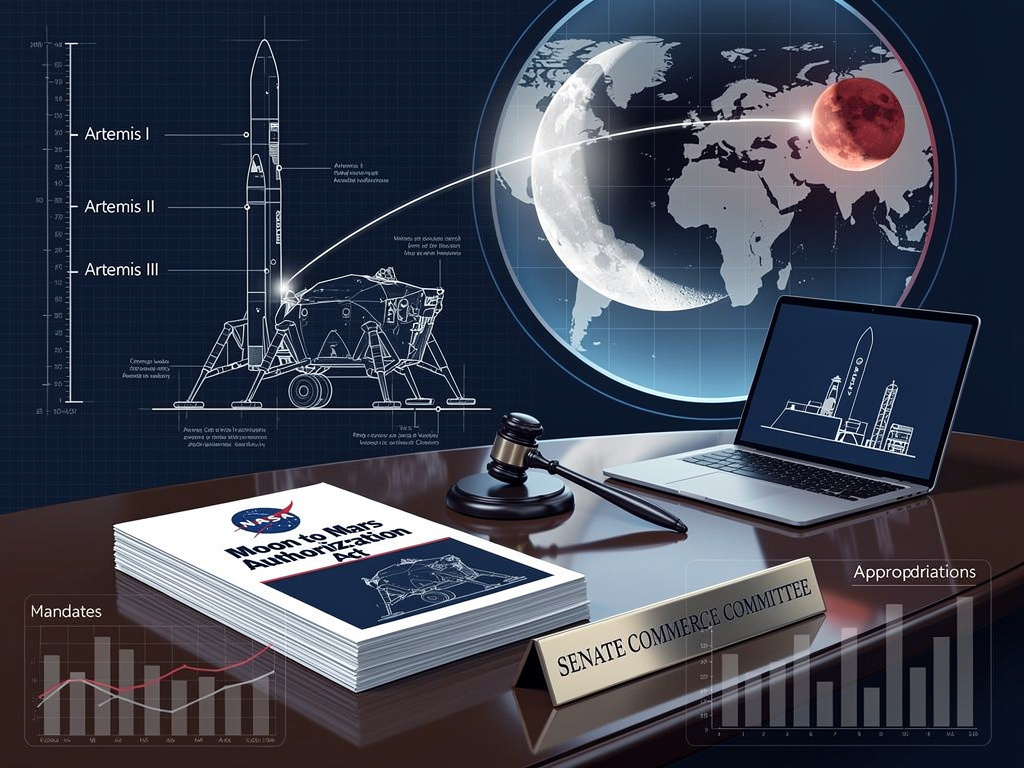
The slow-moving machinery of legislative bureaucracy has finally caught up with the orbital reality: the United States is in a race for the lunar south pole, and Congress is no longer content to let NASA manage the competition on a mission-by-mission basis. The Senate Commerce, Science, and Transportation Committee recently advanced the NASA Authorization Act of 2024, a bipartisan piece of legislation that does more than merely suggest a direction for the agency. It mandates a structural hardening of the Artemis program against political whims and explicitly frames lunar exploration as a matter of national security and geopolitical necessity.
For industry observers, the bill represents a significant shift from the aspirational language of previous decades to codified doctrine. As reported by Ars Technica, the legislation directs NASA to establish a “Moon to Mars Program” office, a bureaucratic maneuver intended to insulate long-term exploration goals from the erratic funding cycles that doomed the Constellation program. The move signals that Washington views the lunar surface not merely as a scientific destination, but as strategic high ground where presence equates to international norms-setting.
Legislative Armor for the Artemis Program
The core of the Senate’s directive addresses the fragility of NASA’s schedule. By legally requiring a cadence of missions, lawmakers are attempting to lock in future administrations, making it politically expensive to cancel or significantly alter the trajectory of Artemis. This statutory scaffolding is essential for the aerospace defense industrial base, which requires long-lead procurement stability to maintain production lines for the Space Launch System (SLS) and the Orion capsule. The bill effectively converts the Artemis Accords—the diplomatic framework governing civil space exploration—from soft power policy into a hard requirement for agency planning.
However, the authorization arrives amidst a tightening fiscal environment. While the policy mandates are ambitious, the appropriations reality is stark. As noted in recent analysis by SpaceNews, the committee’s authorization levels are subject to the spending caps imposed by the Fiscal Responsibility Act. This creates a friction point: Congress is ordering NASA to beat China to the Moon while simultaneously constraining the agency’s purchasing power. The result is an agency forced to cannibalize its own science directorates to fund the human exploration mandates, a tension that industry insiders warn could hollow out robotic exploration programs.
The Commercial Sector as a Geopolitical Instrument
The legislation implicitly acknowledges that NASA cannot achieve these goals under the traditional cost-plus contracting model alone. The Senate’s language doubles down on the reliance on commercial partners, specifically SpaceX and Blue Origin, to deliver the Human Landing Systems (HLS). This creates a unique risk profile for the US government, where national prestige is inextricably linked to the technical execution of private entities. The bill encourages the expansion of the Commercial Lunar Payload Services (CLPS) program, effectively outsourcing the logistics of the lunar supply chain.
This reliance on the private sector extends to regulatory frameworks as well. The act addresses the “learning period” for commercial human spaceflight, a regulatory moratorium that limits the Federal Aviation Administration’s ability to impose strict safety regulations on the nascent industry. By extending this period, Congress is signaling a tolerance for higher risk to foster rapid innovation, mirroring the early days of aviation. This deregulation is calculated to keep American companies faster and more agile than their state-owned counterparts in Beijing.
Countering the International Lunar Research Station
The urgency of the Senate’s action is driven by intelligence assessments regarding China’s International Lunar Research Station (ILRS). Beijing has been aggressively courting international partners for its rival lunar base, securing agreements with nations such as Egypt, Venezuela, and Pakistan. The Senate bill directs NASA to aggressively expand the Artemis Accords signatories, effectively creating a diplomatic bloc in orbit. The text of the bill reveals a concern that if the US does not establish a permanent presence first, the rules of lunar resource extraction—specifically regarding water ice in permanently shadowed craters—will be written by the Chinese Communist Party.
Recent developments highlight the technical competence of the competition. Following the successful retrieval of samples from the lunar far side by Chang’e-6, Chinese space officials have accelerated their timeline for a crewed landing. According to reporting by Reuters, Beijing is adhering to a strict 2030 deadline. The Senate’s authorization act serves as a direct legislative counter-maneuver, attempting to streamline NASA’s bureaucracy to ensure Artemis III does not slip further behind this competitor’s schedule.
The Rocket Equation and Nuclear Propulsion
Beyond the immediate lunar surface goals, the bill places a renewed emphasis on advanced propulsion technologies. The Senate explicitly supports the development of nuclear thermal propulsion (NTP) and nuclear electric propulsion (NEP). These technologies are viewed as prerequisites for the Mars portion of the “Moon to Mars” architecture. By codifying support for these programs, the Senate is attempting to revive capabilities that were explored in the NERVA program of the 1960s but abandoned due to budget cuts and changing political winds.
The inclusion of nuclear propulsion indicates a shift in risk appetite. Traditional chemical rockets are insufficient for rapid transit to Mars, which exposes astronauts to unacceptable levels of cosmic radiation. The legislative push for nuclear systems suggests that Congress is listening to the technical realities presented by NASA engineers: getting to Mars is a physics problem, but getting the funding to build the engine is a political one. The bill aims to solve the latter.
Addressing the Debris and Sustainability Crisis
Another focal point of the legislation is the growing threat of orbital debris and the necessity for In-space Servicing, Assembly, and Manufacturing (ISAM). The Senate bill directs NASA to prioritize technologies that can refuel, repair, or deorbit satellites. This is not merely an environmental concern; it is a matter of orbital asset protection. With the proliferation of mega-constellations like Starlink and Kuiper, Low Earth Orbit (LEO) is becoming congested. The legislation frames ISAM capabilities as a dual-use necessity—maintaining civil science assets while developing the technology base required for resilient national security space architectures.
The mandate for active debris removal research signals a maturation of space policy. Previously, debris mitigation was largely passive—guidelines on deorbiting timelines. The new authorization pushes for active remediation, acknowledging that the “Kessler Syndrome”—a cascading collision event—is a credible threat to the trillion-dollar space economy. This aligns with recent moves by the FCC to shorten deorbit timelines, presenting a unified regulatory front across government branches.
The Stability of the National Space Council
Structurally, the bill reinforces the role of the National Space Council, currently chaired by the Vice President, as the coordinating body for this multi-agency effort. The authorization seeks to prevent the jurisdictional friction that often occurs between NASA, the Department of Defense, and the Department of Commerce. By statutorily defining the council’s oversight role regarding the Moon to Mars objectives, Congress hopes to enforce a “whole-of-government” approach that has often been lacking in previous space initiatives.
This coordination is vital for the integration of the Gateway space station. The bill reaffirms the commitment to Gateway not just as a transit hub, but as a platform for international cooperation. This distinguishes the US approach from the Apollo era; where Apollo was a unilateral sprint, Artemis is designed as a multilateral marathon. The Senate’s language makes clear that the Gateway is the physical manifestation of the Artemis Accords, serving as a diplomatic anchor in cislunar space.
The Financial Reality Check
Despite the forceful language of the authorization, the aerospace industry remains cautious. Authorization bills provide permission and policy direction, but they do not write the checks. That power lies with the Appropriations Committee. Current fiscal constraints mean that while the Senate is authorizing a “space race” footing, the budget is likely to remain flat or see only inflationary increases. This discrepancy forces NASA to make difficult internal trades, often delaying crucial infrastructure like the Mars Sample Return mission to keep the Artemis timeline intact.
The disconnect between the authorized mandate and the appropriated reality is the single greatest risk to the Senate’s vision. While the Bloomberg editorial board and others have highlighted the need for increased funding to match the rhetoric, the political appetite for discretionary spending increases is low. Consequently, the success of this legislation hinges on the ability of commercial partners to lower costs drastically, effectively subsidizing the national ambition with private capital efficiency.


 WebProNews is an iEntry Publication