
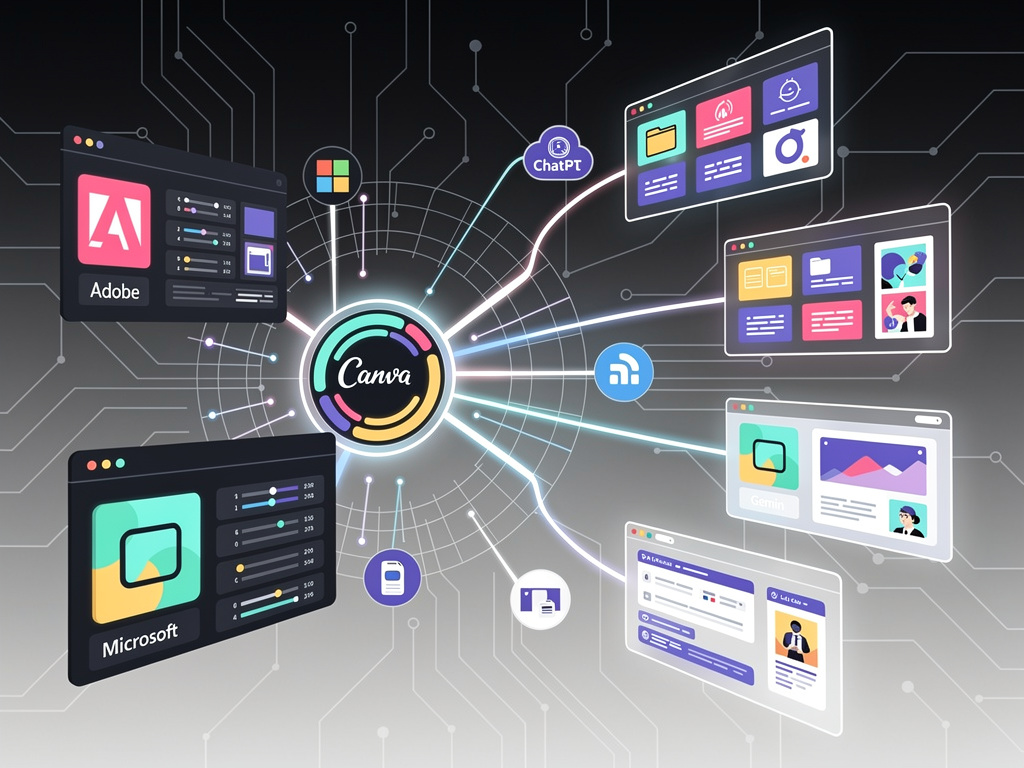
For years, the promise of artificial intelligence in the creative workspace has been tantalizing but incomplete. AI tools could generate text, suggest layouts, and even produce images from simple prompts — but they consistently stumbled on one critical requirement that every marketing director and brand manager knows intimately: staying on brand. Canva, the Australian-born design platform now valued at $26 billion, is making its most ambitious move yet to solve that problem, announcing a suite of integrations that bring brand-consistent design capabilities directly into the AI assistants that millions of workers already use every day.
The company revealed on February 5, 2025, that it is launching new APIs and integrations enabling AI assistants — including OpenAI’s ChatGPT, Google’s Gemini, and other major platforms — to generate designs that adhere to a company’s specific brand guidelines, all without leaving the conversational AI interface. The announcement, detailed in a release on BusinessWire, represents a fundamental shift in how enterprises think about the intersection of design tools, brand governance, and artificial intelligence.
Turning AI Assistants Into Brand-Aware Design Partners
At the heart of Canva’s announcement is the Canva Brand Kit API, which allows AI assistants to access a company’s stored brand assets — logos, color palettes, typography, imagery guidelines, and approved templates — and use them as constraints when generating visual content. Rather than producing generic designs that require extensive manual adjustment, the AI can now output presentations, social media graphics, documents, and marketing materials that are immediately consistent with an organization’s visual identity.
Cameron Adams, Canva’s co-founder and Chief Product Officer, emphasized the significance of the integration in the company’s announcement. The move addresses what has been one of the most persistent pain points in enterprise adoption of generative AI: the “last mile” problem where AI-generated content looks impressive in isolation but fails to meet the rigorous brand standards that large organizations enforce. For a Fortune 500 company with thousands of employees creating content daily, the ability to ensure that every AI-generated asset automatically conforms to brand guidelines is not a convenience — it is a governance imperative.
The Enterprise Play: Why Brand Consistency Is a Billion-Dollar Problem
The timing of Canva’s announcement is no accident. The enterprise design and content creation market has become fiercely competitive, with Adobe, Microsoft, and a constellation of AI-native startups all vying for the attention of corporate buyers. Canva has been aggressively pursuing the enterprise segment through its Canva Enterprise tier, which already serves organizations including Salesforce, FedEx, and Marriott International. By embedding its brand management capabilities into the AI assistants that knowledge workers increasingly rely on, Canva is effectively positioning itself as the invisible infrastructure layer for brand-compliant content creation across the enterprise.
The scale of the brand consistency challenge is staggering. According to research from Lucidpress (now Marq), brand inconsistency costs companies an estimated 10% to 20% of annual revenue. When multiplied across the thousands of pieces of content that a mid-size enterprise produces each month — from internal presentations to customer-facing emails to social media campaigns — the financial impact of off-brand materials becomes enormous. Canva’s integration aims to eliminate this leakage at the point of creation, before off-brand content ever reaches an audience.
How the Technical Architecture Works
The technical underpinnings of Canva’s AI assistant integrations are worth examining in detail. The company is leveraging its existing Canva Connect APIs, which were initially launched to allow third-party applications to tap into Canva’s design engine. The new extensions build on this foundation by adding what the company describes as “brand-aware design generation” — a capability that layers brand rules on top of the generative AI models powering each assistant.
When a user asks an AI assistant to create a quarterly business review presentation, for example, the assistant can now call the Canva API, pull the user’s organization-specific brand kit, and generate slides that use the correct fonts, colors, logo placements, and imagery styles. The output is not a static file but a fully editable Canva design that can be further refined in the Canva editor or shared directly through the assistant interface. This interoperability is critical: it means that Canva is not asking users to abandon their preferred AI tools but rather embedding itself within them, a strategy that mirrors the successful platform plays of companies like Stripe in payments and Twilio in communications.
The Competitive Dynamics With Adobe and Microsoft
Canva’s move puts direct pressure on Adobe, which has been building its own AI-powered design capabilities through Adobe Firefly and its integration into Creative Cloud applications. Adobe’s approach has been to keep users within its own ecosystem, offering AI features as enhancements to Photoshop, Illustrator, and Express. Canva, by contrast, is pursuing a more distributed strategy — meeting users wherever they already work, whether that is in a ChatGPT conversation, a Google Workspace session, or a Microsoft Teams channel.
Microsoft, too, has been investing heavily in AI-powered design through its Copilot integrations with PowerPoint and Designer. But Microsoft’s tools are primarily optimized for its own productivity suite, creating an opening for Canva to serve as a cross-platform brand layer that works regardless of which AI assistant or productivity tool an organization has standardized on. This platform-agnostic positioning could prove to be Canva’s most significant competitive advantage, particularly among enterprises that use a heterogeneous mix of tools across departments and geographies.
The Broader Implications for the AI-Powered Workplace
Industry analysts have noted that Canva’s integration strategy reflects a broader trend in enterprise software: the unbundling of capabilities from monolithic applications and their re-bundling as API-driven services that can be consumed through conversational AI interfaces. In this model, the AI assistant becomes the primary interface through which workers access a wide range of specialized tools, from design platforms to data analytics engines to project management systems. Canva is betting that in this emerging paradigm, the companies that control brand identity and visual content creation will hold a position of outsized influence.
The implications extend beyond marketing and design teams. As AI assistants become the default interface for creating sales proposals, investor decks, training materials, and internal communications, the need for brand consistency permeates every function within an organization. Canva’s integration means that a sales representative in Tokyo and a human resources manager in London can both generate on-brand materials through their preferred AI assistant without any design training or knowledge of brand guidelines. The brand rules are enforced automatically, reducing the burden on centralized brand and marketing teams that have traditionally served as bottlenecks in the content creation process.
What This Means for Canva’s Growth Trajectory
Canva’s push into AI assistant integrations also has significant implications for its business model. The company, which crossed $2 billion in annualized revenue in 2024, has been steadily increasing its average revenue per enterprise customer by adding capabilities that justify higher-tier subscriptions. Brand Kit access through AI assistants is expected to be a premium feature available to Canva Enterprise and Canva Teams subscribers, creating a new vector for upselling organizations that may currently use Canva’s free or Pro tiers.
The move also deepens Canva’s data moat. As more organizations store their brand assets, templates, and design histories within Canva’s platform, switching costs increase substantially. An enterprise that has invested in building out a comprehensive brand kit within Canva — and has trained its workforce to generate on-brand content through AI assistants powered by Canva’s APIs — faces significant friction in migrating to a competitor. This stickiness is precisely the kind of competitive advantage that investors and analysts look for when evaluating SaaS companies at Canva’s scale.
The Road Ahead: Challenges and Open Questions
Despite the ambition of Canva’s announcement, significant questions remain. The quality of AI-generated designs, even when constrained by brand guidelines, is still inconsistent. AI models can follow rules about color codes and font families, but the more nuanced aspects of brand identity — tone, visual hierarchy, the subtle interplay between imagery and messaging — are harder to encode in an API call. Canva will need to continue investing in the sophistication of its brand intelligence layer to ensure that outputs meet the exacting standards of enterprise brand teams.
There are also questions about data security and governance. Enterprise brand assets are among a company’s most sensitive intellectual property, and routing them through third-party AI assistants introduces new vectors for data exposure. Canva has emphasized that its integrations are built with enterprise-grade security, including SOC 2 compliance and data encryption, but chief information security officers will want to scrutinize the architecture carefully before granting AI assistants access to their organizations’ brand vaults. As reported by BusinessWire, Canva is positioning these integrations as secure and enterprise-ready, but the proof will be in the adoption patterns of the most security-conscious industries, from financial services to healthcare.
What is clear is that Canva is no longer content to be simply a design tool. With this latest move, the company is positioning itself as the brand operating system for the AI era — an invisible but indispensable layer that ensures every piece of content generated by every AI assistant, across every department and geography, looks and feels unmistakably like it came from the organization it represents. Whether that vision fully materializes will depend on execution, but the strategic ambition is unmistakable, and the rest of the enterprise software industry is watching closely.


 WebProNews is an iEntry Publication