
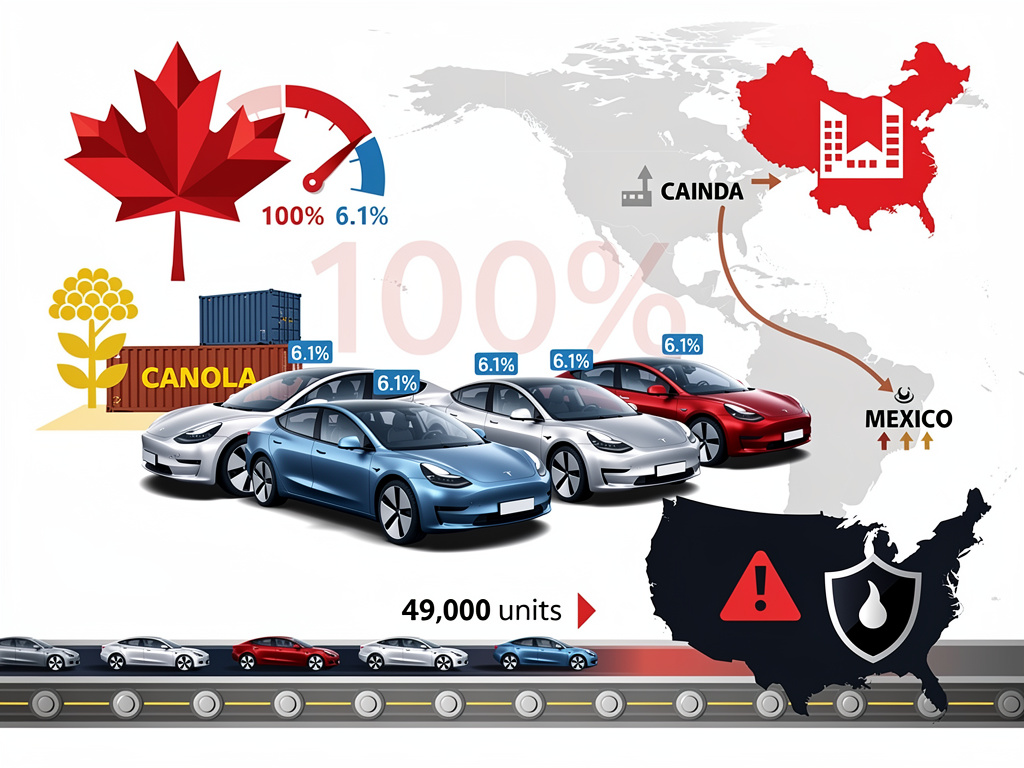
OTTAWA—Canadian Prime Minister Mark Carney’s announcement on Friday to slash import tariffs on Chinese electric vehicles from 100% to 6.1% marks a seismic shift in North American trade dynamics, opening a gateway for Beijing’s automakers just as the U.S. fortifies its barriers. The deal, struck during Carney’s visit to Beijing, caps initial annual imports at 49,000 units, rising gradually to around 70,000 over five years, in exchange for China easing duties on Canadian canola. This move diverges sharply from U.S. policy, where President Trump maintains steep protections while floating ideas for Chinese factories on American soil.
The agreement, detailed in a joint statement, aims to foster a “strategic partnership” amid escalating tensions with Washington. The New York Times reported Carney framing it as diversification from U.S. reliance, while China reciprocates by cutting canola tariffs that had burdened Prairie farmers. Industry observers see this as Canada’s bid to counter potential Trump-era trade disruptions, but it risks flooding the market with low-cost EVs from Geely, BYD, and Xiaomi.
Posts on X from auto sector watchers highlight immediate backlash, with users warning of threats to Ontario’s manufacturing base employing over 500,000. Unifor, Canada’s largest auto union, has signaled layoffs if subsidized Chinese imports undercut local production from GM, Ford, and Stellantis.
Breaking From U.S. Alignment
Canada’s pivot contrasts with the Biden and Trump administrations’ efforts to decouple from China’s EV supply chain over national security concerns. The U.S. Department of Commerce’s Bureau of Industry and Security last year restricted imports of connected vehicles tied to China or Russia, citing data risks. Trump, in recent comments, expressed openness to Chinese firms building U.S. factories for EVs, but critics like Avery Ash, CEO of Securing America’s Future Energy, called it a “catastrophic” risk to the defense industrial base.
Electrek noted the deal as a “massive shift,” potentially allowing Chinese EVs priced under $25,000 to compete directly. Ford CEO Jim Farley has publicly praised Chinese EV quality, yet U.S. tariffs render direct imports unviable, pushing firms toward Mexico as a backdoor.
Mexico’s EV exports to the U.S. surged in 2025, with Chinese makers like BYD establishing plants there under USMCA rules. Geely showcased models at CES last week, with executives hinting at U.S. entry in two to three years via Mexican production, per TechCrunch.
Chinese Export Surge Meets Open Door
China’s EV giants are ramping exports amid domestic oversupply and EU tariff deliberations. BYD, Geely, and Xiaomi leverage low capital costs, cheap labor, and aggressive pricing to dominate globally. InsideEVs highlighted how Canada’s reduced barrier could introduce vehicles cheaper than North American averages, achieved through state subsidies and market-share pursuits.
The 49,000-unit cap may seem modest—less than 5% of Canada’s 1 million annual vehicle sales—but it establishes a beachhead. Analysts predict rapid quota exhaustion, pressuring legacy makers’ pricing power. Ontario’s auto cluster, centered in Windsor and Oshawa, faces direct competition, with battery supply chains at stake.
X sentiment echoes industry fears, with posts decrying the tariff cut as prioritizing canola over auto jobs. Reuters quoted Carney promising “historic gains,” but automakers warn of margin erosion as Chinese firms burn cash for dominance (Reuters).
Security and Supply Chain Alarms
U.S. concerns extend beyond economics. Connected EVs pose cybersecurity threats, prompting BIS rules barring Chinese-linked software. Canada’s embrace raises questions about data flows across the shared border, potentially complicating integrated North American operations.
NPR detailed the canola-for-EVs swap, but security experts urge scrutiny. Ash’s statement urged Trump to “stay tough,” warning of European-style backfires where Chinese imports hollowed out local industries.
Trump’s factory invitation could bypass tariffs if production qualifies as domestic, but legal hurdles persist. Geely’s CES event signaled ambitions, with Mexican exports booming—Chinese vehicles now comprise significant USMCA flows.
Industry Ripple Effects
Ford’s Farley and others acknowledge Chinese prowess in battery tech and integration, yet U.S. incentives like the Inflation Reduction Act favor non-Chinese chains. Canada’s move could siphon investment northward, straining USMCA ties. POLITICO reported Carney and Xi marking a “new strategic partnership” (POLITICO).
Ontario Premier Doug Ford opposes the deal, citing job losses. Unifor president Lana Payne stated it “undermines our sector.” As quotas phase up, expect legal challenges and quota auctions, mirroring EU approaches.
X threads from traders predict short opportunities for $F and $GM, with Chinese deflation hitting legacy margins. Beijing’s canola relief aids $7.9 billion in exports, balancing farmer wins against auto pain.
Geopolitical Trade-Offs
Carney’s Beijing trip underscores Canada’s hedging against U.S. protectionism. With Trump eyeing broader tariffs, Ottawa seeks alternatives. Yet this risks retaliatory U.S. measures under USMCA dispute mechanisms.
Chinese firms gain validation, accelerating global expansion. BYD’s Mexico plant eyes U.S. exports; Geely’s Zeekr brand tests North American waters. Xiaomi’s SU7, praised for value, could follow.
The deal’s fine print—quotas, compliance, reviews—offers levers, but momentum favors imports. As Europe debates cuts, North America’s firewall shows cracks, reshaping competition for EV supremacy.


 WebProNews is an iEntry Publication