
Prime Minister Mark Carney stood in Toronto on Thursday and declared the obvious. Artificial intelligence will transform lives. The real question, he said, centers on whether that change lifts all Canadians or concentrates gains among a select few.
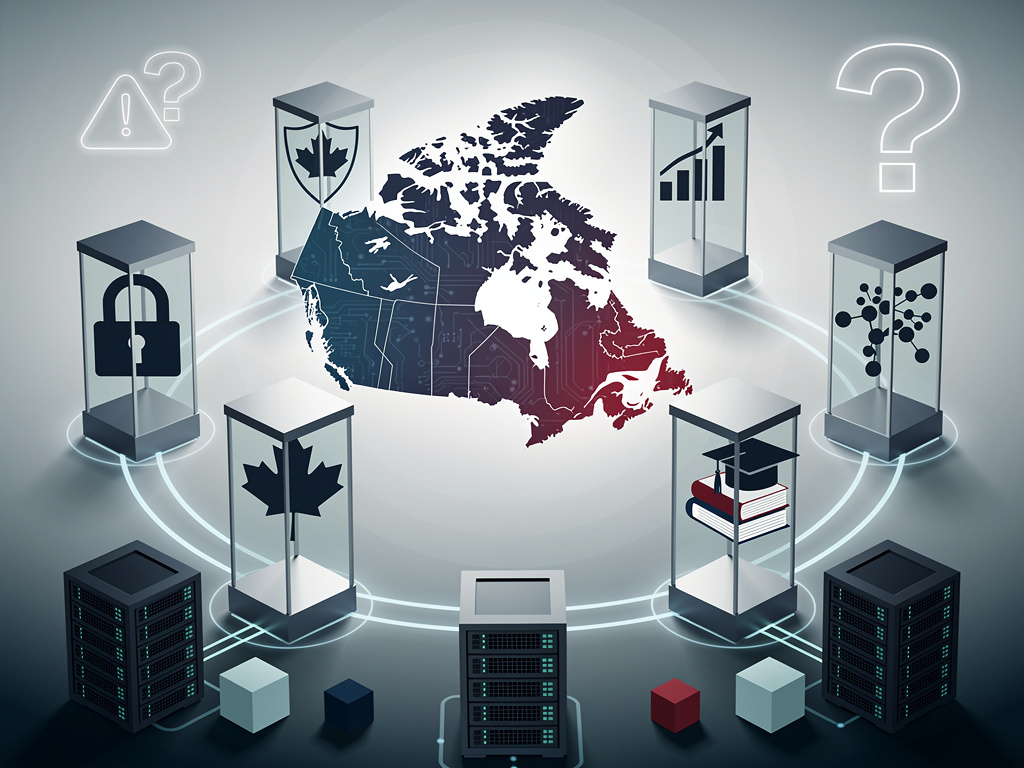
Hours later his government released Canada’s National Artificial Intelligence Strategy: AI for All. The document lays out six pillars. It sets concrete targets. And it promises to close what officials call a glaring adoption gap while building sovereign capacity at home.
Business adoption of AI sits at 12 percent today. The plan aims to push that figure to 60 percent by 2034. Up to 250,000 new jobs could emerge through wider use of the technology by 2031. Another 90,000 AI-related positions and work placements target young Canadians in the same period. Economic gains? Officials project a 3 percent lift to GDP, roughly $200 billion.
Free AI literacy training forms a cornerstone. The national initiative seeks to reach one million entry-level post-secondary students. More than 3,000 educators would receive preparation. Mid-career workers gain pathways too. The vision extends beyond classrooms. AI must reflect Canadian values, languages and culture. French-language tools. Indigenous leadership. Gender-based analysis baked in.
But the strategy’s release comes after repeated delays. A draft obtained by CBC News three days earlier already signaled the direction. Officials described the final version as largely consistent, with minor adjustments. That continuity raises a pointed question. Does the plan deliver enough detail where it matters most?
Experts flagged the gap immediately. Protection against harmful effects receives attention yet lacks specifics on enforcement. The first pillar focuses on safeguarding Canadians and democracy. Modernize privacy laws. Update online safety rules. Introduce watermarking for AI-generated content. Expand the Canadian AI Safety Institute with $50 million. Create a trusted AI certification program.
These steps sound measured. They address deepfakes, disinformation in elections, and inappropriate use of personal data including surveillance pricing. New consumer privacy legislation would enshrine a right to privacy and shield children’s information. Still, critics note the absence of firm timelines or binding requirements. CBC News reported concerns from both opposition parties and independent observers. Conservative MP Melissa Lantsman questioned job-creation claims amid high youth unemployment. NDP voices worried protections for workers remained too soft.
Valérie Pisano of Mila, the Quebec AI institute, offered a more positive assessment. She called the document balanced. Others remain unconvinced. The draft obtained earlier by CBC had already drawn similar commentary. Promises of responsible governance exist. Concrete mechanisms to enforce them appear lighter.
Sovereignty threads through every section. Canada will build a world-leading public supercomputer by 2031. Data centers scaling to at least 100 megawatts. Broader compute capacity targets 5.5 gigawatts by 2030, with initial phases reaching 850 megawatts then expanding to 2.3 gigawatts. Health data spaces receive $100 million. Another $100 million supports the VITAL platform. Total compute-related investments already exceed $2 billion. The government positions itself as anchor customer for domestic solutions. A $500 million Canadian Tech Growth Fund allows equity stakes in scaling firms. Another $500 million Regional AI Initiative targets small and medium enterprises.
These figures build on earlier commitments. The Pan-Canadian Artificial Intelligence Strategy dates to 2017. Canada claimed first-mover status then. Subsequent budgets added billions. The latest strategy attempts to shift from research strength to commercialization and widespread use. AI missions, starting with health care and $200 million in funding, aim to solve national challenges. Examples include tools already deployed in emergency rooms and agriculture.
Talent retention sits high on the agenda. The plan doubles AI research chairs from 130 to 200. Expands the Global Talent Stream. Strengthens institutes in Montreal, Toronto and Edmonton. Yet brain drain remains a live risk. Foundation model companies like Cohere receive mention as homegrown successes worth supporting.
Global alliances complete the framework. A proposed Sovereign Technology Alliance, already discussed with Germany, seeks to reduce reliance on any single power. Open-source contributions. Trade missions across Europe, the Indo-Pacific and Middle East. The message is clear. Canada will build, partner and buy on its own terms.
Recent coverage underscores the stakes. Global News highlighted plans for large-scale data centers alongside restrictions on surveillance pricing. A BBC analysis published hours after the launch distilled five takeaways: sovereignty, stopping talent loss, scaling from business to health care, training programs and international positioning.
Public sentiment adds pressure. Surveys cited in reporting show Canadians rank near the bottom in AI enthusiasm and trust. Excitement has dropped year over year. The strategy explicitly names literacy and trust as foundations. Without them, adoption targets will slip.
Funding flows through multiple channels. Budget 2025 contributed $1.75 billion directly plus $159 million in intellectual property measures. The Business Development Bank of Canada gains expanded financing capacity. Tax incentives such as the scientific research and experimental development credit receive reinforcement. Procurement rules will favor Canadian AI where possible.
Implementation will test the vision. The document acknowledges AI evolves faster than any plan can anticipate. Regular reviews are promised. An official strategy PDF runs 2.37 megabytes and contains the full detail. Yet delivery depends on execution across departments, provinces and the private sector.
Opposition reactions on Parliament Hill were swift. Some called the goals lofty without clear pathways. Others warned of environmental costs from power-hungry data centers. Resistance in certain communities already surfaces in local debates over new facilities.
Health care stands out as early focus. Missions there could accelerate diagnostics and administrative efficiency. Public service applications, such as existing pilots, offer proof points. Success in one sector could build momentum elsewhere.
The strategy avoids overclaiming. It does not pretend AI arrives without disruption. Instead it frames choices made today as decisive. Build with Canadian values. Govern with accountability. Ensure benefits spread broadly. Those phrases appear repeatedly in Carney’s remarks and the document itself.
Whether the mechanisms match the rhetoric remains the open variable. Billions in commitments. Specific numeric targets. A six-pillar structure that touches protection, skills, adoption, infrastructure, scaling and alliances. The architecture looks comprehensive on paper.
Critics want more on enforcement and timelines. Supporters see a pragmatic balance between ambition and feasibility. Both sides will watch closely as programs roll out over the next five years. The decisions, as the document states, will shape the collective future. Canada now has its map. Execution starts immediately.


 WebProNews is an iEntry Publication