
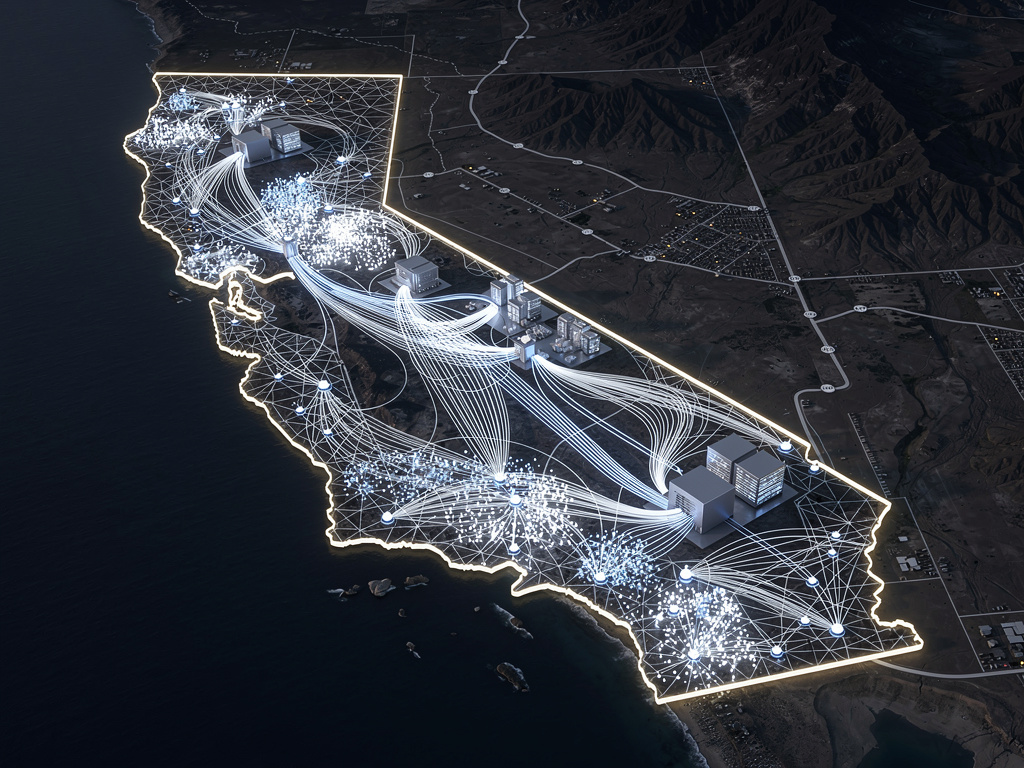
Somewhere beneath the dirt roads and agricultural corridors of rural California, a massive public infrastructure project is taking shape. It doesn’t involve bullet trains or desalination plants. It’s fiber optic cable — 8,100 miles of it — and the state is laying it with a singular, ambitious goal: bring high-speed internet to the millions of Californians who still don’t have it.
The project is called the Middle-Mile Broadband Initiative, and it represents one of the largest public investments in broadband infrastructure in American history. Authorized under legislation signed by Governor Gavin Newsom in 2021 and backed by $3.86 billion in state funding, the network is designed to serve as the backbone — the “middle mile” — connecting major internet exchange points to the rural and tribal communities that private internet service providers have long ignored. The state isn’t delivering internet directly to homes. Instead, it’s building the highway so that local ISPs, municipalities, and tribal governments can build the on-ramps.
And yet, for a project of this scale, it has attracted remarkably little national attention.
The Digital Divide That Wouldn’t Close
California is the world’s fifth-largest economy. It’s home to Silicon Valley, the birthplace of the modern internet. But as Mashable reported, approximately 2.3 million Californians — concentrated in rural, tribal, and low-income communities — still lack access to broadband internet that meets the Federal Communications Commission’s minimum speed benchmarks. In some parts of the state, residents rely on satellite connections or aging DSL lines that can barely load a webpage, let alone support remote work or telemedicine.
The reasons are familiar. Private ISPs like AT&T, Comcast, and Charter have historically found it unprofitable to extend fiber infrastructure to sparsely populated areas. The cost per household can be astronomical when homes are separated by miles of farmland or mountain terrain. So the cables stop where the profit margins do. This has left entire communities in the Central Valley, the Sierra Nevada foothills, and tribal lands across the state functionally disconnected from the digital economy.
The pandemic made this disparity impossible to ignore. When schools shifted to remote learning in 2020, families in rural Kern County and the Coachella Valley found themselves driving to fast-food parking lots to access Wi-Fi so their children could attend class. Healthcare appointments went virtual — but only for those with connections fast enough to sustain a video call. The state’s political establishment, long focused on housing and climate policy, suddenly had broadband at the top of its agenda.
Senate Bill 156, passed in July 2021, was the legislative response. It created the Middle-Mile Broadband Initiative and placed it under the California Department of Technology, working in coordination with the California Public Utilities Commission. The $3.86 billion allocation came from a combination of the state’s general fund surplus and federal American Rescue Plan Act dollars. The goal: construct an open-access, publicly owned fiber network spanning roughly 8,100 miles across the state by 2028.
Open-access is the key phrase. Unlike the closed networks operated by major ISPs, this infrastructure will be available to any qualified entity — local internet service providers, electric cooperatives, municipalities, tribal governments — that wants to use it to deliver last-mile connections to homes and businesses. The state builds the trunk line. Local partners handle the final stretch.
That model isn’t new. It mirrors approaches taken in Sweden, Australia, and parts of the American South. But California is attempting it at a scale that dwarfs previous efforts.
Construction, Complications, and the Long Road to 2028
GoldenStateNet, the entity established to manage the network’s construction and operation, has been moving forward on multiple fronts. As Mashable detailed, the initiative has identified over 18,000 miles of potential routes, with the first phase prioritizing connections to unserved and underserved communities. Construction began in earnest in 2023, with early segments focusing on the San Joaquin Valley, parts of the North Coast, and tribal lands in Southern California.
But the project faces real headwinds.
Permitting is one. California’s environmental review process, governed by the California Environmental Quality Act, can add months or years to infrastructure projects. The state has attempted to streamline approvals for broadband construction, but local permitting requirements vary wildly from county to county. A route that crosses federal land — and many do — adds another layer of regulatory complexity.
Cost is another concern. The original $3.86 billion budget was calculated before inflation spiked in 2022 and 2023, driving up the price of materials like fiber optic cable, conduit, and the specialized labor needed to install them. Some industry analysts have questioned whether the funding will be sufficient to complete all 8,100 miles. The state has signaled it may seek additional federal dollars through the Broadband Equity, Access, and Deployment (BEAD) program, the $42.45 billion federal broadband initiative administered by the National Telecommunications and Information Administration. California’s BEAD allocation is expected to be among the largest in the nation, potentially exceeding $1.8 billion.
Then there’s the last-mile problem. The state can build all the middle-mile fiber it wants, but if local ISPs and communities can’t afford to build the final connections to homes, the backbone sits underused. This is where the economics get tricky. Rural last-mile construction can cost $5,000 to $10,000 per household, sometimes more in mountainous terrain. The state has set aside additional funding for last-mile grants, and the CPUC has been running subsidy programs for years, but the gap remains significant in the most remote areas.
Private ISPs have offered a mixed response. Some smaller regional providers welcome the middle-mile network as a way to expand their coverage areas without bearing the full cost of backhaul infrastructure. Larger incumbents have been less enthusiastic. AT&T and the California Cable & Telecommunications Association lobbied against elements of SB 156 during its passage, arguing that the state was inserting itself into a market that private investment could serve. That argument lost some credibility during the pandemic, when the market’s failure to serve rural communities became a nightly news story.
There’s also the question of maintenance and long-term operation. Building a fiber network is expensive. Operating one in perpetuity — handling repairs, upgrades, customer disputes, right-of-way management — is a different kind of challenge entirely. The state will need to establish a sustainable funding model for GoldenStateNet or risk the network degrading over time, as has happened with some public broadband projects in other states.
Despite these obstacles, the initiative has broad bipartisan support in Sacramento. Rural Republican legislators see it as an economic lifeline for agricultural communities. Urban Democrats frame it as a matter of equity. Governor Newsom has repeatedly cited the project as a signature infrastructure achievement, even as his administration juggles wildfire recovery, housing shortfalls, and budget deficits.
The federal government has been a willing partner. The Biden administration’s Infrastructure Investment and Jobs Act and the BEAD program have created an unprecedented pool of federal broadband funding, and California has positioned itself to capture a disproportionate share. The NTIA’s emphasis on open-access networks and public-private partnerships aligns closely with California’s middle-mile model.
So where does this leave the 2.3 million Californians waiting for a real internet connection?
Closer than they’ve ever been, but still years away in many cases. The first segments of the middle-mile network are expected to be operational by late 2025, with broader coverage rolling out through 2028. Last-mile connections will follow on their own timelines, dependent on local funding, permitting, and provider participation. For a family in a remote part of Humboldt County or on the Yurok Reservation, the promise of fiber internet may still feel abstract.
A Test Case With National Implications
What California is building matters far beyond its borders. If the Middle-Mile Broadband Initiative succeeds — if it delivers affordable, high-speed internet to communities that have been left behind for decades — it will become a template for other states grappling with the same digital divide. Texas, Appalachian states, and tribal nations across the West are watching closely.
If it fails — bogged down by cost overruns, permitting delays, or a lack of last-mile follow-through — it will become a cautionary tale about government overreach into telecommunications. The ISP lobby will point to it for years.
The stakes are that binary.
For now, the cables are going into the ground. Workers are trenching along rural highways and threading fiber through existing utility corridors. It’s unglamorous work, the kind that doesn’t trend on social media or generate breathless press coverage. But it may end up being the most consequential infrastructure project California has undertaken since the State Water Project in the 1960s.
Not because it moves water. Because it moves information. And in the 21st century, that might matter more.


 WebProNews is an iEntry Publication