
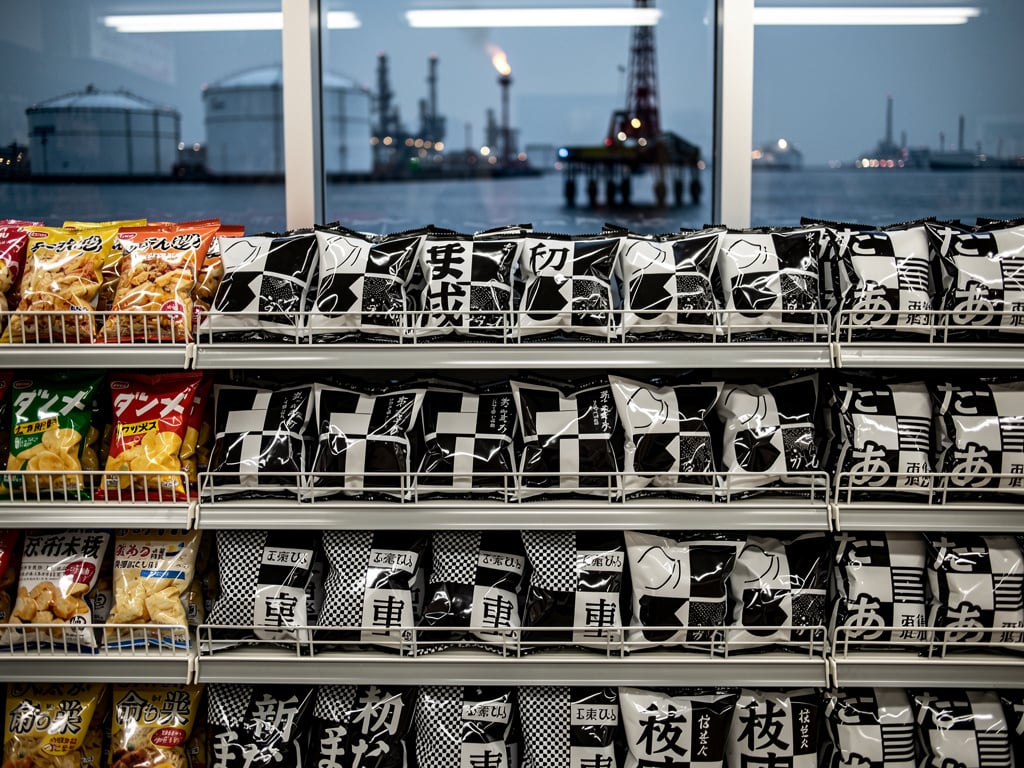
TOKYO — Japan’s biggest snack maker just ditched the color. Starting May 25, bags of Calbee potato chips, Kappa Ebisen shrimp crackers and Frugra granola will appear in stores wrapped in simple black and white. No bright oranges. No vivid yellows. Just two inks.
The reason traces back thousands of miles away. To the Strait of Hormuz. To a war that began in late February between the U.S., Israel and Iran. The conflict has virtually closed that critical chokepoint. Twenty percent of the world’s oil supply once flowed through it. Now the ripples reach Japanese supermarket shelves.
Calbee announced the packaging shift on May 12. The company, which commands roughly half the domestic snack market and 70% of potato chips, pointed to “supply instability affecting certain raw materials amid ongoing tensions in the Middle East.” A spokeswoman confirmed the trouble centered on naphtha. This crude-oil derivative serves as a key solvent in printing inks. Without steady access, full-color printing becomes unsustainable. So the firm conserves. It maintains shipments. The snacks inside stay unchanged. But the bags tell a different story.
War’s Reach Into Everyday Goods
Naphtha shortages didn’t emerge in isolation. Japan imports about 40% of its naphtha from the Middle East, according to Reuters. The country depends on outside sources for over 90% of its oil overall. When Hormuz shuts down, alternatives prove expensive and slow. Prices for naphtha jumped 60% year-over-year. Competition intensified. U.S. exports of the material to Asia hit record levels in March.
Calbee isn’t alone in feeling the pinch. Foodmaker Mizkan suspended some sales and raised prices in May over polystyrene shortages. Meat processor Itoham Yonekyu signaled it might follow Calbee’s lead on packaging, its president telling reporters colorful designs could grow difficult to sustain. Even cosmetics giant Shiseido explores plant-based alternatives for its containers and inks. The war exposes how deeply petroleum derivatives thread through consumer products. From chip bags to moisturizers. From packaging films to paints.
Yet Japanese officials push back on any sense of immediate crisis. Deputy Chief Cabinet Secretary Kei Sato stated on May 12 that authorities “have not received any reports of immediate supply disruption for printing ink or naphtha.” He noted domestic refining continues with stockpiled crude. Imports from non-Middle East sources have tripled in May compared with pre-war levels. “We believe that the necessary quantities for Japan as a whole are secured,” Sato added, per reports in Fortune and The New York Times.
Calbee representatives even met informally with farm ministry officials the same day. The company offered no further details. Still, its decision landed as front-page news across Japan. It followed a brief panic in March when another crisps maker halted production over heavy oil procurement woes. Consumers notice these signals. So do markets.
And the geopolitical backdrop keeps shifting. A fragile ceasefire from April now hangs by a thread. President Donald Trump dismissed Iran’s latest counterproposal as “garbage” on May 11, warning the truce sat “on life support,” as detailed in the Fortune article. Such rhetoric adds uncertainty. Companies can’t bet on quick resolution. They act. They simplify. They prepare for prolonged strain.
This isn’t mere symbolism. Full-color printing demands multiple ink layers, solvents and coatings. All trace back to petrochemical streams. Naphtha feeds into plastics too. The same material shortages threaten flexible films used in food packaging. Snack makers face a double bind. Secure the oil derivative for ink. Or secure it for the bag itself. Calbee chose reduction. Black text on white background. Product photo in grayscale. Recognizable enough. Resource-light enough.
Industry watchers see broader lessons. Japan’s snack sector, long proud of vibrant branding, now confronts the limits of just-in-time global supply. Calbee, founded in 1949, built its empire on consistent quality and eye-catching packs. Those orange-and-yellow potato chip bags became cultural shorthand. Shoppers reached for them without thinking. Now they will see something starker. A visual reminder of distant conflict.
Other firms study the move closely. Some packaging experts predict temporary monochrome designs could spread if tensions persist into summer. Government fact-finding hearings, already underway, aim to map vulnerabilities across sectors. Ministries coordinate with businesses. The goal remains stable supply. But stability now requires adaptation. Fewer colors. More caution.
So Calbee’s bags go quiet. The snacks crunch the same. Yet the packaging change carries weight. It shows how modern supply chains bind distant events to daily life. A war in the Middle East. A snack on a Tokyo shelf. One naphtha molecule at a time, they connect. And for now, that connection strips away the color.


 WebProNews is an iEntry Publication