
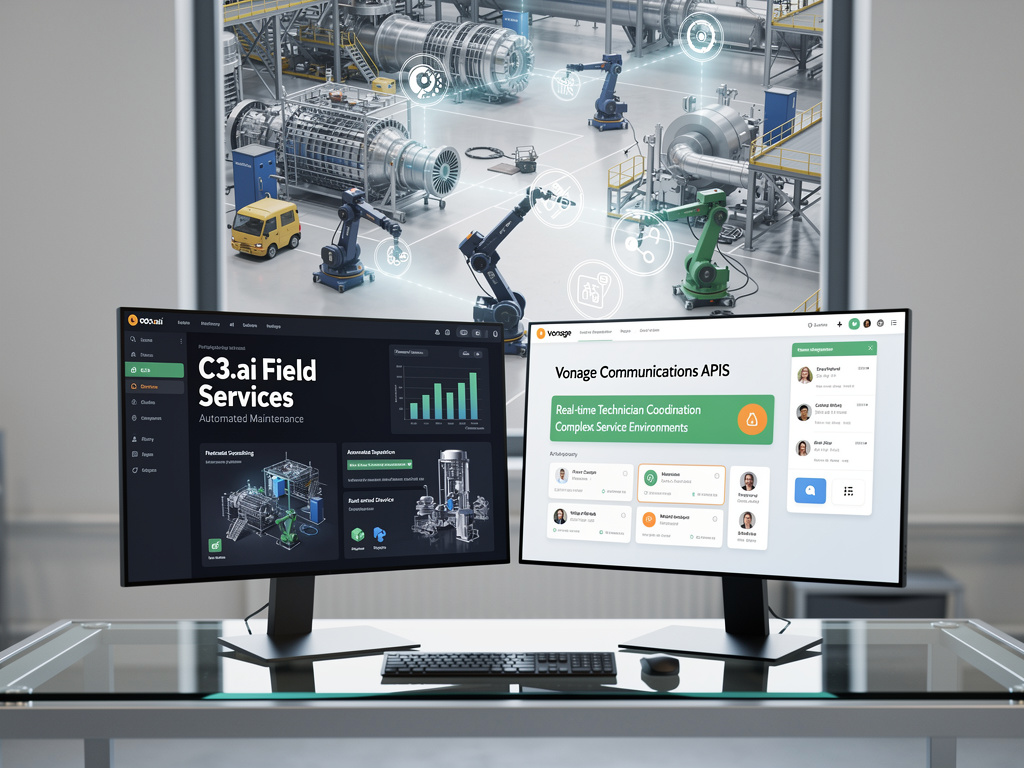
In the enterprise software arena, where artificial intelligence is rapidly moving from boardroom buzzword to operational backbone, a new partnership between C3.ai and Vonage signals a meaningful shift in how companies may soon manage their field service operations. The collaboration, which marries C3.ai’s enterprise AI platform with Vonage’s communications APIs, has produced the C3 AI Field Services module — a product that aims to bring agentic AI directly into the hands of technicians, dispatchers, and service managers working in some of the most complex industrial environments on the planet.
The announcement, first reported by Yahoo Finance, represents more than a typical technology integration. It is a calculated bet by both companies that agentic AI — autonomous AI systems capable of taking actions and making decisions with minimal human intervention — is ready for deployment in mission-critical enterprise workflows. For industry insiders tracking the evolution of AI from analytical tool to autonomous agent, this partnership offers a compelling case study.
What C3 AI Field Services Actually Does — And Why It Matters
The C3 AI Field Services module is designed to optimize the end-to-end workflow of field service operations. That includes everything from predictive maintenance and work order management to technician scheduling, dispatching, and real-time communication. By integrating Vonage’s communication platform — which provides voice, video, messaging, and verification APIs — the module enables seamless, AI-orchestrated interactions between field workers, back-office systems, and customers.
At its core, the solution leverages C3.ai’s enterprise AI capabilities to analyze vast quantities of operational data — sensor readings from industrial equipment, historical maintenance records, parts inventory levels, weather data, and more — and then uses that analysis to drive automated decision-making. A technician arriving at a job site, for instance, could receive AI-generated diagnostic recommendations before even opening a panel, while dispatchers could see optimized routing and scheduling suggestions that account for real-time variables like traffic, technician skill sets, and parts availability.
Vonage’s Role: The Communications Layer That Makes Agentic AI Actionable
Vonage, a subsidiary of Ericsson, brings a critical piece to the puzzle that pure AI companies often lack: a robust, globally scalable communications infrastructure. Through its APIs, Vonage enables the C3 AI Field Services module to facilitate real-time voice and video calls between technicians and remote experts, send automated SMS notifications to customers about appointment windows, and provide secure verification for service confirmations. This communications layer transforms AI insights from passive recommendations into active, executable workflows.
The integration is particularly significant because field service operations have historically been plagued by communication breakdowns — missed appointments, delayed parts orders, and technicians arriving without the right information or tools. By embedding Vonage’s communications capabilities directly into the AI-driven workflow, C3.ai is attempting to close those gaps in a way that feels native rather than bolted on. The result is what both companies are positioning as a truly agentic system: one that doesn’t just analyze and recommend but actually initiates actions, coordinates stakeholders, and adapts in real time.
The Agentic AI Thesis: From Copilot to Autonomous Operator
The term “agentic AI” has become one of the most closely watched concepts in enterprise technology circles in 2025. Unlike traditional AI systems that serve as copilots — offering suggestions that humans must then act on — agentic AI systems are designed to operate with a degree of autonomy. They can initiate workflows, make decisions within defined parameters, and interact with multiple systems and stakeholders without requiring constant human oversight.
C3.ai CEO Thomas Siebel has been an outspoken advocate for the transformative potential of enterprise AI, and the company’s pivot toward agentic capabilities reflects a broader industry trend. Competitors including Salesforce with its Agentforce platform, Microsoft with its Copilot agents, and ServiceNow with its AI agent offerings are all racing to establish dominance in the agentic AI space. The C3.ai-Vonage partnership is a direct response to this competitive pressure, offering a differentiated approach that combines deep industrial AI expertise with best-in-class communications technology.
Why Field Services Is a Prime Testing Ground for Autonomous AI
Field service management is an industry segment worth tens of billions of dollars globally, encompassing utilities, telecommunications, oil and gas, manufacturing, and healthcare equipment maintenance, among other sectors. It is also an area where inefficiency carries enormous costs. According to industry estimates, unplanned downtime in manufacturing alone costs companies billions annually, and poor field service execution is a leading contributor.
The complexity of field operations — which involve coordinating people, parts, equipment, and information across geographically dispersed locations — makes them an ideal proving ground for agentic AI. Traditional field service management software from companies like ServiceMax, IFS, and Oracle has focused primarily on digitizing existing workflows. The C3.ai approach, by contrast, seeks to reimagine those workflows entirely, using AI to predict failures before they occur, automatically generate and prioritize work orders, and dynamically adjust schedules and resource allocations as conditions change throughout the day.
C3.ai’s Strategic Positioning and Market Implications
For C3.ai, the Vonage partnership comes at a pivotal moment. The company, which went public in December 2020, has faced scrutiny from investors over its path to profitability and its ability to scale its enterprise AI platform against well-funded competitors. The stock has experienced significant volatility, and the company has been working to demonstrate that its technology can deliver measurable ROI in specific, high-value use cases rather than serving as a general-purpose AI platform.
Field services represents exactly the kind of vertical-specific application that could help C3.ai build a more compelling growth narrative. By partnering with Vonage rather than building communications capabilities in-house, C3.ai is also demonstrating a pragmatic approach to product development — leveraging best-of-breed technology through partnerships rather than attempting to do everything itself. This strategy mirrors what many successful enterprise software companies have done historically, and it allows C3.ai to move faster while keeping development costs manageable.
Ericsson’s Vonage Bet Gets a New Chapter
For Vonage and its parent company Ericsson, the partnership validates the strategic logic behind Ericsson’s $6.2 billion acquisition of Vonage in 2022. That deal, which was met with skepticism by some analysts who questioned whether a telecommunications infrastructure giant could successfully integrate a cloud communications platform, was predicated on the idea that Vonage’s APIs would become essential building blocks for next-generation enterprise applications. The C3.ai collaboration is a concrete example of that thesis playing out.
Vonage’s communications platform as a service (CPaaS) business has been growing as more enterprises seek to embed real-time communications into their applications and workflows. The field services use case is particularly attractive because it involves high-frequency, high-value interactions — exactly the kind of usage pattern that drives meaningful revenue for CPaaS providers. Each dispatched technician, each customer notification, each remote expert consultation represents API calls that generate revenue for Vonage.
Challenges and Open Questions for the Partnership
Despite the strategic logic, significant questions remain. Enterprise AI deployments are notoriously complex, often requiring extensive data integration, change management, and customization. Field service organizations, many of which still rely on legacy systems and manual processes, may face substantial hurdles in adopting a fully AI-driven approach. The success of the C3 AI Field Services module will depend not just on the sophistication of its algorithms but on its ability to integrate with existing enterprise resource planning systems, customer relationship management platforms, and operational technology infrastructure.
There is also the question of trust. Agentic AI systems that make autonomous decisions in safety-critical environments — such as utility maintenance or oil and gas operations — will need to demonstrate exceptional reliability and transparency. Technicians and managers will need to understand why the AI is making specific recommendations and have confidence that its decisions are sound. Building that trust will require not just technical excellence but thoughtful user experience design and robust governance frameworks.
What This Means for the Broader Enterprise AI Market
The C3.ai-Vonage alliance is emblematic of a broader trend in enterprise AI: the movement from horizontal platforms to vertical, workflow-specific solutions. As the initial excitement around large language models and generative AI gives way to the harder work of delivering measurable business value, partnerships like this one — which combine domain expertise, AI capabilities, and enabling infrastructure — are likely to become increasingly common.
For investors, customers, and industry observers, the key metric to watch will be adoption. Can C3.ai and Vonage convert the promise of agentic AI into signed contracts, deployed systems, and demonstrable improvements in field service efficiency? The technology appears sound, the market need is real, and the partnership structure is logical. Now comes the hard part: execution in the field, where AI meets the physical world and the true test of any enterprise technology begins.


 WebProNews is an iEntry Publication