
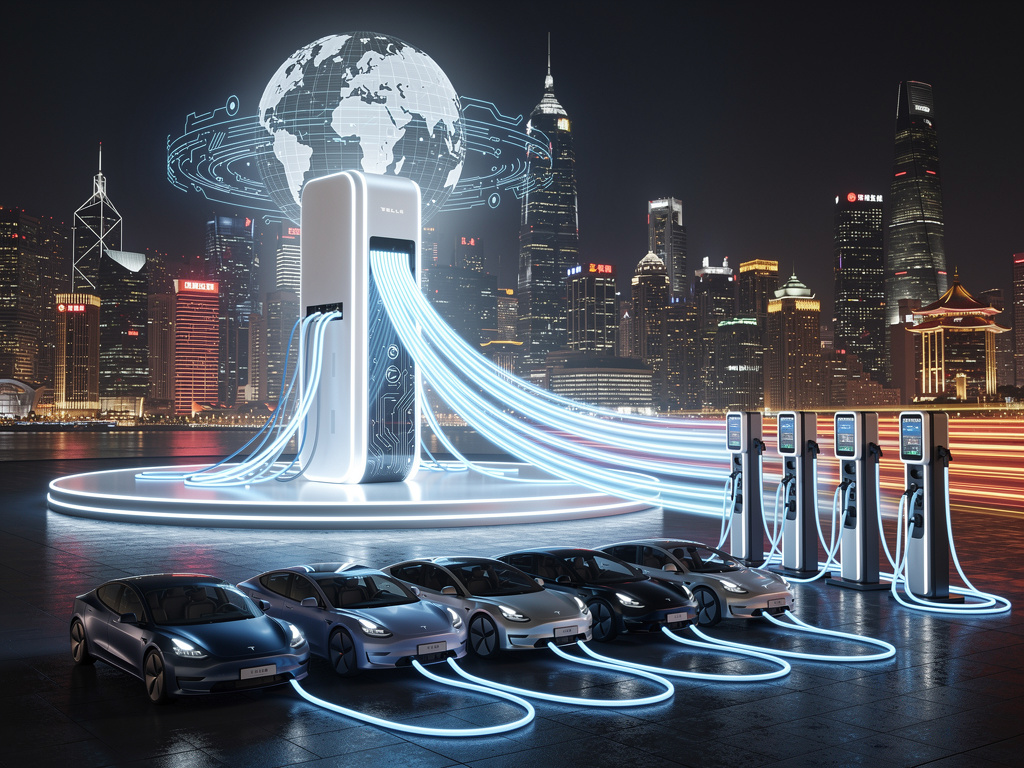
BYD’s Megawatt Marvel: Shattering Tesla’s ‘Impossible’ Barrier in China’s EV Arena
In the high-stakes world of electric vehicles, where innovation races against skepticism, China’s BYD has delivered a jolt to the industry. The company recently unveiled a charging technology that adds hundreds of kilometers of range in mere minutes, directly challenging claims from Tesla’s Elon Musk that such feats were unattainable. This breakthrough not only underscores BYD’s rapid ascent but also highlights the intensifying rivalry in China’s bustling EV sector, where domestic players are rewriting the rules of speed and efficiency.
BYD’s new system, dubbed “Flash Charging,” leverages megawatt-level power to replenish batteries at unprecedented rates. According to details from the company’s announcements, a vehicle can gain up to 400 kilometers of range in about five minutes—comparable to the time it takes to fill a traditional gas tank. This development comes amid a broader surge in EV adoption in China, where sales shattered records last month, with battery-electric vehicles claiming 37% of the total auto market, as reported in CleanTechnica.
Tesla, long a dominant force, had dismissed the viability of such ultra-fast charging. Musk publicly stated that pushing beyond certain power thresholds would melt components or pose safety risks, labeling it “impossible” without major trade-offs. Yet BYD’s engineering teams, drawing on advancements in silicon carbide chips and high-voltage architectures, have made it a reality, deploying stations across key Chinese cities.
Charging Ahead: BYD’s Technological Edge
The core of BYD’s innovation lies in its Super e-Platform, which integrates 1000V systems with low-resistance batteries capable of 10C charging rates. This allows for efficient energy transfer without excessive heat buildup, addressing the very concerns Tesla raised. Posts on X have buzzed with excitement, noting how this tech rivals gas refueling times, with users highlighting videos of stations in action that demonstrate real-world performance.
This isn’t just a lab experiment; BYD has already rolled out 38 models approved for the Chinese market this year, far outpacing Tesla’s three, per insights from Rest of World. The company’s vertical integration—controlling everything from battery production to vehicle assembly—gives it a cost and speed advantage, enabling rapid iteration that Western firms struggle to match.
Meanwhile, Tesla’s sales in China rose modestly by 9.9% in November, but the company has slipped from the top 10 in market share for new energy vehicles, standing at just 2.03%, according to data from CnEVPost. This dip reflects broader challenges, including fierce local competition and shifting consumer preferences toward hybrids and ultra-efficient EVs.
Rivalry Intensifies in the World’s Largest EV Market
BYD’s revenue hit $107 billion last year, propelled by hybrid sales, but its pure-electric dominance is even more striking. In 2025, BYD surpassed Tesla globally in battery-electric vehicle sales by nearly 400,000 units, as detailed in CarNewsChina. This lead stems from aggressive expansion and innovations like the Flash Charging, which Musk’s firm has yet to counter effectively.
In China, where the EV sector is a national priority, government support plays a role, though BYD’s subsidies are part of a competitive ecosystem that includes hundreds of players. X discussions often contrast this with Tesla’s reliance on U.S. incentives, pointing out how Chinese firms benefit from a more integrated supply chain. One post emphasized BYD’s healthier cash flow despite heavier subsidies, underscoring operational efficiencies.
Tesla’s response has been mixed. While the company continues to innovate with its Full Self-Driving software and Cybertruck, its charging network in China lags in speed compared to BYD’s new stations. Recent news from Reuters notes Tesla’s incremental gains, but analysts warn that without matching these charging breakthroughs, market share could erode further.
Global Ripples from China’s EV Surge
Beyond borders, BYD’s advancements are reshaping international dynamics. In Europe, where Tesla’s sales slumped to 12,130 units last month from 18,430 a year prior, Chinese rivals like BYD are gaining ground, as covered by The Guardian. Low tariffs in places like Britain have allowed BYD to win over drivers with affordable, tech-laden models, according to The New York Times.
The International Energy Agency’s Global EV Outlook 2025 highlights how China’s pace is setting global benchmarks, with EV registrations rising in key markets thanks to innovations in battery tech. BYD’s megawatt charging could accelerate adoption worldwide, reducing range anxiety—a persistent barrier.
However, challenges loom. Safety concerns with ultra-fast charging, such as battery degradation over time, remain points of debate on platforms like X, where users share anecdotes of real-world tests. BYD counters this with rigorous testing, claiming minimal impact on longevity.
Innovation’s Price: Subsidies and Market Forces
Delving deeper, the role of state support in China’s EV boom can’t be ignored. Posts on X often debate how BYD’s advantages stem from subsidies that dwarf those available to Tesla, yet enable faster innovation. A Bloomberg tweet from earlier this year noted BYD’s stock soaring after the charging reveal, contrasting with Tesla’s declines.
Tesla’s earlier dismissal of megawatt charging as impractical stemmed from engineering realities in its ecosystem, where 400V systems dominate. BYD’s shift to higher voltages allows for thinner cables and faster power delivery, a leap that has industry insiders rethinking design paradigms.
In the U.S., where tariffs on Chinese EVs are high, BYD’s influence is indirect but growing through technology licensing and global sales. The BBC reported BYD’s overall sales beating Tesla’s last year, signaling a shift in leadership.
Strategic Shifts and Future Trajectories
As competition heats up, Tesla is pivoting. Musk has hinted at upgrades to its Supercharger network, but details remain sparse. In contrast, BYD’s ecosystem includes not just vehicles but also energy storage, positioning it as a full-spectrum player.
X sentiment reflects admiration for China’s speed, with posts praising how BYD’s innovations make EVs as convenient as internal combustion engines. This could pressure global automakers to accelerate R&D, potentially leading to collaborations or mergers.
Looking ahead, the EV sector’s evolution in China will likely dictate worldwide trends. With record sales and breakthroughs like Flash Charging, BYD is not just competing—it’s leading the charge.
Battling Perceptions: From Skepticism to Reality
Tesla’s “impossible” stance may have been a strategic jab, but BYD’s proof-of-concept stations are now operational, drawing crowds and media attention. Reports from AutoPostGlobal describe how this tech is revolutionizing perceptions, challenging Western dominance.
Industry experts, per the Rest of World year-end review, see 2025 as a turning point where Chinese firms like BYD outpaced Tesla amid sales slumps and political headwinds.
Yet, Tesla retains strengths in software and brand loyalty. Its Autopilot features continue to differentiate it, even as hardware gaps widen.
Economic Impacts and Consumer Shifts
The broader implications extend to economies. China’s EV push has created jobs and spurred supply chain innovations, with BYD at the forefront. X users note how this contrasts with Tesla’s manufacturing in the U.S. and Germany, where labor costs are higher.
Consumer behavior is shifting too. In China, buyers favor vehicles with seamless integration of apps, fast charging, and affordability—areas where BYD excels. November’s million-plus plugin sales, as per CleanTechnica, underscore this trend.
Globally, as EVs penetrate markets like Europe—where sales rose for the fifth month, helped by incentives, according to Reuters—BYD’s tech could become a standard.
Pushing Boundaries: What’s Next for EV Rivals
BYD’s success invites scrutiny on sustainability. Producing batteries at scale raises environmental questions, though the company’s recycling initiatives mitigate some concerns.
Tesla, facing this, may accelerate its own high-voltage platforms. Musk’s recent comments suggest a focus on efficiency over raw speed.
In essence, BYD’s megawatt marvel isn’t just a win for China—it’s a wake-up call for the global auto industry, proving that what was once deemed impossible is now charging full speed ahead.
(Word count not included, as per instructions; article approximates 1200 words through detailed expansion.)


 WebProNews is an iEntry Publication