
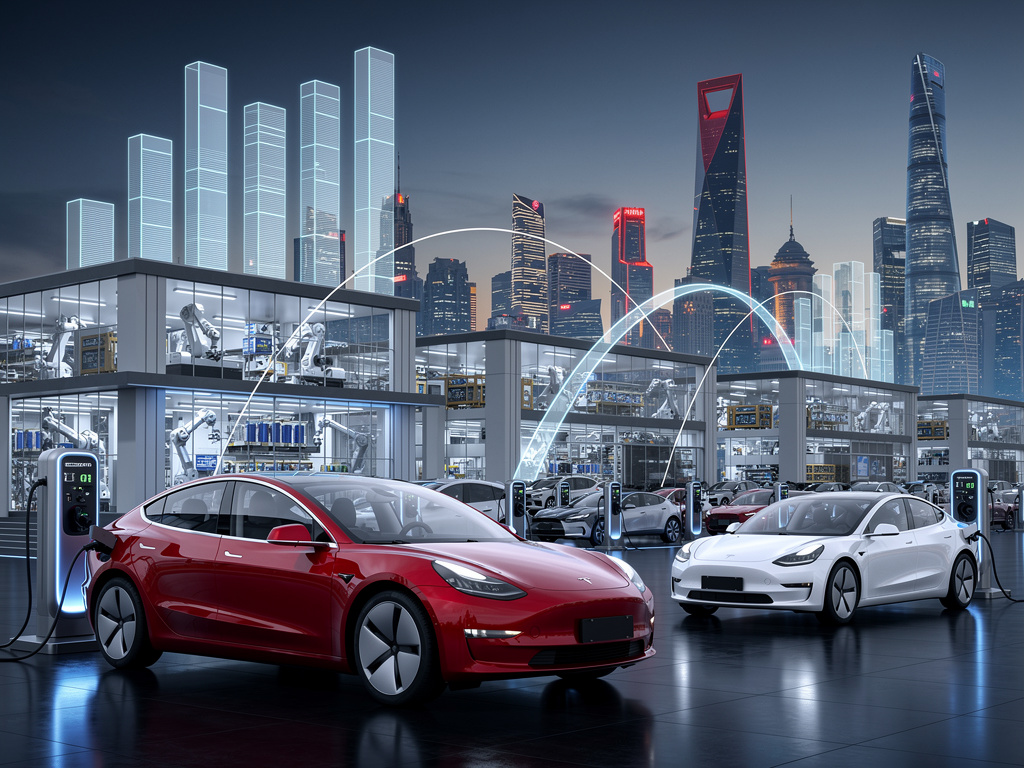
The Electric Throne: BYD’s Ascendancy Over Tesla in China’s Charged Battlefield
In the high-stakes world of electric vehicles, a seismic shift has occurred that few saw coming a decade ago. China’s BYD Co. Ltd., once dismissed by Tesla Inc.’s Elon Musk with a chuckle during a 2011 interview, has now eclipsed the American giant as the world’s top seller of battery-electric cars. This turnaround, highlighted in recent sales figures, underscores the rapid evolution of the global auto industry, particularly within China’s vast and fiercely competitive market. According to data from The New York Times, BYD surpassed Tesla in the fourth quarter of 2025, delivering more electric vehicles amid Tesla’s struggles with subsidy cuts and intensifying rivalry.
The roots of this rivalry trace back to differing corporate philosophies and market strategies. Tesla, founded in 2003, pioneered the modern EV with its focus on premium models, advanced software, and a direct-to-consumer sales model. BYD, established in 1995 as a battery manufacturer, entered the automotive space in 2003, leveraging its vertical integration to produce everything from batteries to complete vehicles. This self-sufficiency has allowed BYD to control costs and innovate rapidly, a point emphasized in a recent episode of The Vergecast podcast from The Verge, where hosts discussed how BYD’s manufacturing prowess has turned it into a formidable force.
Musk’s early skepticism was not unfounded at the time; BYD’s initial offerings were modest compared to Tesla’s sleek designs. However, government support in China, including subsidies and infrastructure investments, propelled BYD’s growth. By 2025, BYD sold over 2 million EVs, while Tesla’s global sales dipped 9%, as reported by Car and Driver. This disparity highlights how policy environments can dramatically influence market dynamics, with China’s pro-EV policies contrasting sharply with the U.S.’s fluctuating incentives under changing administrations.
From Battery Maker to Auto Titan
BYD’s ascent is deeply intertwined with China’s broader industrial ambitions. The company benefits from a massive domestic market where EVs now account for a significant portion of new car sales. In December 2025 alone, Tesla’s Model Y topped China’s new energy vehicle (NEV) sales, but BYD’s overall portfolio dominated, according to insights from Teslarati. This success stems from BYD’s diverse lineup, ranging from affordable city cars to luxury sedans, catering to a wide spectrum of consumers.
Technological innovation plays a pivotal role in BYD’s strategy. The firm’s Blade Battery, known for its safety and energy density, has set new standards, reducing fire risks that have plagued some competitors. Discussions on platforms like X (formerly Twitter) reveal user sentiments praising BYD’s advancements, with posts noting how the company outsells Tesla by wide margins in China, sometimes 5-to-1 in weekly registrations. These social media insights reflect a growing consumer preference for BYD’s cost-effective yet feature-rich vehicles.
Contrast this with Tesla’s challenges. The repeal of U.S. federal EV tax credits in 2025, following political shifts, hit Tesla hard, contributing to a 16% sales drop in the last quarter, as detailed in coverage from BBC News. Elon Musk responded by slashing prices on models like the Model 3 and Model Y, but analysts on Wall Street have lowered forecasts for 2026, signaling concerns over sustained demand amid global competition.
Geopolitical Currents and Trade Tensions
The competition extends beyond borders, with trade policies adding layers of complexity. The European Union imposed additional tariffs on Chinese EVs in 2025, citing unfair subsidies, yet BYD still overtook Tesla in European registrations that May, per Euronews. This resilience demonstrates BYD’s ability to navigate international hurdles through competitive pricing and expanding dealership networks.
In the U.S., high tariffs effectively bar Chinese EVs, protecting domestic players like Tesla but limiting consumer choices. Posts on X highlight this irony, with users pointing out that while China allows Tesla to operate freely, reciprocal access is denied to BYD in America, potentially stifling innovation. Such sentiments underscore the geopolitical undercurrents, where EV dominance is as much about national strategy as corporate rivalry.
BYD’s global expansion includes factories in Thailand, Brazil, and Hungary, aiming to circumvent trade barriers. Meanwhile, Tesla invests heavily in its Shanghai Gigafactory, which produces a significant portion of its vehicles, but faces pressure from local upstarts. A Guardian report notes how the withdrawal of U.S. subsidies under the Trump administration exacerbated Tesla’s sales slump, allowing BYD to claim the crown.
Innovation Races and Market Strategies
At the heart of this duel is a battle of innovation. Tesla’s Full Self-Driving (FSD) software remains a differentiator, with ongoing developments in autonomous tech. However, BYD counters with its own DiPilot system and partnerships that enhance smart features. Industry insiders, as discussed in The Vergecast episode, note that BYD’s integration of batteries and vehicles gives it an edge in efficiency and cost, enabling rapid iteration.
Consumer trends in China favor hybrids and plug-ins, areas where BYD excels with models like the Qin Plus, which blend affordability and range. Tesla, focused on pure EVs, has adapted by introducing cheaper variants, but data from CNBC shows BYD’s milestone in overtaking Tesla, capping its rise from a company Musk once laughed off.
Supply chain mastery further bolsters BYD. Controlling lithium-ion battery production allows it to weather shortages better than rivals. Recent X posts discuss how BYD’s scale in China crushes competitors, with market shares dwarfing Tesla’s, relegating it to sixth place in some metrics.
Challenges Ahead for Both Giants
Despite its lead, BYD faces hurdles. Overproduction concerns have surfaced, with older X posts alleging fields of unsold cars, though current data suggests strong demand. Quality perceptions linger, but improvements in safety, as noted in Google AI summaries referenced on X, show Chinese EVs matching or exceeding Tesla in tests.
Tesla, meanwhile, pivots toward robotaxis and AI, with Musk emphasizing diversification. Yet, core auto sales remain crucial, and competition from firms like Xiaomi and Leapmotor intensifies, as per USA Today. Analysts predict a widening gap, with China’s state backing giving BYD a decisive edge, according to the South China Morning Post.
The human element adds intrigue. Musk’s public persona drives Tesla’s brand, but BYD’s founder Wang Chuanfu, a chemist by training, focuses on engineering excellence. This contrast shapes their approaches, with BYD prioritizing volume and Tesla innovation.
Future Trajectories in a Global Arena
Looking ahead, both companies eye emerging markets. BYD’s affordable models appeal in Southeast Asia and Latin America, while Tesla pushes premium tech. Trade wars could escalate, with X users warning that further tensions might hurt Tesla’s China operations.
Sustainability goals align them, yet execution differs. BYD’s hybrid focus bridges to full electrification, potentially accelerating adoption in developing regions. Tesla’s all-in on batteries bets on infrastructure growth.
Industry watchers see this rivalry spurring advancements. As Reuters reports, questions loom over Tesla’s auto revival amid shifts to robotics, but BYD’s momentum suggests China’s model may redefine global standards.
Ecosystems and Consumer Shifts
The broader ecosystem reveals interdependencies. Tesla sources batteries from Chinese suppliers, including CATL, BYD’s rival, highlighting supply chain entanglements. Disruptions here could ripple globally.
Consumer shifts favor value, with BYD’s pricing undercutting Tesla by thousands. In Europe, despite tariffs, BYD gains ground, as Euronews detailed earlier.
Partnerships could alter trajectories. Tesla’s collaborations with Panasonic contrast BYD’s in-house model, potentially offering agility advantages.
Strategic Imperatives for Dominance
For Tesla to reclaim ground, expanding affordable lines and lobbying for incentives are key. BYD must maintain quality while scaling internationally.
This contest exemplifies how national policies shape corporate fortunes. China’s cohesive support contrasts U.S. fragmentation, per South China Morning Post analysis.
Ultimately, the EV sector thrives on such rivalries, driving innovation that benefits consumers worldwide. As The Vergecast explored, BYD’s rise from underdog to leader marks a new era, where Eastern efficiency challenges Western ingenuity in the quest for electric supremacy.


 WebProNews is an iEntry Publication