
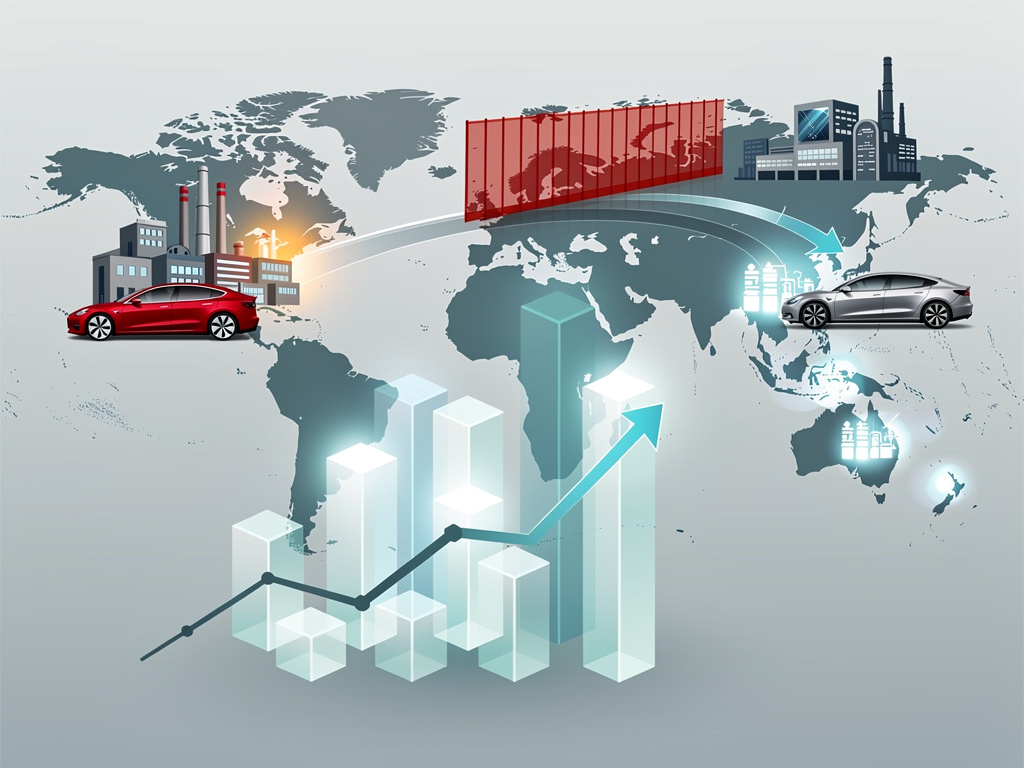
The Chinese electric vehicle giant BYD isn’t waiting for an invitation. It’s building factories in Mexico, Hungary, Brazil, Thailand, and Indonesia. It’s selling cars in more than 70 countries. And it just posted quarterly revenue that, for the first time, exceeded Tesla’s.
Yet in the United States — the world’s second-largest auto market — BYD sells exactly zero passenger vehicles. The question that should keep Detroit and Palo Alto executives awake at night isn’t whether BYD will eventually enter the American market. It’s what happens to the competitive order when it does.
As Motley Fool recently reported, BYD is closing in on the U.S. from multiple directions, even as Tesla retains significant structural advantages on American soil. The dynamic between these two companies — one ascending globally with ferocious speed, the other defending home turf with brand loyalty and an installed charging network — is shaping up to be the defining rivalry of the next decade in automotive.
The Revenue Crossover Nobody Expected This Soon
BYD’s rise has been nothing short of staggering. In Q4 2024, the Shenzhen-based company reported revenue of approximately $29.4 billion, surpassing Tesla’s $25.7 billion for the same period. That marked the first time BYD overtook Tesla on a quarterly revenue basis. Full-year 2024 revenue for BYD hit roughly $107 billion, still trailing Tesla’s $97.7 billion — wait. Read that again. BYD’s full-year revenue actually exceeded Tesla’s by nearly $10 billion when including its non-automotive businesses.
The comparison requires nuance. BYD is a conglomerate. It manufactures batteries, semiconductors, solar panels, and rail transit systems in addition to cars. Tesla, while diversified into energy storage and solar, derives the vast majority of its revenue from vehicle sales. But the headline number matters to investors, and BYD’s trajectory is unmistakable.
In unit terms, BYD delivered over 4.27 million vehicles globally in 2024, compared with Tesla’s 1.79 million. Not all of BYD’s vehicles are fully electric — about half are plug-in hybrids — but the sheer volume tells a story of manufacturing scale that Tesla hasn’t matched.
And the gap is widening. BYD’s January-March 2025 sales surged over 58% year-over-year. Tesla’s global deliveries, meanwhile, declined in Q1 2025, dropping to roughly 337,000 vehicles — a figure that alarmed Wall Street and sent the stock into a tailspin earlier this spring.
So how did a company that most American consumers have never heard of get here?
The answer involves vertical integration taken to an extreme. BYD manufactures its own battery cells — it is, in fact, the world’s second-largest EV battery maker behind CATL. It designs its own semiconductors. It produces its own electric motors. This level of in-house control gives BYD cost advantages that most Western automakers simply cannot replicate. The company’s entry-level Seagull EV retails for under $10,000 in China. Even after tariffs, shipping, and compliance costs, the underlying economics are jarring.
Warren Buffett’s Berkshire Hathaway was an early investor in BYD, taking a stake in 2008. Berkshire has trimmed its position in recent years but still holds a meaningful share — a quiet endorsement from the Oracle of Omaha that speaks to BYD’s long-term fundamentals.
The company’s technology portfolio has also expanded rapidly. In early 2025, BYD unveiled its “God’s Eye” advanced driver-assistance system, which it plans to offer as standard equipment across its entire lineup — including its cheapest models. That’s a direct challenge to Tesla’s approach of charging thousands of dollars for its Full Self-Driving software. As Motley Fool noted, this move could pressure Tesla to reconsider its FSD pricing strategy globally, particularly in markets where BYD competes head-to-head.
Then there’s charging speed. BYD introduced a new architecture capable of adding nearly 250 miles of range in just five minutes. Tesla’s Supercharger network remains the gold standard in the U.S., but BYD’s charging technology — if it performs as advertised in real-world conditions — would neutralize one of the most common objections to EV adoption: the time it takes to recharge.
The American Fortress — and Its Cracks
Tesla’s position in the United States remains formidable. It commands roughly 49% of the American EV market, down from over 60% a few years ago but still dominant by any measure. The Supercharger network, with over 2,600 stations and 30,000+ connectors across the country, is a physical asset that no competitor can quickly replicate. And Tesla’s brand recognition among American consumers is unmatched in the EV category.
But the fortress has cracks.
Tesla’s U.S. market share has eroded as legacy automakers like Ford, GM, Hyundai, and BMW have launched competitive electric models. The Model 3 and Model Y, while still strong sellers, are aging designs. The Cybertruck has generated attention but hasn’t moved the sales needle in volume terms. And CEO Elon Musk’s increasingly polarizing public persona — his role in the Trump administration’s Department of Government Efficiency, his prolific and controversial activity on X — has created a brand perception problem that shows up in survey data and, some analysts argue, in order cancellations.
A February 2025 survey by automotive research firm Caliber found that Tesla’s brand perception among U.S. Democrats had turned sharply negative, while even among Republicans, purchase intent hadn’t risen proportionally. The net effect: a narrower addressable market for Tesla in its home country at precisely the moment competition is intensifying.
BYD, for its part, faces enormous barriers to U.S. entry. The current tariff regime imposes a 27.5% duty on Chinese-made vehicles, and the Biden-era tariff increases on Chinese EVs pushed the effective rate to over 100%. The Trump administration has shown no inclination to lower these barriers — quite the opposite. National security concerns about Chinese-connected vehicles, data privacy, and supply chain dependencies add regulatory hurdles beyond tariffs alone.
BYD’s response has been to build manufacturing capacity outside China. Its factory in Mexico — which could theoretically serve as a backdoor to the U.S. market via the USMCA trade agreement — has drawn intense scrutiny from Washington. Whether vehicles assembled in Mexico with Chinese components and technology would qualify for preferential trade treatment remains an open and politically charged question.
But tariffs aren’t permanent. Trade policy shifts with administrations. And BYD is playing a long game.
Consider the company’s strategy in Europe. BYD entered the European market cautiously, first with commercial vehicles and buses, then with passenger cars. It now sells models like the Atto 3, Dolphin, and Seal across multiple European countries. Its Hungarian factory, announced in late 2023, will give it local production capacity that sidesteps EU tariff concerns. The playbook is clear: establish a beachhead, build local manufacturing, and scale.
Could the same approach work in the Americas? BYD’s Brazilian factory is already operational. Its Mexican facility is under construction. If political conditions change — or if BYD finds a creative structural workaround — the company could be selling cars to American consumers within a few years, not a few decades.
The financial resources are there. BYD generated over $4.8 billion in net profit in 2024, a 34% increase year-over-year. Its balance sheet is strong, supported by the Chinese government’s industrial policy apparatus, which has provided subsidies, favorable lending terms, and infrastructure support that Western competitors view as unfair advantages. The European Commission launched an anti-subsidy investigation into Chinese EV makers in 2023, and preliminary findings led to proposed additional tariffs on BYD imports into the EU.
None of this has slowed BYD’s global expansion.
What the Market Is Pricing In — and What It’s Missing
Tesla trades at a valuation that implies far more than car sales. At roughly 90 times forward earnings as of early April 2025, the stock prices in expectations for autonomous driving, robotaxis, humanoid robots (Optimus), energy storage, and AI. Bulls argue that Tesla is a technology platform company that happens to make cars. Bears counter that the automotive business is deteriorating and the futuristic bets remain speculative.
BYD, by contrast, trades at approximately 23 times forward earnings — a fraction of Tesla’s multiple despite faster revenue growth and higher unit volumes. The valuation gap reflects several factors: BYD’s lower margins (it competes aggressively on price), its exposure to Chinese regulatory and geopolitical risk, limited access to Western capital markets, and the perception that it’s “just” a car company without Tesla’s optionality.
But that perception may be outdated. BYD’s semiconductor division, BYD Semiconductor, supplies chips not only to BYD’s own vehicles but to external customers. Its battery technology — particularly the Blade Battery, which uses lithium iron phosphate chemistry for improved safety and longevity — is licensed to other automakers. And its energy storage business is growing rapidly, putting it in direct competition with Tesla Energy.
For American investors, the practical question is straightforward: does Tesla’s U.S. dominance justify a valuation premium of this magnitude when its global market position is under sustained pressure from a competitor with lower costs, faster growth, and an aggressive international expansion strategy?
The answer depends on time horizon. In the near term — the next two to three years — Tesla’s American moat holds. The Supercharger network is a genuine competitive advantage. Brand loyalty among existing Tesla owners remains high. And BYD faces near-insurmountable tariff barriers to direct U.S. sales.
But zoom out five years, and the picture gets murkier. BYD’s manufacturing footprint will be global by then. Its technology — in batteries, charging, and driver assistance — is advancing at a pace that matches or exceeds Tesla’s in several dimensions. And trade policy is inherently cyclical; the tariff walls that protect Tesla today could be lowered or restructured by a future administration seeking cheaper EVs for American consumers or diplomatic concessions from Beijing.
There’s also the question of what happens in third markets. In Southeast Asia, Latin America, the Middle East, and Africa, BYD is establishing itself as the default affordable EV brand. Tesla has limited presence in these regions. If the global EV market’s center of gravity shifts toward emerging economies — where price sensitivity is highest — BYD’s cost structure gives it an advantage that Tesla cannot easily counter without fundamentally restructuring its product lineup.
The rivalry between Tesla and BYD isn’t a zero-sum game. The global EV market is still growing, and both companies can succeed simultaneously. But the era of Tesla as the unchallenged leader of the electric vehicle industry is over. BYD has the scale, the technology, the capital, and the ambition to compete at every level.
The only thing it doesn’t have — yet — is access to American driveways. For Tesla investors banking on U.S. market dominance as a permanent condition, that word “yet” should loom large.


 WebProNews is an iEntry Publication