
Enterprise leaders keep writing checks for artificial intelligence. They show few signs of stopping. Even as some big names burn through annual budgets in months and analysts question the payoff, data points to commitment rather than retreat.
Retention Rates Signal Lasting Change
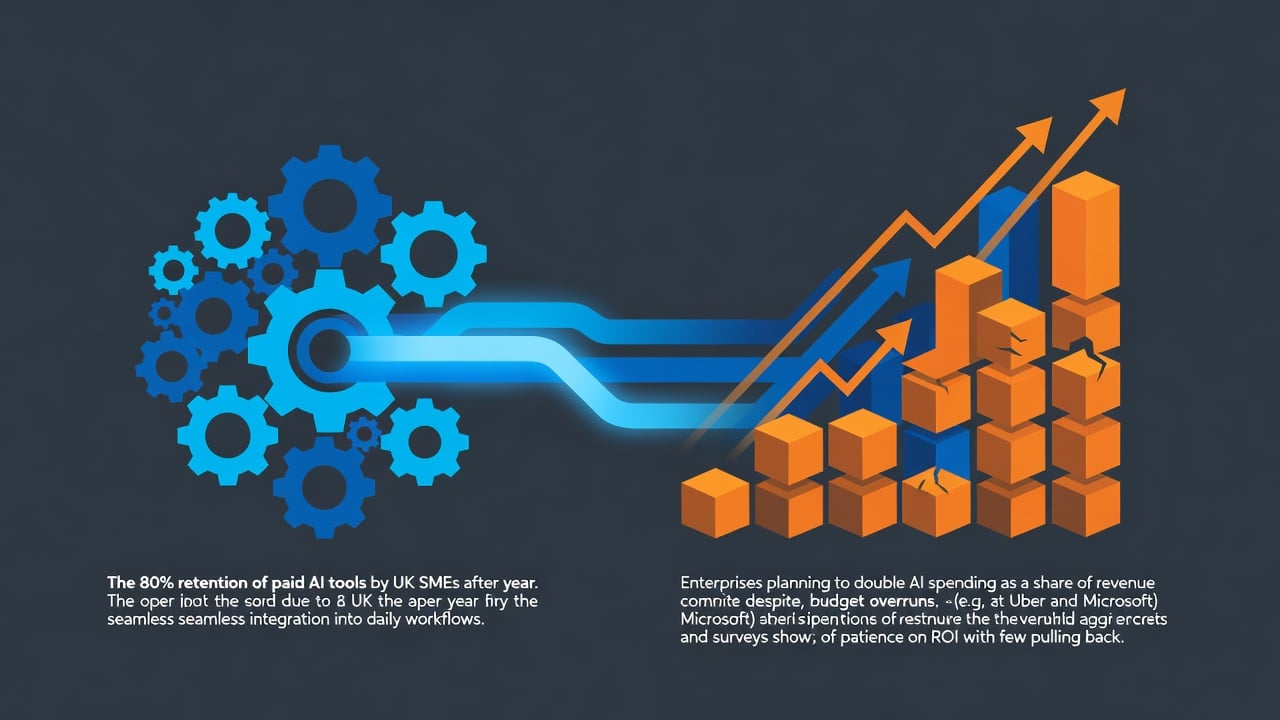
Nearly eight in ten UK small and midsize businesses that paid for AI tools in 2024 still paid a year later. That figure comes from TechRadar. Businesses do not keep spending on software that fails to deliver. They renew because the tools have woven themselves into daily operations. Admin tasks. Data processing. Customer service. These areas see the heaviest use among smaller outfits. AI removes friction. It lets small teams move faster without adding headcount.
And the integration runs deeper than standalone apps. Many companies now find AI capabilities baked into the systems they already run for invoicing, reporting, and communications. Remove the AI and entire workflows break. Rebuild them from scratch. That reality drives retention far more than any pilot enthusiasm. Ciarán Quilty, SVP International at Intuit, notes in the TechRadar piece that AI lets small teams operate with the governance and delivery capacity once reserved for larger organizations. The value feels practical. Measurable. Not experimental.
Yet caution persists. Businesses hesitate to hand AI full control over legal calls, personnel moves, or major financial choices. Human oversight stays central there. Trust issues explain the boundary. Routine work gets automated. High-stakes judgment does not. This selective approach explains why tools stick. They solve clear problems without overstepping.
Contrast that with past technology waves. Earlier software waves left companies with fragmented systems, overlapping licenses, and mounting frustration. AI appears different. It often enhances what already exists rather than layering on yet another login. Smaller businesses, operating on thin margins, notice the difference immediately. If it does not save time or reduce pressure, it gets cut. Many AI implementations survive that test.
Larger organizations mirror some of this pattern. A Boston Consulting Group survey of 2,360 executives found companies plan to spend about 1.7% of revenue on AI this year. That more than doubles the 0.8% average from the prior period, according to a CFO.com report from January. Technology firms lead at 2.1%. Every industry tracked expects higher outlays. Only 6% of executives said they would reduce investment if current projects fail to deliver in 2026. Patience appears real. CEOs have stepped up as primary decision makers. Their job security increasingly ties to AI outcomes.
But the bills create tension. Uber reportedly exhausted its entire 2026 AI coding budget by April. The company had rolled out cloud coding tools to roughly 5,000 engineers late last year. Adoption hit 95%. Costs followed. Microsoft has pulled back on certain third-party AI licenses for engineers, partly for cost control, as detailed in a Forbes analysis from May. A four-person startup cited in the same story ran up a $113,000 AI bill in one month. These examples highlight a broader worry. Expenses can outrun productivity gains quickly.
OpenAI missed internal revenue and user targets, according to a Wall Street Journal report referenced in the Forbes piece. Its chief financial officer expressed concern about covering future computing contracts if growth lags. Hyperscalers collectively plan hundreds of billions in capital spending. Goldman Sachs estimates tech companies could spend $7.6 trillion through 2031 on data centers alone. A recent CBS News article from this week captures investor nervousness. The Nasdaq slipped nearly 5% amid fears that trillions poured into AI infrastructure may not yield matching revenue or profit. Kate Brennan of the AI Now institute told CBS News the returns simply are not materializing at the scale promised.
So why the continued spend? Gartner forecasts worldwide AI investment will reach $2.5 trillion in 2026. A later update pushed the figure to $2.59 trillion. Enterprises drive much of the growth in generative models and agents. Deloitte’s 2026 State of AI report shows worker access to AI jumped 50% last year. The number of companies moving at least 40% of AI experiments into production is expected to double within six months. Momentum builds even when early results disappoint.
Klarna offered a cautionary tale. The payments firm scaled AI for customer service and claimed big efficiency wins at first. Months later it admitted over-automation hurt experience and began reintroducing human agents. The LinkedIn post by Bernard Marr in April highlighted this as a readiness problem, not pure automation failure. Processes must stabilize before AI scales safely. Many firms now grasp that lesson. They adjust rather than abandon.
Productivity data remains mixed. Some surveys show only 29% of companies report significant returns despite heavy investment. A WRITER survey referenced on LinkedIn found 59% of firms committing at least $1 million yet most see limited transformation. Still, average spend per U.S. employee on AI tooling has climbed to $400-$500 annually. Ramp data shows the share of businesses paying for AI services hovered near 44% late last year before climbing again to records in early 2026. Retention has improved. Over 80% of companies that subscribed in 2024 kept those subscriptions through year end. The figure was barely 50% in 2022.
Executives appear to bet on future gains. Agentic AI and multistep automation represent the fastest-growing spend category. Integration into existing enterprise software makes the cost feel like an upgrade rather than a new line item. That shift reduces the temptation to cancel. When AI sits inside Microsoft 365 or ERP platforms, the decision to drop it disrupts core operations. Businesses have built processes around it. They hesitate to unwind them.
Environmental impact and energy demands add another layer. Data centers consume massive power. New concerns about sustainability appear in surveys. Yet the infrastructure buildout continues. TrendForce projects hyperscalers will invest over $600 billion in AI infrastructure this year. The numbers keep rising even as some voices call for restraint.
Small and midsize firms may lead the way on pragmatism. They cannot afford vanity projects. When UK SMEs report using AI for concrete tasks that speed up work and cut admin, the tools earn their keep. Larger enterprises watch those outcomes. They look for similar embedded value rather than flashy demos. The era of pilot projects without clear paths to production appears to be fading. Scale or sunset has become the operating principle.
Challenges remain. Cybersecurity risks, regulatory hurdles, and skill gaps top many lists even if percentages have declined. Technical failures worry 38% of executives, up from prior readings. Boards demand better visibility into costs and returns. Some companies now track AI usage more rigorously. They tie budgets to measurable output instead of hype.
But the overall direction holds. Spending forecasts keep climbing. Adoption metrics improve. Retention data suggests companies have passed the experimental stage. AI has become part of the operational baseline for those who paid early and stuck with it. They are not walking away. They are figuring out how to make the economics work at greater scale. The coming quarters will test whether productivity finally catches the expense curve. For now the checks continue to clear.


 WebProNews is an iEntry Publication