
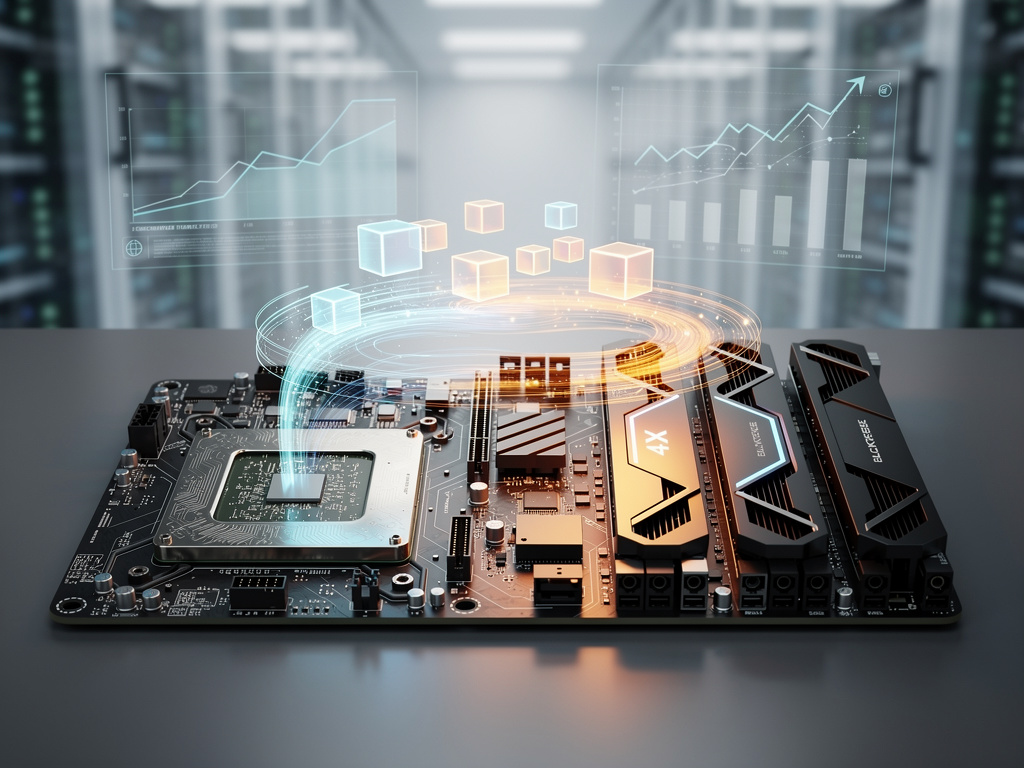
In the high-stakes arena of deep learning deployment, hardware inconsistencies have long exacted a heavy toll on engineers. The Burn framework’s 0.20 release, unveiled this week, confronts this challenge head-on by merging CPU and GPU kernel execution through its CubeCL backend. This move promises to streamline development while boosting performance across diverse silicon, from consumer processors to NVIDIA’s cutting-edge Blackwell GPUs.
Burn, an MIT- and Apache 2.0-licensed tensor library written in Rust, has gained traction for its portability and speed. Version 0.20 introduces CubeK, a rigorous kernel architecture that shifts hardware specialization and error handling to the just-in-time compilation phase. Previously, such logic triggered latency penalties on CPUs during every kernel launch; now, caching optimizes launches for operations like Flash Attention, selecting ideal instructions and tiling dynamically.
The refactored CubeCL supports dynamic data types with compile-time details, slashing binary bloat from macro-heavy approaches. Developers report cleaner code and quicker builds, enabling peak efficiency on everything from standard CPUs to high-end accelerators. Burn.dev highlights how this unification ‘squeezes every drop of performance out of modern hardware.’
CPU Inference Gains Reshape Economics
CPU-based inference often undercuts GPU clusters on cost, but latency has hindered adoption. Burn 0.20’s CubeCL CPU backend now emphasizes cache line alignment, memory coalescing, and SIMD vectorization. It expands line sizes and tunes cube settings to honor physical cache limits, minimizing core contention.
Benchmarks reveal striking improvements. For max_pool2d on a (2, 32, 512, 512) tensor, CubeCL clocked 4.66 milliseconds median time—4x faster than LibTorch’s 16.96 milliseconds and vastly superior to ndarray’s 851.3 milliseconds. These wins arise from smarter launch strategies exploiting CPU architecture, without altering model logic. Developer Tech notes this addresses ‘a classic challenge: achieving peak performance on diverse hardware without fragmented codebases.’
Broader changes decouple learners from feedback providers, easing custom training loops. This paves the way for reinforcement learning support, extending beyond supervised paradigms. For production teams, it means extensible infrastructure without setup complexity.
Blackwell and Beyond: GPU Optimizations Accelerate
On the GPU front, Burn 0.20 integrates NVIDIA’s Tensor Memory Accelerator (TMA) and inlined PTX for manual matrix-multiply accumulate instructions. This targets Blackwell architectures like the RTX 5090, alongside Ada and Hopper, blending TMA with warp specialization to approach theoretical peaks in matrix operations.
Phoronix describes the release as delivering ‘speedy perf across CPUs & GPUs,’ underscoring Rust’s role in a framework that rivals established players. NVIDIA’s Blackwell, powering AI factories with 3x faster training than prior generations, pairs ideally here—NVIDIA Technical Blog claims nearly 2x training performance per dollar.
Zero-copy ONNX loading via memory-mapped tensors cuts memory overhead for large models. Result-based error propagation in lazy execution aids debugging, surfacing issues like out-of-memory without crashes. Synchronizing devices now returns Result<(), Error> for graceful handling.
Benchmarks Spotlight Real-World Impact
Independent tests affirm the gains. Burn’s max_pool2d not only outpaces LibTorch but scales efficiently on commodity hardware, altering ROI for edge inference. Convolution and matrix multiplication lag, however; the team cautions against production reliance there yet. Burn.dev benchmarks show CPU kernels now rival specialized libraries in supported ops.
API breaks include scatter and select_assign requiring IndexingUpdateOp, and Shape no longer implementing IntoIterator—users must access dims directly. These enforce precision, reducing bugs in complex pipelines. For migrating teams, the trade-off is worthwhile given performance uplifts.
Posts on X from @burn_ml buzz with developer excitement over CubeK’s strict guidelines enabling portable, high-speed kernels. Sentiment echoes relief from maintaining siloed code for each accelerator.
Fragmentation’s Endgame: Trade-Offs Persist
While unification advances, full parity remains elusive. CPU backend excels in pooling and select ops but needs convolution tuning. GPU support shines on Blackwell, aligning with NVIDIA’s push—NVIDIA touts unparalleled efficiency for generative AI.
Rust’s safety and speed position Burn uniquely amid hardware proliferation. As NVIDIA eyes Rubin successors like Vera Rubin NVL72—promising 5x inference over Blackwell per Tom’s Hardware—frameworks like Burn must adapt swiftly.
Technical leads eyeing cost savings will audit operator coverage. For research, extensible loops invite innovation. Burn 0.20 doesn’t erase all divides but equips teams to navigate them with unprecedented agility.
Strategic Implications for AI Deployers
Enterprises face GPU shortages—rumors swirl of NVIDIA slashing supply 20%, delaying consumer cards to 2027 per Tom’s Hardware. CPU unification thus gains urgency, enabling inference on existing fleets without massive CapEx.
Burn’s trajectory—from supervised focus to RL readiness—mirrors industry shifts toward agentic AI. By prioritizing kernel portability, it sidesteps the bloat plaguing C++ frameworks, appealing to Rust adopters in finance and autonomous systems.
As hardware evolves, Burn’s CubeCL evolution signals a blueprint: compile-time smarts over runtime hacks. Developers stand to reclaim productivity lost to specialization, fueling faster iteration in competitive fields.


 WebProNews is an iEntry Publication