
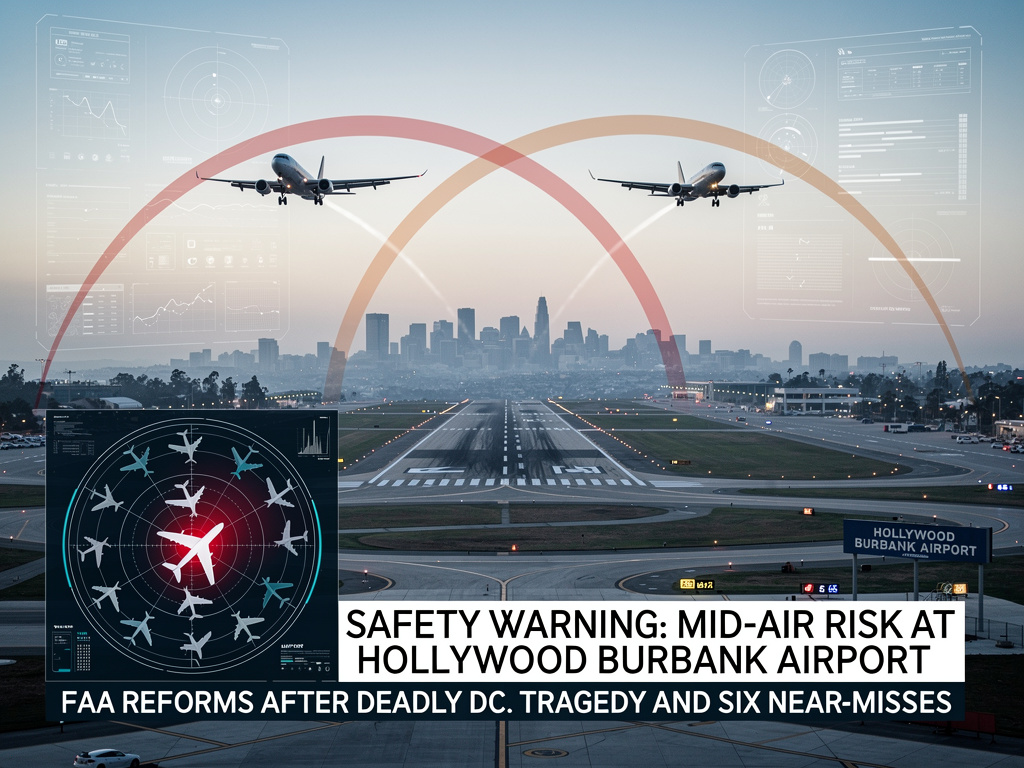
Hollywood Burbank Airport, a bustling hub nestled in the San Fernando Valley, faces mounting scrutiny after commercial airlines warned the National Transportation Safety Board that it could be the site of the next catastrophic mid-air collision. NTSB Chair Jennifer Homendy highlighted these dire predictions during a January 27, 2026, hearing on last year’s deadly crash near Washington, D.C., where an American Airlines jet and an Army Black Hawk helicopter plummeted into the Potomac River, killing 67 people.
“Burbank is one where commercial airlines have called me to say the next mid-air is going to be at Burbank, and nobody at FAA is paying attention to us,” Homendy stated, underscoring a pattern of ignored red flags. She added, “Whether it is involving helicopters or not, people are raising red flags, and why aren’t people listening? The FAA has to ensure safety. That is their job.” The remarks, delivered amid revelations of FAA shortcomings in the D.C. incident, have thrust Burbank into the national spotlight.
Airlines’ Direct Pleas Ignite Urgency
Commercial carriers, operating frequent flights from Burbank’s single runway, have bypassed the FAA to contact Homendy directly, citing persistent risks in the congested airspace shared with nearby Van Nuys Airport, just nine miles away. Van Nuys handles up to 700 daily non-commercial flights, including private jets, corporate aircraft, and helicopters, creating overlapping paths with Burbank’s commercial jets.
According to the Aviation Safety Reporting System, six near mid-air collisions have occurred at Burbank since January 1, 2021, fueling airline executives’ fears. These incidents, coupled with the D.C. crash’s lessons on mixed traffic hazards, prompted Homendy’s public call for FAA action, as reported by ABC7 Los Angeles.
Congested Airspace Breeds Hidden Dangers
The core issue lies in the tight proximity of Hollywood Burbank and Van Nuys airports, fewer than 10 miles apart, where arrival and departure paths converge dangerously. Burbank serves major airlines like Southwest and American with commercial passenger jets, while Van Nuys caters to general aviation, amplifying collision risks during peak hours. Reuters noted in October that the FAA had already begun scrutinizing these traffic flows, as detailed in its coverage.
In a 2023 incident, a Mesa Airlines plane nearly landed on the same runway from which a SkyWest flight was departing, closing to within 1,680 feet, according to Los Angeles Times reporting. Such close calls underscore the precarious balance air traffic controllers maintain amid surging volumes.
FAA’s AI-Driven Response Under Fire
The FAA countered Homendy’s criticisms by touting post-D.C. reforms, including AI tools deployed in February 2025 to pinpoint high-risk zones. Focusing on Burbank and Van Nuys, the agency lowered Van Nuys’ traffic pattern by 200 feet in a 2025 trial, reducing Traffic Collision Avoidance System (TCAS) alerts for Burbank arrivals. This change became permanent on January 5, 2026, per FAA statements cited by KTLA.
“Preliminary data indicated the change resulted in a reduction of TCAS alerts for Burbank arrivals,” the FAA said, emphasizing proactive mitigations nationwide. Yet Homendy dismissed these as insufficient, pointing to the D.C. probe’s findings of “deep, underlying systemic failures” like overreliance on visual separation and ignored recommendations.
Lessons from D.C.’s Fatal Oversight
The January 2025 D.C. crash exposed FAA lapses, including helicopter routes passing within 75 feet of arriving planes at Reagan National Airport and faulty altimeters on Black Hawks with up to 200-foot errors. The NTSB deemed it “100% preventable,” faulting unheeded calls for ADS-B In technology—a $400 GPS system that could have alerted crews 59 seconds before impact, as per ABC News.
Over 15,200 air separation incidents and 85 close calls preceded the tragedy near Reagan, mirroring Burbank’s six reported near-misses. The NTSB issued over 30 recommendations, including better helicopter routing and data reviews, now echoing in California’s airspace debates, according to The New York Times.
Passenger Fears Ground-Level Reality
At Burbank’s terminal, travelers expressed mixed reactions. Chrissy Stone, a local, voiced worry: “One of my concerns has always been the amount of traffic over the city… With the new findings, I am concerned.” Trent Jackson, a frequent flyer, remained unfazed: “I’ve never really had thoughts of safety here.” A spokesperson for Hollywood Burbank Airport declined comment, redirecting queries to the FAA, as noted by NBC Los Angeles.
These sentiments capture the tension between convenience—Burbank’s appeal as a smaller alternative to LAX—and escalating safety alarms. With airlines like Southwest reporting separate near-misses from the airport, public pressure mounts for resolution.
Path Forward Amid Regulatory Pushback
NTSB board members, troubled by years of dismissed warnings, demand comprehensive FAA overhauls, including mandatory collision-avoidance tech and refined traffic patterns. The FAA maintains it is “acting proactively to mitigate risks before they affect the traveling public,” having cut Reagan’s arrival rate post-crash.
Industry insiders watch closely as Burbank tests these fixes. While TCAS reductions offer hope, persistent airline outreach to the NTSB signals deeper issues. Homendy’s hearing testimony, amplified across outlets like FOX 11 Los Angeles and CBS Los Angeles, pressures regulators to act decisively before warnings become wreckage.


 WebProNews is an iEntry Publication