
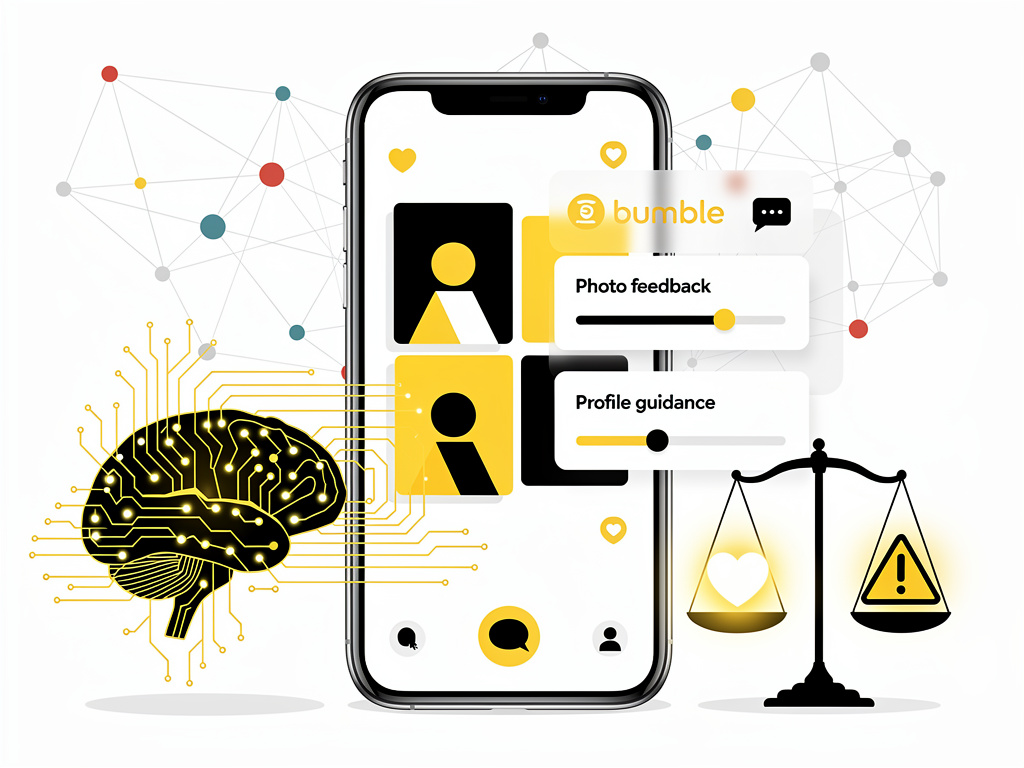
Bumble, the dating app that built its brand on women making the first move, is now asking artificial intelligence to make the first impression. The company announced a set of new AI-powered tools designed to help users select better photos and craft more compelling profiles, a move that signals how deeply machine learning is penetrating even the most personal corners of consumer technology.
The new features, which began rolling out in late February 2026, include AI-driven photo feedback that analyzes a user’s uploaded images and provides suggestions on which pictures are most likely to attract matches. Alongside this, Bumble introduced profile guidance tools that use generative AI to coach users on how to write bios and answer prompts in ways that are more engaging and authentic, according to TechCrunch.
From Swiping to Coaching: Bumble’s New AI Features Explained
The photo feedback tool works by evaluating several dimensions of a user’s images — lighting, composition, facial expression, and even background context — to rank which photos are most likely to generate positive engagement. Rather than simply telling users to smile more, the system reportedly draws on aggregated, anonymized data about which types of images historically perform well on the platform. Users receive specific, actionable guidance such as suggestions to lead with a photo that shows their face clearly or to avoid group shots as a primary image.
The profile guidance feature operates in a similar vein. When a user is filling out their bio or responding to Bumble’s conversation prompts, the AI assistant can offer real-time suggestions. These are not pre-written lines that the AI generates wholesale; instead, the tool provides feedback on tone, specificity, and authenticity. The goal, Bumble has said, is to help people present themselves more accurately rather than to fabricate a persona. As TechCrunch reported, the company has been careful to position these tools as assistive rather than generative — a distinction that matters in an industry increasingly wary of AI-manufactured deception.
A Strategic Pivot After a Turbulent Year
The AI rollout comes at a critical juncture for Bumble Inc. The company has faced mounting pressure from investors and analysts over slowing user growth and increased competition from rivals including Hinge, which is owned by Match Group, and newer entrants that have attracted younger demographics. Bumble’s stock has been volatile over the past 18 months, and the company underwent a leadership transition in 2025 when founder Whitney Wolfe Herd stepped back from her role as CEO, handing the reins to Lidiane Jones, a former Salesforce executive.
Under Jones’s leadership, Bumble has signaled a more technology-forward strategy. The company’s most recent earnings call emphasized investments in AI and machine learning as central to its product roadmap. Jones has spoken publicly about the need for dating apps to move beyond the swipe-based model that has defined the industry for over a decade, arguing that the next generation of users expects more personalized, intelligent experiences. The new AI tools represent the most visible manifestation of that philosophy to date.
The Broader Industry Rush Toward AI-Assisted Dating
Bumble is far from alone in its AI ambitions. Match Group, which operates Tinder and Hinge, has been experimenting with AI-powered features of its own, including conversational prompts and compatibility scoring. Hinge introduced an AI-based feature in 2025 that suggests conversation starters based on a match’s profile content. Meanwhile, smaller startups have gone further, offering AI agents that can conduct initial conversations on a user’s behalf — a concept that has drawn both fascination and criticism from dating experts and ethicists.
The tension at the heart of this trend is straightforward: dating apps exist to facilitate genuine human connection, yet they are increasingly powered by technology designed to optimize and automate that process. Critics argue that AI coaching risks homogenizing profiles, making everyone sound polished in the same way and stripping out the idiosyncrasies that actually attract compatible partners. Proponents counter that most people are simply bad at presenting themselves online and that a little algorithmic coaching can lower barriers to meaningful engagement.
Privacy Concerns and the Data Behind the Recommendations
One of the more sensitive aspects of Bumble’s new tools involves the data that powers them. To provide photo feedback, the AI must analyze images in ways that touch on physical appearance, a domain fraught with potential for bias. Bumble has stated that its models are trained on engagement data rather than subjective attractiveness ratings, and that the system does not make judgments about a user’s appearance per se. Instead, it focuses on technical and contextual factors — whether a photo is well-lit, whether the user is clearly visible, and whether the image conveys warmth and approachability.
Still, researchers have raised questions about whether engagement-based training data can truly be separated from appearance-based bias. If certain types of photos historically receive more swipes, and those patterns correlate with race, body type, or other protected characteristics, the AI could inadvertently reinforce existing biases in user behavior. Bumble has said it conducts regular audits of its AI systems to check for such biases, though the company has not published the results of those audits publicly. This is an area where the dating industry as a whole has faced scrutiny, and Bumble’s approach will likely be watched closely by regulators and advocacy groups alike.
User Reception: Enthusiasm Mixed With Skepticism
Early user reactions on social media platforms including X have been mixed. Some users have praised the photo feedback tool as a welcome addition, noting that choosing the right profile photos has always been one of the most anxiety-inducing parts of online dating. Others have expressed discomfort with the idea of an algorithm evaluating their images, describing it as an extension of the judgment culture that already pervades dating apps. A number of posts on X reflected a common concern: that AI-assisted profiles could make it harder to distinguish between genuine and manufactured personas.
This anxiety is not unfounded. A 2025 survey by the Pew Research Center found that 53% of American adults who have used dating apps expressed concern about the use of AI in online dating, with worries ranging from catfishing to emotional manipulation. At the same time, 61% of respondents said they would welcome tools that helped them improve their own profiles, suggesting a complex and somewhat contradictory relationship with AI in this context.
Monetization and the Business Case for AI Coaching
From a business perspective, the AI features also serve a clear monetization purpose. Bumble has indicated that while basic versions of the photo feedback and profile guidance tools will be available to all users, more advanced features — such as detailed analytics on profile performance and iterative coaching over time — will be reserved for premium subscribers. This follows a broader industry pattern in which AI-powered features are used to justify higher subscription tiers and drive revenue per user upward.
Analysts have noted that this approach could help Bumble address one of its most persistent challenges: converting free users into paying customers. The company’s average revenue per paying user has been a closely watched metric on Wall Street, and AI features that demonstrably improve match rates could provide a compelling reason for users to upgrade. Whether the tools actually deliver on that promise remains to be seen, but the strategic logic is sound.
What Comes Next for AI in Online Dating
Looking ahead, the integration of AI into dating apps is almost certain to deepen. Bumble has hinted at future features that could include AI-assisted date planning and real-time conversation coaching during chats. Match Group has similarly telegraphed plans for more sophisticated AI integration across its portfolio of apps. The question for the industry is not whether AI will play a larger role, but how companies will balance the efficiency gains of automation with the authenticity that users ultimately seek.
For Bumble, the stakes are particularly high. The company has staked its identity on empowering users — especially women — to take control of their dating lives. If AI tools enhance that sense of agency, they could become a powerful differentiator. If they instead make the experience feel more mechanical or surveilled, they risk undermining the very brand promise that set Bumble apart in the first place. As the company moves forward with its AI strategy, the answer will likely be determined not by the sophistication of the technology, but by how thoughtfully it is deployed.


 WebProNews is an iEntry Publication