
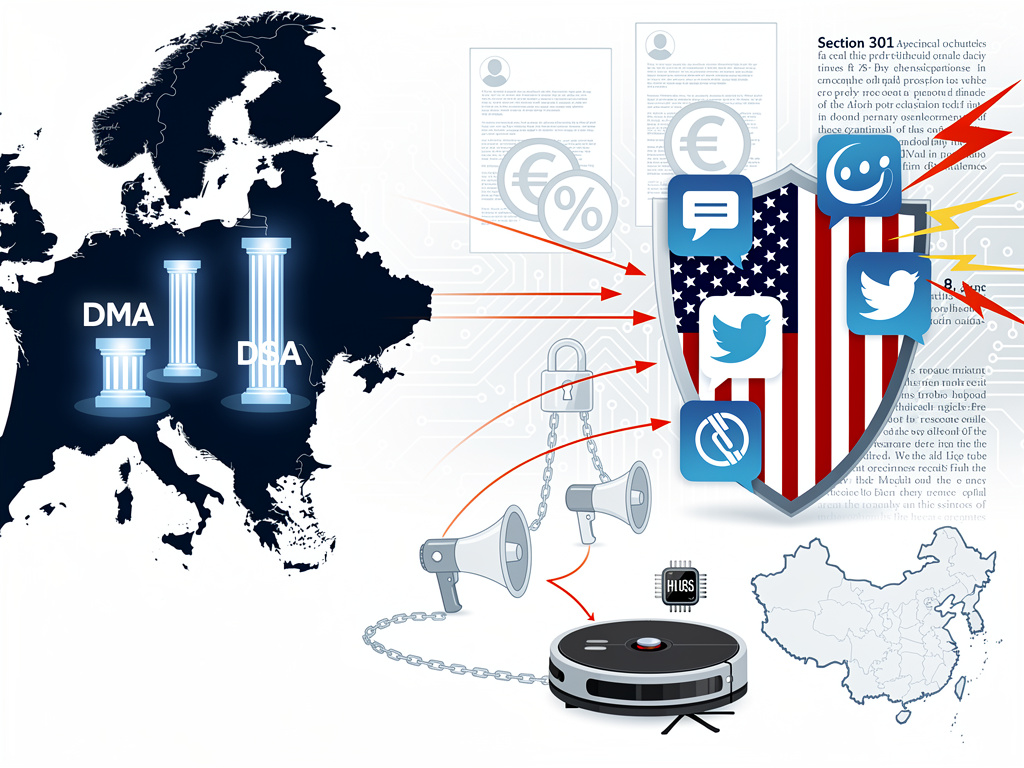
In the escalating clash between Washington and Brussels, the European Union’s Digital Markets Act (DMA) and Digital Services Act (DSA) are drawing fire as weapons aimed squarely at American technology giants. Recent fines on Elon Musk’s X, totaling €120 million for alleged breaches in content moderation and ad transparency, mark the EU’s first major DSA enforcement action, igniting accusations of discriminatory overreach. The Trump administration, echoing sentiments from U.S. Trade Representative Jamieson Greer, has signaled readiness to unleash Section 301 investigations, framing these regulations as unfair trade barriers that burden U.S. firms while sparing European rivals.
The National Pulse warns that these laws represent ‘economic and political aggression, masquerading as consumer protection,’ with five of seven DMA ‘gatekeepers’—including Alphabet, Amazon, Apple, Meta, and Microsoft—being American companies. European competitors face lighter scrutiny, critics argue, creating an uneven playing field that penalizes U.S. innovation. Posts on X from industry watchers like Pirate Wires highlight how the DSA and DMA threaten profit margins essential for research and development, effectively exporting European regulatory norms extraterritorially.
Gatekeeper Designations Fuel Discrimination Claims
Designated as gatekeepers under the DMA, U.S. firms must comply with stringent rules on data access, interoperability, and self-preferencing, facing potential fines up to 10% of global revenue. Fortune reports that the Trump administration’s Office of the U.S. Trade Representative issued an ultimatum on December 17, 2025, threatening ‘every tool at its disposal’ against EU practices, including possible fees on services like Spotify and DHL operating in the U.S. market (Fortune).
EU regulators defend the acts as vital for fair competition and user safety, but U.S. officials point to selective enforcement. The Register detailed X’s €120 million fine on December 5, 2025, for deceptive blue-check systems and poor ad repository transparency, contrasting with TikTok’s settlement without penalty (The Register). Reuters noted Europe’s defiance of Trump, forging ahead with crackdowns on Alphabet and X amid transatlantic tensions (Reuters).
Jamieson Greer expressed disappointment over the EU’s ‘zero moderation’ on DSA and DMA, despite U.S.-EU trade framework commitments from August 2024. This lack of progress, per The National Pulse, betrays joint efforts to remove digital barriers (The National Pulse).
iRobot’s Fall Exposes Merger Block Fallout
iRobot’s recent bankruptcy filing underscores the real-world toll of EU interventions. Three years ago, Amazon’s proposed acquisition of the Roomba maker was blocked by EU and FTC regulators over competition fears. Now, a Chinese supplier is poised to gain control, handing Beijing a strategic win in robotics. The National Pulse cites this as a prime example of how DMA gatekeeper status hampers U.S. deals, leading to American firm failures and foreign takeovers.
Euronews chronicled 2025’s top EU actions, including probes into Apple, Google, and Meta, with fines totaling billions, intensifying the transatlantic rift (Euronews). CEPA warns that USTR’s aggressive posture signals no abatement in conflicts over tech policy, with Brussels in Washington’s crosshairs (CEPA).
Free speech concerns amplify the stakes. The DSA empowers EU overseers to mandate content removals for ‘harmful’ material, even if lawful in the U.S. Jonathan Turley on X decried the EU’s ‘war on free speech,’ targeting X for resisting moderation pressures. Under Secretary Jacob Helberg labeled the X fine ‘censorship and financial extortion,’ not safety measures.
Section 301: Washington’s Retaliatory Arsenal
Section 301 of the 1974 Trade Act equips the USTR to probe ‘unjustifiable, unreasonable, or discriminatory’ foreign practices burdening U.S. commerce. The National Pulse outlines how a Trump-directed investigation could reframe DMA/DSA as trade violations, inviting public hearings, EU consultations, and potential tariffs within 12-18 months. This formal process would document discrimination patterns, testing against WTO non-discrimination rules.
WebProNews reports U.S. threats of penalties on EU firms like Siemens and Spotify in direct response to DMA fines on U.S. giants (WebProNews). TechPolicy.Press tracks enforcement statements amid shifting U.S. politics, noting platforms’ DSA reports now eye Trump-era pushback (TechPolicy.Press).
Proponents argue this would generate leverage, pressuring sensitive EU exports if Brussels persists. The German Marshall Fund details Trump’s prior threats of Section 301 over digital taxes and fines, like Google’s €2.95 billion antitrust penalty, foreshadowing current battles (German Marshall Fund).
Censorship Exports Threaten U.S. Norms
DSA mandates risk assessments for ‘systemic risks’ like misinformation, enabling fines up to 6% of global revenue. Reclaim The Net exposes it as a ‘censorship weapon,’ pressuring platforms to delete political speech, satire, and memes. X posts from Jake highlight Musk’s retort—’Abolish the EU’—after the €140 million equivalent fine (adjusted for reports), with State Department moves against EU fact-checkers as ‘speech police.’
Heinrich Böll Stiftung analyzes DSA pressures from the Trump administration, which views it as imposing foreign speech codes (Heinrich Böll Stiftung). The National Pulse insists Americans reject European norms creeping online, urging zero tolerance for regulatory censorship.
Enforcement data reveals asymmetry: Chinese firms evade heavy DMA/DSA pressure, per critics, aiding Beijing as U.S. firms bleed cash on compliance. TechPolicy.Press notes platforms’ 2025 DSA reports strategically address U.S. political shifts, anticipating retaliation (TechPolicy.Press).
Trade Framework Betrayal Accelerates Rift
The U.S.-EU trade framework demands non-discriminatory treatment, yet Greer laments no DSA/DMA recalibration. Fortune details USTR’s accusations of ‘discriminatory and harassing lawsuits, taxes, fines, and directives’ against U.S. providers. Reuters confirms X’s fine as the DSA’s inaugural penalty, drawing U.S. government criticism anew (Reuters).
A Section 301 probe would formalize these grievances, potentially suspending concessions or imposing restrictions. The National Pulse posits this restores balance, ending years of U.S. acquiescence. As Trump prioritizes American workers and speech, the DMA/DSA standoff tests transatlantic ties, with market access as the ultimate bargaining chip.


 WebProNews is an iEntry Publication