
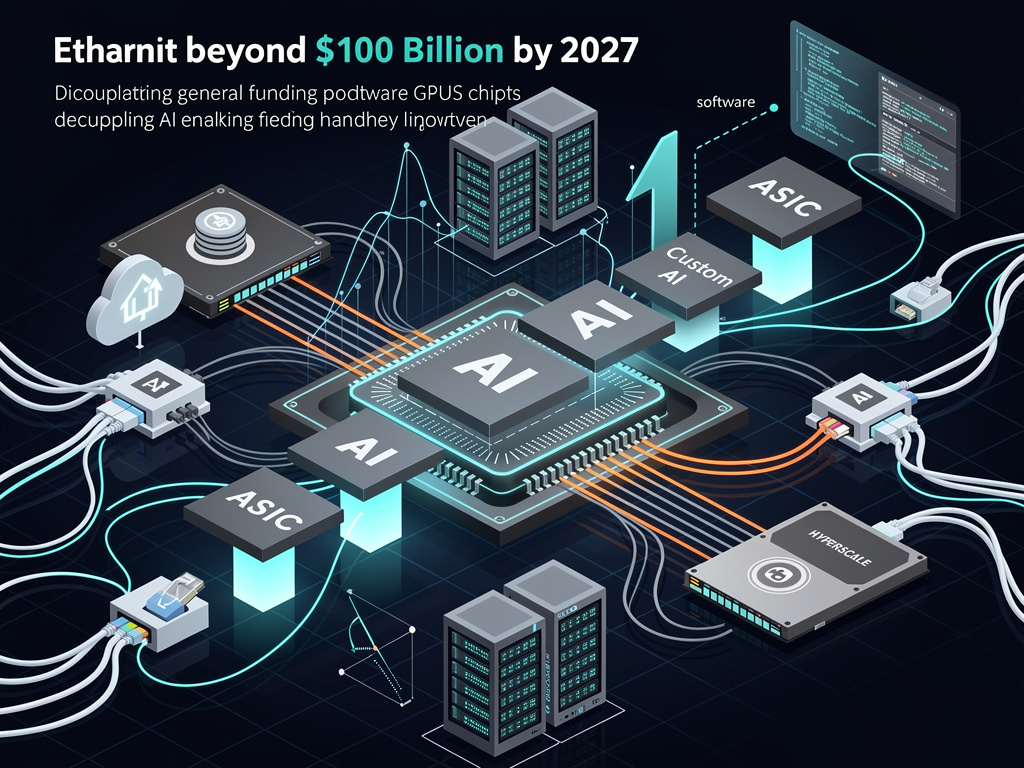
Hock Tan, the CEO of Broadcom, is not known for speculative optimism. A disciplined dealmaker who built a semiconductor empire on aggressive acquisitions and ruthless cost-cutting, Tan typically prefers operational metrics to visionary forecasting. Yet, during a recent strategic update, Tan offered a projection that startled analysts and investors alike: he expects the market for AI accelerator chips—specifically the custom silicon sector Broadcom leads—to balloon to over $100 billion by 2027.
This figure represents more than just a revenue target; it indicates a structural bifurcation in how artificial intelligence infrastructure is built. While Nvidia continues to dominate the market for general-purpose graphics processing units (GPUs), Broadcom is placing a massive wager on the idea that the world’s largest technology companies will increasingly abandon off-the-shelf components in favor of bespoke processors designed in-house. As reported by Bloomberg via MSN, Tan’s commentary suggests that the sheer scale of capital expenditure from hyperscalers like Meta, Google, and Microsoft is forcing a shift toward efficiency that only custom application-specific integrated circuits (ASICs) can provide.
The Economics of Customization
The logic underpinning Broadcom’s forecast relies on the shifting economics of data centers. In the early stages of the generative AI boom, speed was the only metric that mattered. Companies bought whatever silicon was available to train models, leading to Nvidia’s unprecedented rise. However, as the focus shifts from training models to running them—a phase known as inference—power consumption and cost per query become the primary constraints. General-purpose GPUs, while powerful, are often over-engineered for specific workloads, consuming excess energy.
Broadcom’s strategy targets this inefficiency. By partnering with hyperscalers to design custom XPUs (AI accelerators), Broadcom allows these companies to strip away unnecessary logic gates and optimize chips for their specific algorithms. According to a recent analysis by Reuters, this custom silicon division is already driving significant revenue beats, with the company raising its annual forecast based on insatiable demand from consumer internet giants. The $100 billion figure implies that custom silicon will not merely be a niche alternative but a dominant pillar of AI hardware.
A Bifurcated Market Structure
Investors must recognize that Broadcom is not competing directly with Nvidia in the merchant market. Instead, they are the primary enabler for Nvidia’s biggest customers to reduce their dependence on Nvidia. This creates a unique market dynamic where Broadcom serves as the foundry partner and IP licensor for the “anti-Nvidia” alliance. The company provides the intellectual property blocks for input/output, memory controllers, and packaging, while the customer provides the proprietary logic.
The revenue implications of this model are distinct. Unlike the merchant model, where margins are stacked on top of the hardware sale, Broadcom’s custom silicon business operates on a co-design model with guaranteed volume commitments. This reduces inventory risk—a plague of the semiconductor industry—and locks in customers for multiple product generations. Once a company like Google optimizes its TensorFlow workload for a specific Broadcom-designed TPU, the switching costs become prohibitive.
The Critical Role of Networking
While the compute side of the equation garners headlines, Broadcom’s dominance in networking infrastructure remains the less visible engine of its growth. AI clusters require tens of thousands of chips to operate in unison, necessitating a network fabric with massive bandwidth and effectively zero latency. Here, the battle is between Nvidia’s InfiniBand and the Ethernet standard championed by Broadcom.
Tan’s $100 billion roadmap assumes that Ethernet will win the war for the AI backend network. The company’s Jericho3-AI and Tomahawk 5 switch chips are designed specifically to handle the “elephant flows” of data inherent in large language model training. As noted in coverage by CNBC, the market has reacted favorably to Broadcom’s assertion that open standards like Ethernet will eventually displace proprietary interconnects due to cost and vendor interoperability. If the industry standardizes on Ethernet for the AI back-end, Broadcom effectively taxes every packet of data moving through a modern data center.
Integration of Software and Silicon
The hardware narrative is buttressed by Broadcom’s aggressive expansion into enterprise software, most notably through the acquisition of VMware. This strategic pivot provides a steady stream of recurring revenue that smooths out the cyclicality inherent in the semiconductor market. By converting VMware customers to subscription models, Broadcom generates the free cash flow necessary to fund the intense R&D required for 2-nanometer and 3-nanometer chip design.
This dual-engine approach—high-growth AI hardware funded by high-margin enterprise software—creates a financial profile distinct from pure-play chipmakers. The software division acts as a ballast, allowing Broadcom to weather potential downturns in hardware spending without cutting into the engineering budgets required to maintain its lead in SerDes (Serializer/Deserializer) technology and optical interconnects.
Concentration Risk and Customer Power
Despite the bullish projection, the path to $100 billion is fraught with concentration risk. Broadcom’s custom silicon business relies heavily on a handful of clients, often euphemistically referred to in earnings calls as “Customer A” or “Customer B.” These are undoubtedly entities like Apple, Google, and Meta. The power dynamic in these relationships is complex; while Broadcom provides essential IP, the customers themselves possess virtually unlimited resources and are constantly evaluating whether to bring more design phases in-house.
Furthermore, the reliance on consumer internet companies ties Broadcom’s fortunes to the monetization of AI. If the hyperscalers fail to generate sufficient return on investment from their AI features, capital expenditures could contract as quickly as they expanded. The semiconductor industry has a history of boom-and-bust cycles driven by over-ordering, and while the custom nature of ASICs mitigates double-ordering, it does not immunize Broadcom from a macro-level pullback in infrastructure spending.
The Optical Interconnect Frontier
To reach the 2027 targets, Broadcom is also banking on the physical limits of copper wiring. As data transmission speeds increase, copper cables can only carry signals for very short distances before degradation occurs. This necessitates a shift to optical interconnects (using light to move data) even for short hops within a server rack. Broadcom’s investment in silicon photonics positions it to capture value not just at the switch level, but at the connection point of every GPU and TPU in the cluster.
This technological moat is difficult for competitors to cross. Mastering the physics of photonics and integrating it with standard CMOS manufacturing processes requires decades of specialized engineering. This capability ensures that even if a hyperscaler designs their own compute logic, they will likely still rely on Broadcom for the physical layer that allows that chip to communicate with the outside world.
Navigating Geopolitical Headwinds
No discussion of semiconductor growth is complete without addressing the geopolitical environment. Broadcom’s supply chain is deeply entangled with TSMC in Taiwan for manufacturing. While the company is headquartered in the United States, the physical production of its most advanced AI chips occurs in a geopolitical hotspot. Any disruption in the Taiwan Strait would render the $100 billion forecast moot.
However, the company has managed these risks by diversifying its assembly and testing operations. Furthermore, the custom nature of its chips means they are less likely to fall under blanket export controls compared to general-purpose GPUs, as they are often designed for specific proprietary internal workloads of US-based companies rather than for resale to restricted entities.
A defining Moment for Infrastructure
Hock Tan’s projection serves as a marker for the industry. It signals that the initial “gold rush” phase of AI—characterized by frantic purchasing of any available hardware—is maturing into a phase of architectural optimization. The winners in this next cycle will not necessarily be those with the rawest compute power, but those who can deliver the most efficient performance per watt at the system level.
By anchoring its future in custom silicon and Ethernet networking, Broadcom is betting that the future of AI belongs to specialists rather than generalists. If the $100 billion target is met, it will validate the view that the infrastructure of the future will be bespoke, highly integrated, and built on a foundation of open networking standards.


 WebProNews is an iEntry Publication