
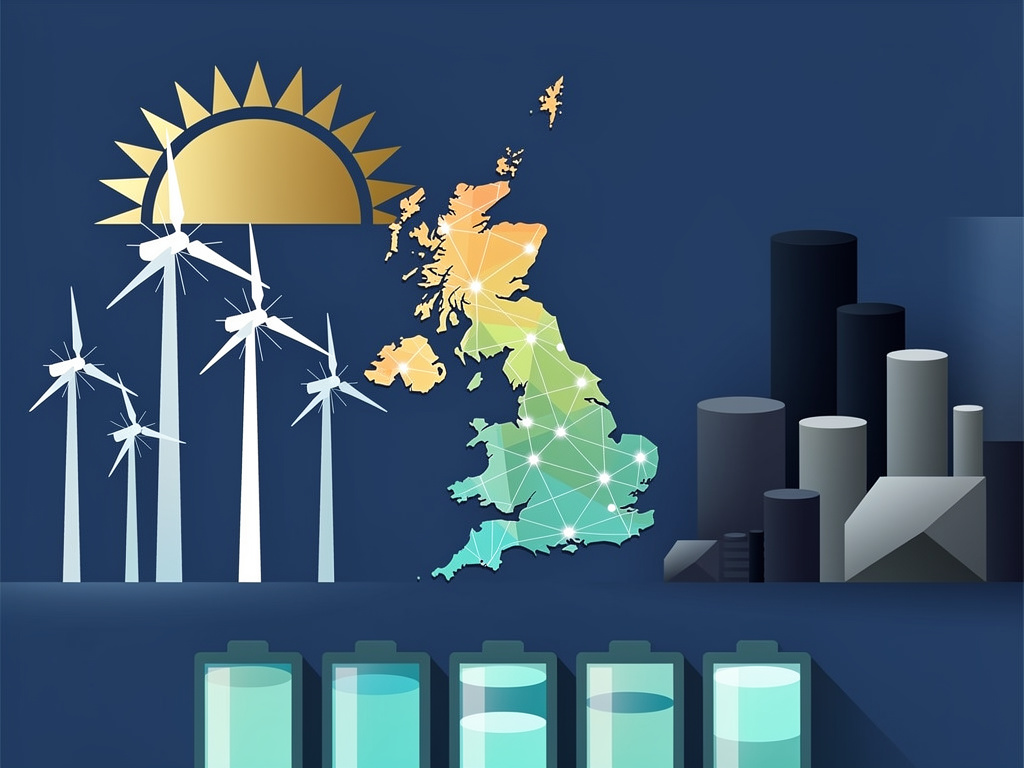
In March 2026, something remarkable happened on the British power grid. Wind turbines and solar panels generated so much electricity that they displaced an estimated £1 billion worth of natural gas imports — a single-month record that stunned even seasoned energy analysts. The figure wasn’t a projection or a modeled scenario. It was the observed result of an extraordinary confluence of weather, infrastructure buildout, and market dynamics that reshaped the UK’s energy balance sheet in real time.
The analysis, published by Carbon Brief, found that renewables generated record volumes throughout the month, driven by persistently strong winds across the North Sea and unusually favorable solar irradiance for the time of year. Together, wind and solar produced enough electricity to meet a historically high share of total UK demand, pushing gas-fired power stations to the margins of the dispatch order. The result: gas plants ran far less than usual, and the fuel that would have been burned simply wasn’t needed.
That £1 billion figure deserves scrutiny. Carbon Brief calculated it by estimating how much additional natural gas the UK would have needed to import and burn had wind and solar output been unavailable, using prevailing wholesale gas prices and the efficiency rates of the UK’s combined-cycle gas turbine fleet. At current European gas prices — still elevated relative to pre-2021 norms, though well below the crisis peaks of 2022 — the avoided import bill adds up fast. Every terawatt-hour of wind or solar generation that displaces gas saves roughly £60–80 million in fuel costs at recent price levels. March 2026 delivered more than enough clean generation to push the total past the billion-pound threshold.
The performance didn’t materialize from nowhere. It was the product of years of offshore wind deployment, particularly in the North Sea, where several large projects commissioned in 2024 and 2025 reached full operational capacity. The UK’s total installed wind capacity — onshore and offshore combined — now exceeds 35 gigawatts, with offshore alone accounting for more than 18 GW. Solar capacity has also expanded sharply, surpassing 20 GW following a wave of ground-mounted installations across southern and eastern England.
March is a sweet spot for this combination. Days are lengthening, boosting solar yields, while winter wind patterns haven’t yet fully subsided. The overlap produced sustained periods when renewables exceeded 70% of electricity demand, according to grid data tracked by National Grid ESO.
But the savings figure carries an implicit question: saved compared to what?
The counterfactual matters. Carbon Brief’s methodology assumes that without renewables, the same electricity demand would have been met primarily by gas-fired generation, which is the marginal fuel source on the British grid. That’s a reasonable assumption. The UK has virtually no coal capacity left, nuclear output has been declining as aging reactors retire, and interconnector flows from continental Europe are constrained by both cable capacity and price dynamics. Gas is the default backstop. So when wind and solar produce more, gas produces less — almost megawatt-for-megawatt in practice.
Critics of such analyses sometimes argue they overstate the value of renewables by ignoring system costs: the expense of grid reinforcement, backup capacity, and balancing services needed to manage variable generation. That’s a fair point in a full cost-benefit accounting. But the £1 billion figure isn’t claiming to be a net benefit calculation. It’s measuring gross fuel cost displacement. And on that narrow but significant metric, the number is real.
The geopolitical dimension adds weight to the finding. Since Russia’s invasion of Ukraine in 2022, European energy security has been reframed around reducing dependence on imported fossil fuels. The UK imports the majority of its natural gas, primarily from Norway via pipeline and from global markets via liquefied natural gas terminals. Every cubic meter of gas not burned in a power station is a cubic meter that doesn’t need to be shipped, contracted, or paid for. In a world where LNG cargoes are fought over by buyers in Europe, Asia, and Latin America, domestic renewable generation functions as a hedge against commodity price volatility.
This isn’t a theoretical benefit. UK wholesale electricity prices in March 2026 were notably lower during high-wind periods than during lulls, a pattern that has become increasingly pronounced as renewable penetration has grown. Consumers and businesses don’t always see these savings directly — retail energy contracts smooth out hourly price swings — but the aggregate effect flows through to lower wholesale costs, which eventually feed into bills.
The March record also highlights a tension that the UK energy sector is grappling with in real time: curtailment. On several days during the month, renewable output was so high that grid operators had to pay wind farms to reduce generation because the system couldn’t absorb it all. Constraint payments — essentially paying generators not to generate — cost consumers hundreds of millions of pounds annually and represent a growing inefficiency. More transmission capacity, particularly between Scotland (where much onshore wind is located) and England (where most demand sits), would reduce curtailment. So would more energy storage and flexible demand. But building transmission lines takes years, and the regulatory process remains slow.
The storage picture is evolving. Battery installations across the UK have grown rapidly, with grid-scale lithium-ion projects now providing several gigawatts of short-duration storage. These batteries help smooth out sub-hourly fluctuations and capture arbitrage opportunities — charging when prices are low (during windy, sunny periods) and discharging when prices rise. But they can’t yet store enough energy to bridge multi-day wind droughts, which remain the system’s Achilles’ heel. Longer-duration storage technologies, including compressed air, flow batteries, and hydrogen, are in various stages of development but haven’t reached commercial scale.
Hydrogen, in particular, occupies an awkward position in UK energy policy. The government has committed to building a hydrogen economy, including hydrogen-ready gas turbines that could provide firm backup power without carbon emissions. But electrolyzer deployment has lagged behind targets, and the economics of green hydrogen — produced by splitting water using renewable electricity — remain challenging at current costs. If surplus renewable generation during months like March 2026 could be efficiently converted to hydrogen and stored for later use, the value of that generation would increase substantially. That’s the theory. Practice is proving slower.
What March 2026 demonstrates most clearly is the sheer scale that renewables have achieved on the British grid. A decade ago, a billion pounds of avoided gas imports in a single month would have been inconceivable. Wind and solar were marginal contributors, generating single-digit percentages of total electricity. Now they routinely provide 40–50% on an annual basis, with individual months and days far exceeding that. The infrastructure is built. The electrons are flowing.
And the trajectory points to more. The UK government’s target of a decarbonized power sector by 2030 — a deadline that many analysts consider extremely ambitious — requires continued rapid deployment of offshore wind, solar, and nuclear, alongside grid upgrades and flexibility solutions. The March 2026 data point suggests the generation side of that equation is broadly on track, even if the system integration side lags behind.
Internationally, the UK’s experience offers a reference case for other mid-latitude nations with strong wind resources. Denmark and Ireland have achieved even higher penetrations of wind power relative to demand, but the UK’s absolute scale — serving a population of nearly 70 million — makes its grid transition one of the most consequential globally. Germany, with its larger economy but weaker offshore wind resource and continued reliance on lignite, watches the British experience closely.
There’s a financial market angle too. The displacement of gas-fired generation has implications for the business models of companies operating gas plants in the UK. Load factors for combined-cycle gas turbines have fallen steadily as renewables have grown, squeezing revenues. Some operators have already mothballed or closed plants that can’t earn enough running hours to justify their fixed costs. The capacity market — a mechanism that pays generators to be available even if they don’t run — provides a safety net, but the payments may need to increase as gas plants shift from baseload workhorses to rarely used peaking assets. That transition has costs, and who bears them is a live political question.
For consumers, the net effect of the renewable buildout on energy bills remains contested. Renewables have driven down wholesale costs, but the costs of subsidies (paid through levies on bills), grid reinforcement, and system balancing have risen. The net calculation depends heavily on assumptions about gas prices. If gas stays expensive — as most forecasters expect given tight global LNG markets and ongoing geopolitical risks — then renewables look increasingly like a bargain. If gas prices were to collapse (an unlikely but not impossible scenario involving, say, a major global recession), the economics would shift.
The £1 billion figure for March 2026 is ultimately a snapshot. A vivid one. It captures a moment when decades of policy, investment, and engineering converged to produce a measurable, large-scale economic benefit. It doesn’t resolve the harder questions about storage, transmission, or the final stretch to full decarbonization. But it does something important: it puts a price tag on what renewables are already delivering, right now, in avoided fossil fuel costs.
That’s not a projection. It’s an invoice that was never sent.


 WebProNews is an iEntry Publication