
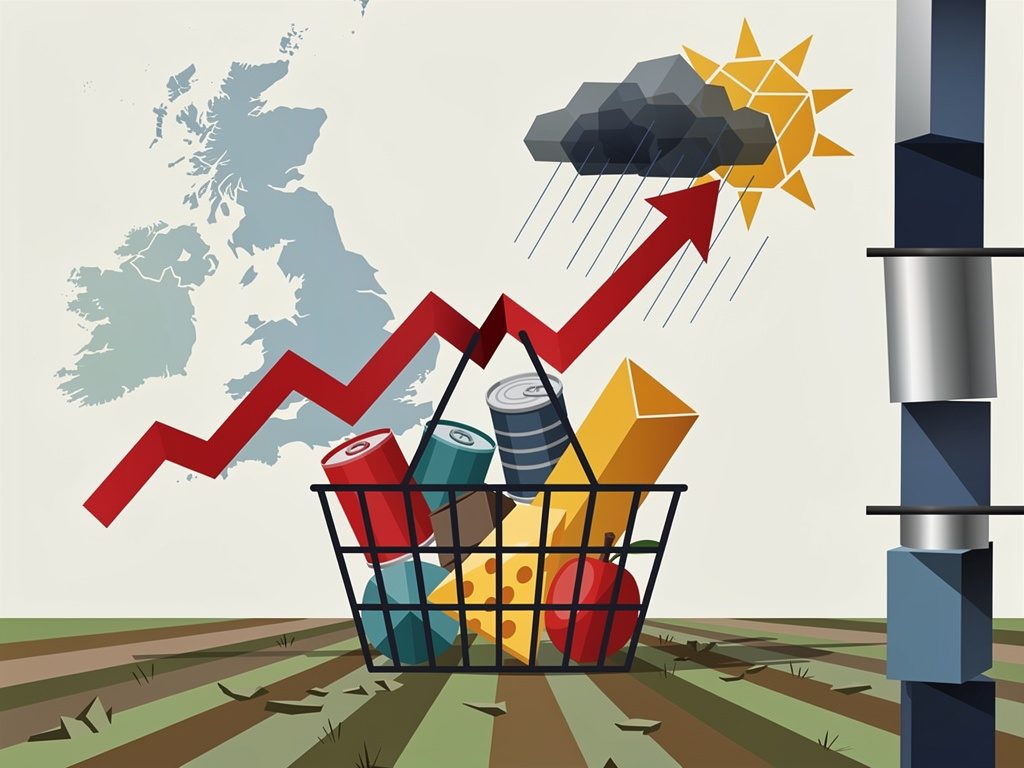
British households just got a harsh reminder that the cost-of-living crisis hasn’t ended. It’s merely been resting.
Food price inflation in the United Kingdom surged to 9% in May, up sharply from 6.5% in April, according to the British Retail Consortium’s shop price index. That’s the steepest monthly acceleration in over two years and a figure that has rattled analysts, retailers, and policymakers alike. As Yahoo Finance reported, the spike has been driven by a convergence of forces — poor harvests in key agricultural regions, the lingering effects of extreme weather in southern Europe and North Africa, and the continued pass-through of higher energy and logistics costs that suppliers absorbed for months before finally raising prices.
The timing is terrible.
The Bank of England has been cautiously signaling that rate cuts might come later this year, but persistent food inflation complicates that calculus significantly. Core inflation had been trending downward, giving policymakers cover to suggest that the worst was behind them. Now, with grocery costs accelerating at this pace, the central bank faces an awkward contradiction: headline inflation could re-accelerate even as wage growth moderates and housing costs stabilize. Food doesn’t care about monetary policy cycles. It responds to weather, trade disruptions, and supply-chain bottlenecks — none of which Andrew Bailey can control with interest rate adjustments.
The BRC data, compiled in partnership with NielsenIQ, showed that overall shop price inflation also ticked upward in May, rising to 1.3% from 0.8% in April. Non-food prices remained relatively subdued, which makes the food component all the more striking. Fresh food led the charge, with fruit, vegetables, and dairy products showing the sharpest increases. Meat prices also climbed, though less dramatically.
So what’s actually happening in the supply chain?
Start with the weather. Spain and Morocco, two of Britain’s most important suppliers of off-season produce, experienced severe droughts followed by flooding in early 2025. Spain’s Murcia and Almería regions — sometimes called the “salad bowl of Europe” — saw crop yields decline markedly. Tomato, pepper, and lettuce supplies tightened across the continent, and the UK, which imports roughly half its food, felt the impact immediately. Morocco’s citrus and soft fruit exports were similarly disrupted. These aren’t new vulnerabilities, but they’ve worsened. Britain’s reliance on Mediterranean and North African produce during winter and spring months has long been a structural weakness in its food system, and climate volatility is turning what used to be occasional disruptions into recurring ones.
Then there’s the labor picture. Post-Brexit immigration rules have made it harder and more expensive to recruit seasonal agricultural workers, both domestically and from traditional source countries in Eastern Europe. The UK’s Seasonal Worker visa scheme has been expanded multiple times, but employers say the bureaucratic overhead and costs associated with the program eat into already thin margins. Some farms have simply reduced planted acreage. Less planting means less domestic production, which means greater dependence on imports — imports that are themselves getting more expensive.
Energy costs are another factor that refuses to fade into the background. While wholesale natural gas prices in Europe have fallen substantially from their 2022 peaks, they remain well above pre-pandemic norms. Food manufacturing is energy-intensive. Baking, refrigeration, pasteurization, packaging — all of it requires significant power. And transportation costs, while off their highs, haven’t returned to pre-crisis levels either. Diesel prices in the UK are still elevated compared to 2019, and the logistics sector has been passing incremental cost increases through to food companies for months.
Retailers are caught in a bind. The major supermarket chains — Tesco, Sainsbury’s, Asda, and Morrisons — have spent the past two years engaged in a fierce price war, using loyalty card discounts and loss-leader strategies to attract cash-strapped shoppers. That competition has compressed margins to razor-thin levels. When input costs spike as sharply as they did in May, retailers have limited room to absorb the increase. They can hold prices steady for a few weeks, maybe a month or two. But eventually the math forces their hand, and shelf prices go up.
Discounters Aldi and Lidl, which gained significant market share during the peak inflation period of 2022–2023, are facing the same pressures. Their model depends on ruthless efficiency and enormous volume, but even they can’t fully offset a 9% surge in food input costs. Recent Kantar data showed that grocery price inflation across all UK retailers had begun creeping upward again after months of deceleration — a trend that predates the BRC’s May reading but is now accelerating.
The political implications are immediate. Prime Minister Keir Starmer’s Labour government, which came to power partly on promises to address the cost of living, is under pressure to respond. But the policy toolkit is limited. The government can’t control the weather in Spain. It can’t unilaterally reduce global shipping costs. And it has shown little appetite for revisiting post-Brexit trade arrangements that might ease some supply-chain friction. What it can do is tinker at the margins — adjusting tariffs on certain imports, expanding the seasonal worker scheme further, investing in domestic food production infrastructure. Whether any of that moves the needle quickly enough to matter is another question entirely.
Chancellor Rachel Reeves has acknowledged the strain on household budgets but has framed the issue primarily as a global supply problem rather than a domestic policy failure. That framing is largely accurate. But accuracy doesn’t pay grocery bills, and voters feeling the pinch at the checkout counter aren’t inclined toward nuance.
There’s a broader structural issue here that transcends the current spike. The UK’s food system is extraordinarily exposed to external shocks. The country produces only about 60% of the food it consumes, and that ratio has been declining for decades. Climate change is making traditional import sources less reliable. Trade barriers, however modest, add friction and cost. And domestic agriculture faces its own challenges — aging farmer demographics, declining soil quality in some regions, and uncertain subsidy frameworks post-Brexit as the Environmental Land Management scheme replaces the EU’s Common Agricultural Policy payments.
None of these problems are new. All of them are getting worse.
Financial markets have taken notice, though the reaction has been measured so far. Sterling dipped modestly on the BRC release, and gilt yields ticked higher as traders priced in a slightly reduced probability of a Bank of England rate cut in August. But the moves were small. Markets are treating this as a potentially temporary supply shock rather than evidence of re-entrenched inflation. That’s a reasonable bet — for now. If June and July data show food inflation remaining at or above 9%, the calculus shifts considerably. The Bank of England would find it very difficult to cut rates while one of the most visible components of the consumer price basket is running at four times the 2% target.
Industry groups are sounding the alarm. The Food and Drink Federation, which represents UK food manufacturers, warned that the May data reflects cost increases that have been building in the pipeline for months and that further price rises are likely through the summer. Helen Dickinson, chief executive of the BRC, said in a statement accompanying the data release that “food inflation remains the primary driver of shop price rises” and urged the government to work with industry to address supply-chain vulnerabilities.
For consumers, the effects are tangible and immediate. A basket of staple groceries — bread, milk, eggs, chicken, rice, pasta, cooking oil, and fresh vegetables — now costs approximately 18% more than it did in early 2022, according to the Office for National Statistics. The May spike means that any relief shoppers had been feeling in recent months has effectively evaporated. And lower-income households, which spend a proportionally larger share of their budgets on food, are hit hardest. The Joseph Rowntree Foundation has repeatedly documented how food inflation exacerbates poverty and inequality in the UK, with the poorest decile of households spending nearly 20% of their income on food compared to around 8% for the wealthiest.
Food banks are seeing the consequences firsthand. The Trussell Trust reported record demand in its most recent annual data, distributing over 3 million emergency food parcels in the 2023–24 fiscal year. Early indicators suggest 2024–25 numbers will be similar or higher. The May inflation spike will only intensify that pressure.
Looking ahead, much depends on the summer growing season. If weather conditions in southern Europe and North Africa normalize, some of the supply-side pressure should ease by autumn. But “normalize” is an increasingly fraught concept in a warming climate. The five-year trend in Mediterranean agricultural output is concerning, with more frequent extreme weather events disrupting production cycles in ways that traditional seasonal patterns can’t accommodate.
And then there’s the question of what happens to global grain and oilseed markets. The Russia-Ukraine conflict continues to inject uncertainty into global commodity flows. While the Black Sea grain corridor has functioned intermittently, any escalation or disruption could send wheat, sunflower oil, and barley prices sharply higher — all of which feed directly into UK food costs through animal feed, baking, and processed food manufacturing.
Britain’s food inflation problem is not a single-cause phenomenon. It’s a convergence. Climate disruption, trade friction, labor shortages, energy costs, and structural underinvestment in domestic food production are all contributing simultaneously. Any one of these factors alone would be manageable. Together, they create a situation where sharp, unpredictable price spikes become more frequent and harder to mitigate.
The 9% figure is a wake-up call. Whether anyone acts on it is the real question.


 WebProNews is an iEntry Publication