
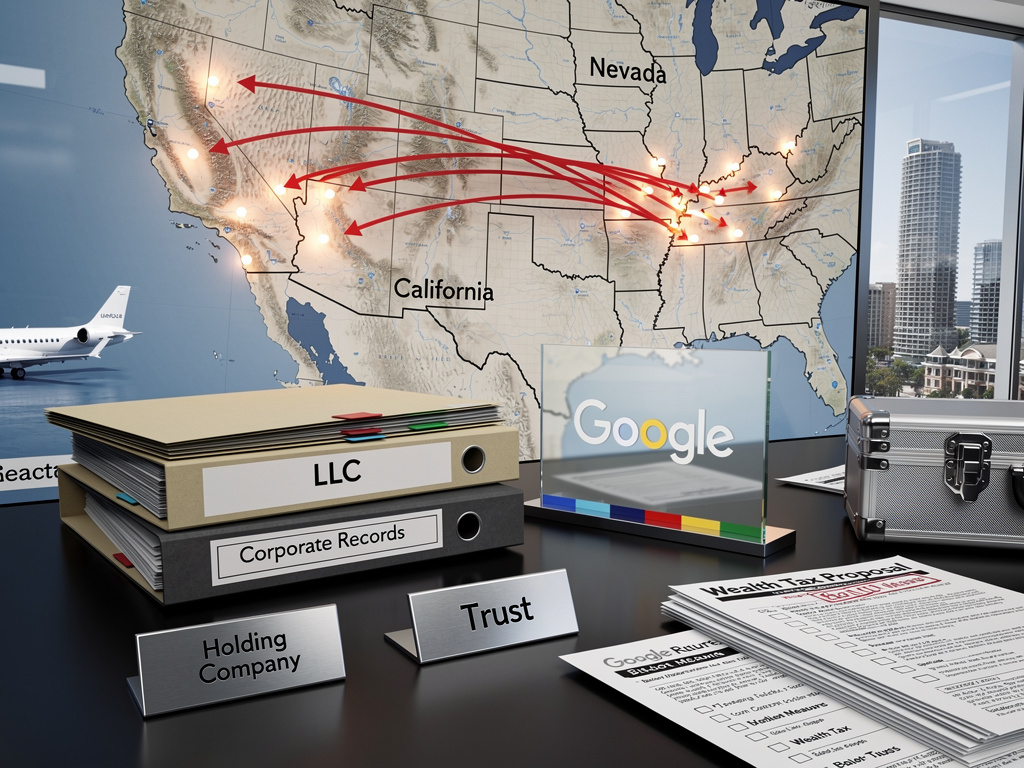
Google co-founder Sergey Brin has accelerated a retreat from California, relocating or terminating at least 15 limited liability companies tied to his personal investments just weeks before a proposed wealth tax on the state’s ultrarich takes effect. The moves, detailed in state filings, come amid a ballot initiative that would impose a retroactive 5% levy on net worth exceeding $1 billion, prompting an exodus of business entities among Silicon Valley’s elite.
Documents reviewed by multiple outlets show Brin converting California-based LLCs into Nevada counterparts in late December 2025. These entities managed diverse assets, from a superyacht to a private terminal at San Jose International Airport. The shift mirrors actions by co-founder Larry Page, who has inactivated or relocated over 45 similar vehicles, according to Fox Business.
Ahead of the Tax Storm
The catalyst is Proposition 29, a citizen-led measure qualifying for California’s November 2026 ballot. It targets residents with fortunes over $1 billion, aiming to raise $25 billion annually for housing and education. Backers tout it as fairness; critics decry it as punitive flight risk. ‘This is the final straw for many,’ said one investor anonymously, echoing sentiments on X where users track billionaire migrations.
Brin’s maneuvers predate the proposal’s momentum but align with its retroactive January 1, 2026, start date. A joint Brin-Page entity, T-Rex LLC, dissolved its Palo Alto registration on December 24, 2025, reemerging as T-Rex Holdings in Delaware with a Reno, Nevada, address, per Business Insider. Nevada’s zero state income and corporate taxes, plus no wealth levy, make it a haven.
Mapping the Entity Flight
California Secretary of State records reveal Brin’s LLCs handled real estate, aviation, and philanthropy. One cluster managed his Gulfstream fleet; another his yacht, Dragonfly. By year-end, 12 converted to Nevada filings, two terminated, and one merged. Page’s portfolio shows broader pruning: 30+ entities dormant since mid-2025, filings indicate.
This isn’t isolated. Hedge fund titan Bill Ackman warned on X of a ‘$1 trillion wealth exodus’ from California last month, citing similar shifts. Posts on the platform amplify reports, with users like @followthroughd1 noting ‘$700 billion in billionaire wealth exited’ recently, shrinking taxable assets from $2 trillion to $1.3 trillion.
Broader Silicon Valley Ripples
The New York Times reports Brin joining Page in ‘reducing ties to the state where they built their fortunes,’ linking moves to tax fears (The New York Times). Page, long reclusive, shifted his family office to Nevada in 2024. Their actions underscore a trend: Tesla’s Elon Musk relocated X and SpaceX headquarters to Texas in 2024 over regulatory gripes.
Yahoo Finance frames it as founders ‘pulling back’ from Google birthplace California (Yahoo Finance). TechCentral.ie details 15 Brin LLCs relocated by December 2025, including investment managers (TechCentral.ie). Firstpost questions why fortune-builders bid ‘bye’ to the Golden State (Firstpost).
Tax Measure Under Fire
Proposition 29, led by activist group Tax the Rich CA, exempts primary homes, art, and small businesses but captures stocks, yachts, jets. Retroactivity alarms planners; assets valued January 1 face immediate hit. ‘Billionaires are already moving,’ tweeted Replit CEO Amjad Masad on December 29, 2025, predicting startup ecosystem damage.
MLQ.ai tracks Brin terminating California LLCs for Nevada ones, Page inactivating dozens, amid $1 trillion wealth flight warnings (MLQ.ai). Nevada filings surged 20% in Q4 2025 for California-linked entities, state data shows.
Personal Stakes Escalate
Brin, worth $140 billion per Forbes, and Page, $152 billion, hold Alphabet stakes fueling wealth. California taxes income at 13.3%; no direct wealth tax exists federally. The proposal, if passed, applies one-time but renewable. Opponents like the California Chamber of Commerce call it ‘economic suicide,’ projecting 100,000 job losses.
Brin’s moves preserve control: Nevada LLCs shield personal liability, ease asset transfers. A Brin-linked entity bought Miami real estate in November 2025; Page expanded Hawaiian holdings. X sentiment boils, with posts decrying ‘hypocrisy’ yet praising tax dodges.
Historical Precedents Weigh In
This echoes 2021’s oracle of Omaha Warren Buffett shifting to low-tax states, or 2018’s HP HQ move to Texas. California’s $68 billion budget deficit fuels the push, but outflows risk shrinking the $400 billion tech tax base. Governor Gavin Newsom‘s office declined comment; backers insist the rich won’t flee en masse.
Fox Business notes Brin ‘joins California exodus,’ tying to ballot fears. Business Insider highlights the joint LLC shift days before Christmas. As filings proliferate, insiders watch: Will Proposition 29 pass? Or accelerate the drain?
Investment Implications Unfold
For venture capitalists, family offices, the signal is clear: Diversify domiciles. Nevada, Texas, Florida beckon with no income taxes. California’s startup funding dipped 15% in 2025, per PitchBook, partly from policy chills. Brin-Page moves test loyalty to innovation cradle amid fiscal pressures.
Stakeholders from Sand Hill Road to Reno prepare. If history holds, high-tax pursuits spur relocation waves, reshaping wealth geography.


 WebProNews is an iEntry Publication